How to Transport Drums Safely: A Guide to Safety and Efficiency
Depending on its contents, a full 200-litre drum can quickly weigh more than 200 kilograms. At the same time, it offers hardly any secure handholds and can tip over or roll away uncontrollably even on minor floor irregularities. Filled drums must therefore not be handled like ordinary parcels.
This practical guide explains how to lift drums safely, move them within a business, load them and secure them on vehicles. It also explains which regulations apply, when the ADR rules governing the carriage of dangerous goods by road become relevant and which type of handling equipment is suitable for the task.
Safety notice: The following recommendations do not replace a workplace-specific risk assessment, operating instruction or manufacturer’s instructions.
The key points at a glance
In normal workplace operations, a filled 200-litre drum must not be lifted or carried by one person. Use suitable mechanical handling equipment.
Occupational safety law does not specify a universal weight limit for adult employees. The decisive factors include weight, frequency, posture, distance, floor conditions and the person’s physical suitability.
Before moving a drum, check its contents, closures and condition, the transport route and the equipment to be used.
Forklift drum grabs or clamps may only be used when the attachment and truck are compatible and the remaining load capacity is sufficient.
If a drum contains dangerous goods, the ADR requirements covering classification, packaging, marking, documentation and carriage also apply.
How do you transport a heavy drum safely?
A heavy drum should be moved with equipment suited to the drum type, weight and route. A drum trolley or drum dolly is often suitable for short distances over level ground. Drum lifters or drum rotators are used for lifting, turning and emptying. Compatible forklift attachments are used where throughput is higher. Before work starts, check the drum, its closures, the surface, route, equipment capacity and required personal protective equipment.
Why transporting drums is particularly hazardous
A drum combines several unfavourable characteristics. It is heavy and round and often has a high centre of gravity. It is also difficult to control with bare hands. When an upright drum is tilted, its centre of gravity shifts suddenly. Employees can then become trapped between the drum and a wall, rack, vehicle or floor.
Drums moved on their sides also pose a serious rolling hazard. Even a slight gradient can be enough for a heavy drum to start moving by itself. The risk increases further on ramps, tail lifts and uneven traffic routes.
The contents are equally important. Leaking oil can make a floor slippery. Acids or alkalis can cause serious chemical burns. Flammable liquids can create fire and explosion hazards. A drum with unknown contents must therefore not be moved until the substance, condition and necessary precautions have been established.
The health impact of physical strain is considerable. According to the DGUV, musculoskeletal disorders accounted for around 22.6 per cent of days lost to incapacity for work in Germany in the reference year 2020. Frequent heavy lifting, carrying, pulling and pushing can increase this strain.
Calculating the actual drum weight correctly
The term “200-litre drum” describes volume, not weight. The following formula provides an approximate calculation:
Total weight = fill volume × density of the contents + empty drum weight
Example contents
Example density
Weight of 200 litres
Total weight
Light oil
0.85 kg/l
170 kg
plus drum
Water
1.00 kg/l
200 kg
plus drum
Dense liquid
1.20 kg/l
240 kg
plus drum
The specific density can be found in the product documents or the Safety Data Sheet (SDS). A drum filled with water therefore weighs more than 200 kilograms because the weight of the steel or plastic drum must also be included.
Legal foundations and regulations
Several sets of rules apply simultaneously to the commercial handling and transport of drums. The rules that apply in a specific case depend on factors including the contents, the equipment used and whether the drum is moved only within business premises or also carried on public roads.
DGUV Regulation 1: risk assessment and instruction
DGUV Regulation 1 requires companies to assess the hazards associated with an activity. The results, specified measures and their review must be documented. If equipment, routes, drum types or operating procedures change, the risk assessment must be reviewed.
Employees must also be instructed about the hazards and specified protective measures. Instruction must be repeated when necessary, but at least once a year, and must be documented. It must be delivered in a form and language employees can understand.
Training in drum handling should cover at least the following points:
selection and visual inspection of handling equipment
permitted drum types and maximum loads
correct positioning and securing of the drum
working on ramps, gradients and loading edges
crushing and shearing points
handling damaged or leaking drums
emergency action for leaking substances
required personal protective equipment
DGUV guidance on musculoskeletal and physical strain at work is particularly useful as a supplementary assessment aid. By contrast, DGUV Information 208-002, which was named in the original brief, is not relevant because it concerns seated checkout workplaces.
German Manual Handling of Loads Ordinance: avoid before reducing
The German Manual Handling of Loads Ordinance covers more than conventional lifting and carrying. Setting down, pushing, pulling, supporting and otherwise moving a load by human force also count as manual handling.
An employer must avoid hazardous manual handling wherever possible. If it cannot be eliminated completely, working conditions must be assessed and suitable measures taken to reduce the strain as far as possible. Weight, size, shape, centre of gravity and points of access to the load are expressly included among the assessment criteria.
The ordinance does not contain a universal weight limit. This does not mean that employees may move loads of any weight. The strain must be assessed as a whole. For this purpose, the German Federal Institute for Occupational Safety and Health (BAuA) provides key indicator methods for lifting, holding and carrying as well as for pulling and pushing.
For a filled 200-litre drum, this assessment will generally lead to the use of mechanical equipment. Carrying the drum manually or lifting it completely off the floor is not a suitable standard procedure.
German Ordinance on Industrial Safety and Health: equipment must suit the task
Drum trolleys, drum lifters, forklifts and drum grabs are work equipment. The hazards arising from their use must be assessed beforehand. This assessment must consider the equipment itself, the working environment and the intended use together.
In particular, check:
permitted load capacity
suitable drum diameters and designs
condition of castors, brakes, chains and straps
secure attachment of accessories
traffic routes and floor load capacity
possible crushing points
required inspection intervals
manufacturer’s instructions and intended use
A device with sufficient rated capacity is not automatically suitable. Its gripping mechanism, the drum rim and material, centre of gravity and actual operating conditions must also be compatible.
ADR: when is a drum classed as dangerous goods?
A drum is not classed as dangerous goods simply because of its shape or size. Its contents are decisive. If it contains flammable, toxic, corrosive, oxidising or environmentally hazardous substances, for example, its carriage may be subject to the ADR.
Section 14 of the Safety Data Sheet contains basic transport classification information. This may include the UN number, proper shipping name, transport hazard class and packing group.
The ADR regulates matters including:
classification of dangerous goods
permitted packaging
UN packaging marks
hazard labels and other marks
closure and leak-tightness
transport documents
vehicle equipment
duties of the parties involved
possible exemptions and quantity thresholds
In 2026, ADR 2025 is the applicable biennial edition. It has applied since 1 January 2025.
Important: Even an empty, uncleaned drum may remain subject to dangerous goods law. Empty packaging containing hazardous residues is generally treated like filled packaging unless all hazards have been effectively eliminated.
If in doubt, consult a competent person or Dangerous Goods Safety Adviser.
Manual handling or mechanical equipment?
The term “manual handling” is often misunderstood. Human force is still used when pushing a drum trolley. The important distinction is whether the body directly supports the load or suitable equipment controls its weight and overturning moment.
Criterion
Moving without equipment
Mechanical equipment
Control of the drum
low
significantly higher
Physical strain
very high
reduced
Crushing risk
high
reduced when used correctly
Suitable for filled 200-litre drums
no
yes, with sufficient capacity
Repeated movements
unsuitable
suitable
Ramps or gradients
particularly hazardous
only with approved equipment
Process speed
slow and unpredictable
predictable
Training requirement
high
also required
A small empty drum may be moved by hand under certain conditions. Even then, its weight, dimensions, handholds and route must be assessed. Improvised tipping, dragging or rolling a filled standard drum on its side should not be planned as a normal working method.
The main types of drum handling equipment
Not every item of handling equipment is suitable for every task. Drum weight, material and design, handling frequency, distance, floor and required work steps are decisive.
Equipment
Typical use
Advantages
Limitations
Drum trolley
short to medium distances
flexible, requires little space
unsuitable for unsecured ramps
Drum dolly
moving upright drums
low profile, manoeuvrable
does not lift the drum onto pallets
Drum lifter
lifting and positioning
controlled lifting
lifting height depends on equipment
Drum rotator
tilting and emptying
controlled rotation
drum must fit exactly
Forklift drum grab
high handling volumes
fast and reduces physical effort
requires a forklift, competent operator and sufficient residual capacity
Drum clamp
side gripping
may suit certain rimless drums
incorrect clamping pressure can damage the drum
Drum tong or lifting clamp
crane handling
allows vertical lifting
only for approved drum types
Stair-climbing drum trolley
suitable stairways
specialist solution
do not use an ordinary drum trolley
Drum trolleys for short routes
A drum trolley usually picks up a drum using a toe plate, gripping mechanism or retaining device. A chain, strap or bar prevents the drum from coming loose when it is tilted.
Drum trolleys are particularly suitable for short routes over load-bearing, level and clean floors. The trolley must be rated for the drum’s actual weight. The drum size and position of the retaining mechanism must also match.
The DGUV expressly lists trolleys as aids for the safe movement of items such as drums and gas cylinders. Different designs are available for different routes and applications.
An ordinary drum trolley must not be used on stairs without specific approval. Only drum trolleys or powered stair climbers expressly approved for stairs may be used.
Drum dollies and drum transport carts
A drum dolly often consists of a low platform with several castors. The drum stands on the device and can be moved around workshops, warehouses or production areas.
Its low height and good manoeuvrability are important advantages. The drum must, however, first be placed safely on the dolly. Depending on the design, this requires a drum lifter or a special pick-up mechanism.
Check for:
sufficient load capacity
parking locks or brakes
suitable castor diameters
chemical resistance of the castors
positive location of the drum base
a level, obstacle-free floor
An unbraked drum dolly must not be used on a gradient.
Drum lifters and drum rotators
Drum lifters are used to raise upright drums, place them on pallets or remove them from pallets. Drum rotators can also turn a drum or move it into an emptying position.
These devices are particularly suitable where drums are regularly filled, emptied or positioned in machines. They prevent employees from having to tilt a drum with improvised levers or physical force.
In addition to weight, the following points are important when selecting equipment:
open-head or closed-head drum
whether a drum rim is present
steel, plastic or fibre drum
required lifting height
required angle of rotation
potentially explosive atmosphere
need for controlled emptying
A drum may only be rotated if its closure is leak-tight and the equipment holds it securely in every position.
Forklift attachments
Drum grabs, drum clamps and multi-drum handlers are particularly efficient for higher volumes. They allow one or more drums to be picked up without employees having to tilt them manually first.
Clear requirements apply to their use. Operators of rider-operated or stand-on industrial trucks must be suitable, trained and appointed in writing. Understandable written operating instructions are also required.
The attachment must be technically compatible with the forklift. Before use, check that it is correctly fitted and connected. Neither the attachment’s capacity nor the forklift’s capacity may be exceeded.
An attachment often changes the load centre. The forklift’s remaining capacity can therefore be significantly lower than the rated capacity shown on its original capacity plate. The approved combination and associated capacity information are decisive.
Drum tongs and lifting clamps for crane handling
Drum tongs, drum hooks and lifting clamps are available for crane operations. They may only be used for drum types approved by the manufacturer.
A clamp designed for steel drums is not automatically suitable for plastic drums. Similarly, equipment for a closed-head drum may be unsuitable for an open-head drum.
Before every lift, check at least:
marking and load capacity
visible damage
operation of the locking mechanism
condition of the drum rim
secure engagement with the drum
a clear route
an exclusion zone around the hazard area
No one may stand beneath a suspended load or within the drum’s possible fall zone.
Distinguishing steel and plastic drums correctly
Handling equipment must match not only the weight but also the drum’s construction.
Steel drums are generally dimensionally stable and, depending on their design, have a pronounced upper rim. Certain drum grabs can engage with this rim. Corrosion, deformation or a damaged closing ring can, however, prevent safe engagement.
Plastic drums are often lighter than comparable steel drums. Depending on their construction, they may be moved using standard drum-handling equipment. Plastic can nevertheless deform under incorrect clamping pressure. Side-clamping equipment may therefore only be used if approved for the specific diameter and drum profile. Manufacturers supply plastic drums in different shapes, sizes and profiles.
In practice, distinguishing between an open-head drum, closed-head tight-head drum, L-ring drum and rimless drum is often more important than the material alone.
Decision rule: Do not buy handling equipment solely on the basis that it is described as “for 200-litre drums”. Also check drum diameter, rim shape, material, total weight and intended use.
Step by step: moving drums safely
A standardised procedure prevents employees from improvising under time pressure. The following steps must be adapted to the manufacturer’s instructions and the workplace risk assessment.
Check the preparation and working environment
Step 1: identify the contents
Establish which substance is in the drum. For hazardous substances, the marking, Safety Data Sheet and operating instructions must be available. Do not move an unknown or incorrectly marked drum.
Step 2: inspect the drum’s condition
Check the drum for:
leaks
corrosion
cracks and dents
damaged welds
defective lids or closing rings
loose closures
residues on the outside surface
A damaged or leaking drum must be made safe before transport. Depending on the contents, an approved salvage drum may be required.
Step 3: determine the weight
Use the delivery note, marking, scales or a calculation based on volume and density. Do not rely on an estimate obtained by trying to tip the drum.
Step 4: inspect the route
Remove obstacles and check:
floor load capacity
uneven surfaces and thresholds
gradients
ramps
door widths
turning radii
lighting
pedestrian and forklift traffic
escape and emergency routes
Step 5: select the equipment
The equipment must be approved for the weight, drum design and route. Check castors, retaining devices, brakes, chains, hydraulics and locking mechanisms.
Step 6: prepare emergency measures
For hazardous substances, absorbents, containment equipment, barrier materials, eyewash facilities or suitable extinguishing agents may be required, depending on the contents.
Instructions for using a drum trolley
Position the drum trolley straight and securely in front of the upright drum.
Move the toe plate or gripping mechanism fully into its intended position.
Fit the chain, strap or retaining bar around the drum in accordance with the manufacturer’s instructions.
Check that the restraint is closed and protected against accidental opening.
Use the intended lever or foot mechanism to tilt the drum onto the trolley in a controlled manner.
Keep hands and feet away from possible crushing points.
Move slowly and avoid sudden changes of direction.
Keep a safe distance from people, racking and machinery.
Set the drum down in a controlled manner on a load-bearing, level surface.
Do not release the restraint until the drum is fully stable again.
A second person may be required to guide or safeguard the operation. They must not, however, attempt to “stabilise” the drum with their hands or feet in the hazard area.
Instructions for using a forklift drum grab
Check the written approval for the combination of forklift and attachment.
Inspect the mounting, connections, locks and capacity information.
Check the drum type, weight, rim and visible damage.
Exclude pedestrians from the pick-up area.
Approach the drum slowly and as straight as possible.
Position the grab precisely at the intended point.
Check that the gripping mechanism is fully engaged.
Lift the drum only as high as necessary for movement.
Travel with the load low and at an appropriate speed.
Avoid sudden steering, braking and lifting movements.
Set the drum down only on a load-bearing, stable surface.
Do not open the grab until the drum is standing securely.
When loading or unloading a vehicle, secure it against rolling away and, where necessary, against tipping. The forklift operator and vehicle driver must agree the working procedure.
Securing drums on lorries and vans
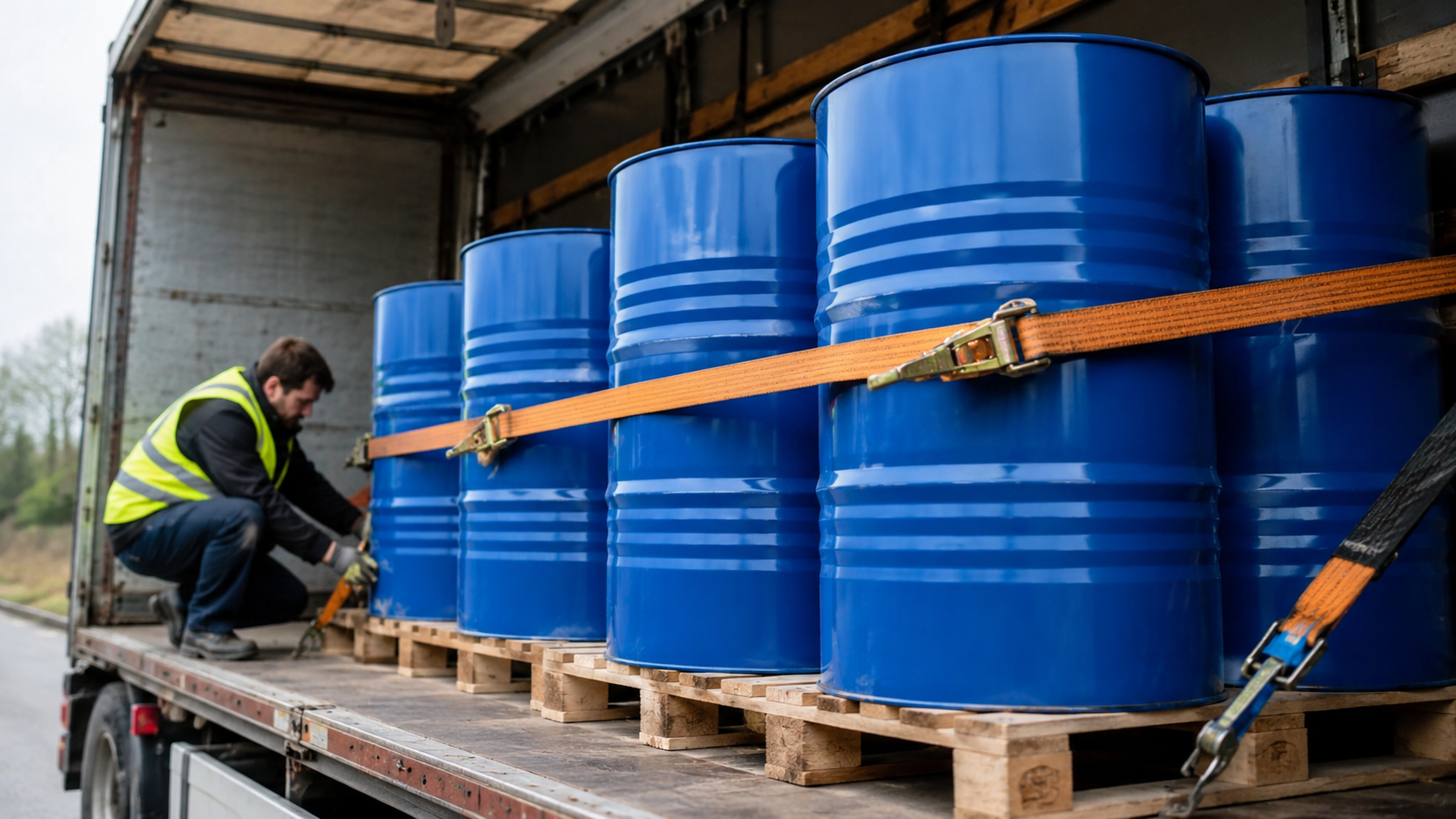
A heavy drum does not remain stationary during emergency braking merely because of its own weight. Driving and evasive manoeuvres can cause it to slide, roll or tip over.
Section 22 of the German Road Traffic Regulations requires cargo to be stowed and secured so that it cannot slide, tip over, roll backwards and forwards or fall from the vehicle, even during emergency braking or a sudden evasive manoeuvre. Recognised engineering rules must be observed.
Positive restraint and frictional restraint
Positive restraint means that the load rests without significant gaps against boundaries or securing elements capable of withstanding the forces. These may include a suitable headboard, locking bars, partitions or other restraint devices.
Frictional restraint is usually produced by tie-down lashing. The pre-tensioning force of the lashings increases friction between the load and the loading surface. Anti-slip material can support this effect.
BG Verkehr recommends stowing cargo with positive restraint wherever possible. If this is not possible, other suitable securing equipment must be used. Examples include lashing straps, chocks, void fillers and anti-slip materials. The principles are explained further in our glossary entry on load securing.
Securing a single drum on a pallet
Simply placing a drum on a Euro pallet and wrapping it in stretch film does not automatically provide adequate load securing. The drum must first be reliably connected to the pallet or to a load carrier developed for this purpose.
Suitable solutions may include:
tested drum-and-pallet systems
drum holders
pallet collars
form-fitting receptacles
approved clamping or restraint systems
direct lashing methods
combinations of positive restraint and lashing
Reusable systems capable of securing one, two, three or four drums on a pallet are available. What matters, however, is the proven field of application for the particular system.
Also observe the following points:
The pallet must be undamaged and have sufficient load capacity.
The drum must stand firmly on the pallet.
The drum-and-pallet unit must not tip or come apart.
The load centre should be as low as possible and close to the vehicle’s longitudinal centreline.
Permitted gross weight and axle loads must be observed.
The loading surface must be clean, dry and capable of bearing the load.
Lashing points and the vehicle body must withstand the forces involved.
Lashings must be undamaged and suitable for the securing method.
Sharp edges require suitable edge protection.
The securing arrangement must be checked after a short distance and during the journey.
A blanket statement such as “two straps are always enough” is technically incorrect. The required securing arrangement depends on factors including drum mass, coefficient of friction, vehicle body, lashing angles, pre-tensioning force, lashing capacity and securing method. It should be designed by a suitably qualified person.
Additional requirements for drums containing dangerous goods
For dangerous goods, correct load securing is not enough. The drum itself must also be approved for the substance and intended carriage.
Check in particular:
a legible UN packaging mark
the permitted packing group
material compatibility
correct closure
required hazard labels
UN number and proper shipping name
orientation arrows where required
the transport document
possible mixed-loading prohibitions
required vehicle equipment
The German Federal Institute for Materials Research and Testing (BAM) states that dangerous goods must be classified, packaged, marked, labelled and documented in accordance with the applicable ADR. Companies that require professional carriage can use specialist ADR road transport services.
Personal protective equipment for drum handling
The necessary PPE follows from the risk assessment and, for hazardous substances, additionally from the Safety Data Sheet. There is no single standard set suitable for every drum.
Safety footwear
Safety footwear with suitable toe protection protects against falling equipment, drum edges and crushing injuries. Depending on the working environment, penetration-resistant or chemical-resistant soles may also be required.
Protective gloves
Gloves improve grip and protect against sharp edges, dirt or chemicals. For hazardous substances, the glove material must be suitable for the particular substance and duration of exposure. A universal “chemical-resistant glove” does not protect against every substance.
Safety goggles or face protection
Tight-fitting safety goggles or face protection may be required where splashing is possible, closures are damaged or corrosive liquids are handled.
Protective clothing
Chemical protective clothing, aprons or specialist protective suits may be necessary if contact with hazardous liquids cannot be reliably ruled out.
Respiratory protection
Respiratory protection must not be used as a blanket precaution. It must be matched to the substance, concentration, task and environmental conditions. Simple filter respirators are not sufficient in an unknown atmosphere or where oxygen is deficient.
The German Hazardous Substances Ordinance requires suitable protective measures to be specified and necessary PPE to be provided. Employees must use the PPE provided for as long as the hazard exists.
The five most common mistakes when transporting drums
Lifting a filled drum by hand
The weight of a filled standard drum is far beyond a controllable manual lifting load. Even lifting it briefly can cause back injuries, muscle strains and loss of control.
Rolling the drum on its side across the floor
A drum rolled on its side can accelerate, change direction or trap hands and feet. Its shell, coating and closures can also be damaged.
Moving the drum on a trolley without securing it
If the retaining chain is missing or not closed, the drum can tip off the trolley when braking or crossing a threshold.
Using an arbitrary forklift grab
A rim grab designed for steel drums may fail on a rimless plastic drum. Sufficient rated forklift capacity does not replace approval for the equipment combination.
Relying on stretch film alone
Stretch film can stabilise a load unit. It does not automatically replace a proven connection between drum and pallet or the necessary securing of the entire load unit on the vehicle.
Checklist: transporting drums safely
Before transport
The drum’s contents are known.
A Safety Data Sheet is available for hazardous substances.
The total weight has been determined.
The drum is leak-tight and undamaged.
Closures and closing rings are correctly fastened.
Markings are legible.
The route is clear and adequately lit.
The floor is load-bearing, clean and slip-resistant.
Ramps and gradients have been considered.
Suitable handling equipment has been selected.
The equipment has sufficient load capacity.
The equipment has been checked for visible defects.
The required PPE is available.
Emergency and containment equipment is ready.
Uninvolved people have been removed from the hazard area.
During transport
The drum is positively located on the equipment or secured with retaining devices.
Hands and feet remain outside crushing points.
Speed is appropriate for the floor and visibility conditions.
The load is moved as low as possible.
Sudden changes of direction are avoided.
No one stands beneath a suspended load.
Only suitable equipment is used on gradients.
There is clear communication during forklift operations.
When setting down and loading
The set-down area is level and load-bearing.
The drum is stable and cannot roll away.
The retaining device is released only after the drum has been set down safely.
The pallet or load carrier is undamaged.
The drum is reliably connected to the pallet.
The load is stowed with positive restraint wherever possible.
Anti-slip material and lashings are used correctly.
Axle loads and gross weight are observed.
Load securing has been checked and documented.
Dangerous goods documents and markings are complete.
Practical tip: Use this checklist for your next training session or display it prominently in the warehouse and loading area.
Frequently asked questions
How much does a full 200-litre drum weigh?
The weight depends on the density of the contents and the empty weight of the drum. Two hundred litres of water weigh approximately 200 kilograms, plus the weight of the empty drum. A light oil may weigh less, while dense chemicals may weigh considerably more. The actual fill volume and the density stated in the Safety Data Sheet or product data sheet are decisive.
Can a heavy drum be rolled over a short distance?
Uncontrolled rolling or edging of a filled drum should not be used as a normal working method. Rolling it on its side creates significant risks of crushing, collision and damage. A suitable drum trolley or dolly should be used even over short distances. Any alternative procedure would only be acceptable following a risk assessment and instruction and in compliance with the manufacturer’s information.
What is the difference between a drum grab and a drum clamp?
Depending on its design, a drum grab often picks up the drum by its upper rim. A drum clamp instead holds it using clamping surfaces acting on the sides. Manufacturers do not always use these product names consistently. The technical description is therefore more important than the name: approved drum type, diameter, material, weight, gripping point and required clamping pressure.
Do employees need training for drum handling?
Yes. Employees must receive instruction about the specific hazards and protective measures. This instruction must be repeated and documented at least annually and whenever relevant changes or special circumstances occur. Driving certain industrial trucks independently also requires training, evidence of competence and written authorisation.
How do I secure a single drum on a lorry loading platform?
The drum should first be connected to a suitable load-bearing carrier to form a stable load unit. The unit should then be stowed with positive restraint where possible or secured with a calculated combination of direct lashing, tie-down lashing, blocking devices and anti-slip materials. It is not possible to state a serious blanket minimum number of lashing straps without information about mass, friction, vehicle body and lashing angles.
Which drum handling equipment suits your task?
Starting situation
Suitable solution
Single drum, short level route
drum trolley with retaining device
Drum only needs to be moved at the workstation
drum dolly with parking locks
Drum must be lifted onto a pallet
drum lifter
Drum must be rotated or emptied
drum rotator
Regular high throughput
forklift drum grab or drum clamp
Several drums at once
multi-drum handler or suitable load unit
Crane handling
approved drum tong or lifting clamp
Stairway
expressly approved stair-climbing drum trolley
Potentially explosive atmosphere
suitably approved equipment
Damaged dangerous-goods drum
professionally selected salvage drum
Conclusion: safe drum transport starts before the first movement
Safe drum transport does not depend on physical strength or experience alone. A documented risk assessment, suitable handling equipment, trained employees and a clearly defined procedure are decisive. Mechanical aids are the practical standard, particularly for filled 200-litre drums. If a drum contains dangerous goods, additional packaging, marking, documentation and emergency-preparedness requirements apply. Systematic checks protect employees, goods, the environment and the entire operating process. For carriage beyond the premises, choose a provider experienced in road freight transport and specialist industrial logistics solutions.
Courier Service > Blog > How to Transport Drums Safely: A Guide to Safety and Efficiency
 Dansk
Dansk
 Deutsch
 Eesti
Eesti
 English (GB)
 Español
 Français
 Hrvatski
 Italiano
 Latviešu valoda
 Lietuviškai
 Magyar
 Nederlands
 Norsk Bokmål
 Polski
 Português
 Română
 Slovenčina
 Slovenščina
 Suomi
Suomi
 Svenska
 Čeština
 Ελληνικά
 Русский
 Українська
 български
 العربية
 中文 (中国)
 English