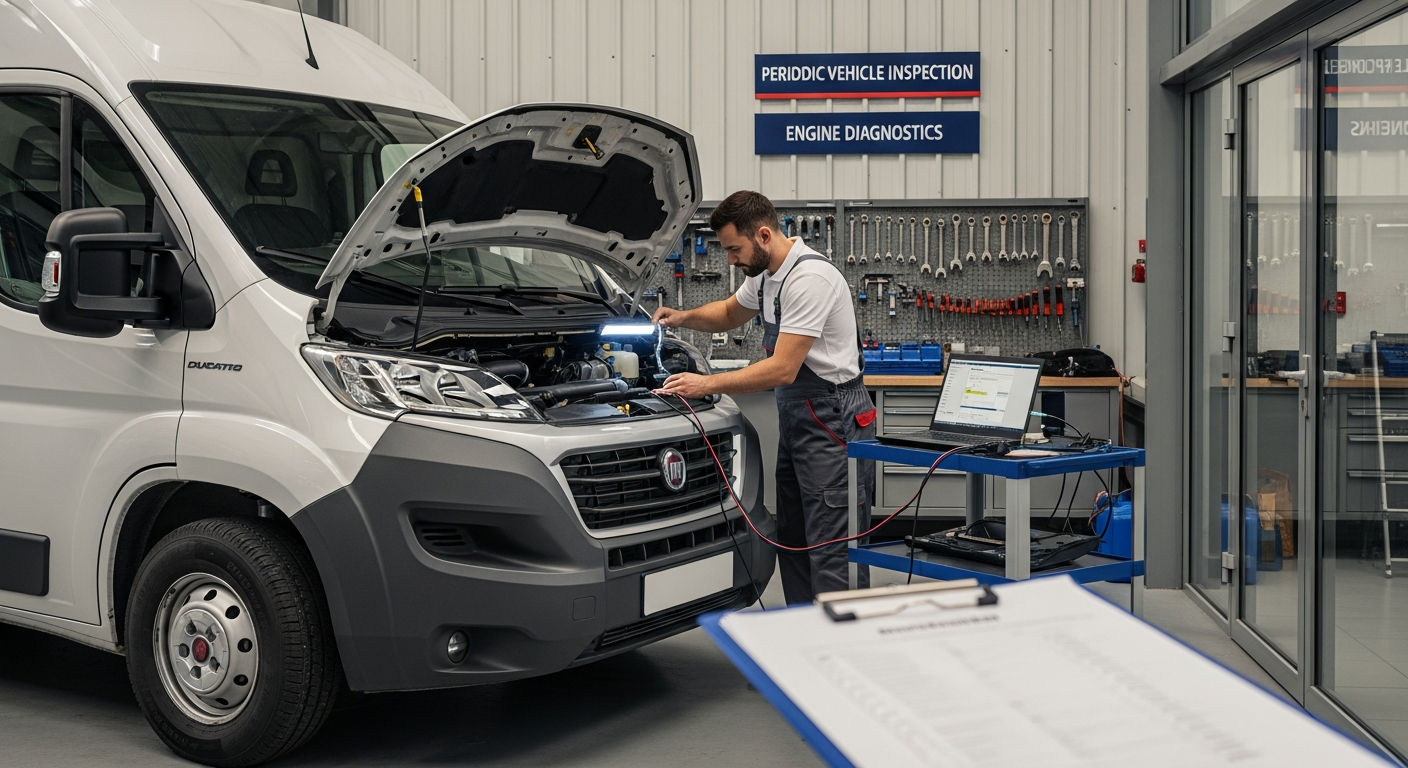
Fiat Ducato service intervals depend heavily on the model year and engine. Older models had fixed, shorter maintenance cycles, while modern Ducatos benefit from much longer intervals. These differences often cause uncertainty among van and motorhome owners, including operators in road freight transport or dedicated transport. Missing or misjudging a deadline can lead to higher subsequent costs.
Fiat Ducato servicing: the key points at a glance
- Service intervals differ considerably by model year and generation
- Modern Ducatos require servicing less often than older versions
- An annual oil change is advisable for short-distance use and motorhomes
- Maintenance consists of standard work and additional interval-based tasks
- Independent workshops can noticeably reduce servicing costs
When is a Fiat Ducato service due? Interval overview
The exact maintenance intervals follow the official specifications of Fiat Professional, part of Stellantis. Whichever comes first is decisive: mileage or time. Note for motorhome owners: because motorhomes often remain parked for long periods and rarely reach the mileage limit, the time interval, normally every two years, is usually what matters.
| Model year / series | Engine | Use | Interval by mileage / time |
|---|
| Up to 2011, Type 250 / Euro 4 | 2.2 / 2.3 / 3.0 Multijet | Van and motorhome | 40,000–45,000 km or every 2 years |
| 2011–2021, Type 250/290 / Euro 5 and 6 | 2.3 Multijet | Van and motorhome | 48,000 km or every 2 years * |
| From 2021, Series 8 and 9 / Euro 6d-Final | 2.2 Multijet 3 | Van and motorhome | 40,000 km or every 2 years * |
*According to the manufacturer, an annual oil change and inspection are strongly recommended under severe operating conditions, such as frequent short trips, dusty roads or long periods of inactivity with a motorhome.
Fiat Ducato service costs in 2026
Service prices vary according to workshop type, region and the exact scope of work. Based on current workshop data and Fiat guide values, the following average cost ranges apply for 2026:
- Minor service, including maintenance and oil change: approximately €300–€550
- Major service, including filters and brake fluid: approximately €600–€950
- Timing-belt replacement including water pump: approximately €750–€1,300, depending on model
Risk of engine damage: timing belt or timing chain?
A broken timing belt usually causes major engine damage in a Fiat Ducato. It is therefore essential to know which drive system your engine uses and the replacement intervals specified by Fiat:
Modelle mit Zahnriemen (Wechselpflicht!)
Applies to the 2.3 Multijet up to 2021 and the newer 2.2 Multijet 3 from Series 8 / 2021. Interval: Fiat generally specifies replacement every 96,000–144,000 km or every five years, whichever comes first. Expert advice for motorhomes: because long outdoor parking accelerates material ageing, many specialist workshops recommend replacement after four to five years regardless of mileage.
Modelle mit Steuerkette (Wartungsfrei)
Applies to the 3.0 Multijet engines with 160 or 177 hp and the older 100 Multijet, a 2.2-litre Ford Puma engine used until 2011. Interval: the timing chain is generally designed to last the life of the engine and does not require preventive replacement. It should nevertheless be checked for unusual rattling during a service.
Differences between older and newer Ducato models
Older Ducato generations were designed with shorter maintenance intervals. Their engines and lubricants were less durable than today's technology. Modern Ducatos use improved materials and optimised engine management.
As a result, oil and filters last longer. The onboard computer also monitors maintenance status. Longer intervals do not replace regular visual inspections, however. Owners of older vehicles should follow the service schedule strictly, while newer models often allow a two-year cycle.
Modell-Check: Wartungsvorteile von Euro 5 bis Euro 6d-Final
Series 250 models up to around 2011 often had fixed 30,000 km intervals, whereas modern Euro 6 models use a flexible maintenance system. Sensors continuously monitor oil quality.
- Warning about oil dilution: frequent short trips, such as delivery work, or repeated particulate-filter regeneration can trigger an oil change after only 15,000 km to prevent engine damage.
- AdBlue system: on newer models, inspection of the SCR catalytic converter and AdBlue lines is part of the standard work to prevent warning messages and limp mode.
What work is included in a standard service?
Every service includes checks of basic safety-related components. The oil and oil filter are changed first. The braking system and parking brake are inspected and adjusted where necessary.
A professional Ducato service goes beyond the oil filter. Experienced technicians pay particular attention to Ducato-specific components:
- Injector protection: check for moisture in the engine bay, especially on motorhomes, to prevent injectors from corroding in place.
- Suspension and top mounts: because of the high weight of 3.5 tonnes or more, top mounts and control arms wear faster than on passenger cars.
- Brake lines: check the rear lines for corrosion, a frequent issue when preparing for the roadworthiness test.
The suspension is also inspected so that wear can be identified early. Fluid levels are another important point. Electrical systems are read with diagnostic equipment. Finally, door mechanisms are lubricated to reduce wear.
Additional work by mileage and time interval
In addition to standard servicing, certain additional jobs have fixed intervals. Brake fluid must be replaced every two years. Air, fuel and cabin filters are generally changed every 48,000 km. The timing belt is especially important.
Depending on the engine, the interval is between 120,000 and 192,000 km or a maximum of five years. Replacement should take place earlier under heavy use. Engines with timing chains require less maintenance, but noises should still be checked regularly.
Timing belt or timing chain – a crucial difference
Not every Fiat Ducato uses a timing belt. Some engines have a timing chain, which often lasts for the life of the engine. It is not completely maintenance-free, however. Oil quality and regular servicing remain essential.
The engine choice determines the risk of major engine damage:
3.0 Multijet and newer 2.2: these use a timing chain, but it is not maintenance-free. Rattling during a cold start can indicate a defective chain tensioner and requires immediate attention to prevent the chain from jumping.
2.3 Multijet, the classic version: this engine uses a timing belt. Fiat often states 192,000 km, but experts strongly recommend replacement after five years or no later than 120,000 km because brittle rubber, especially after long motorhome lay-ups, can cause the belt to break.
How much does a Fiat Ducato service cost?
Service costs vary considerably. Region, engine and workshop choice all play a major role. A minor service with an oil change generally costs a mid-three-figure amount. Major servicing with filters and brake fluid is significantly more expensive.
Timing-belt replacement is particularly costly because both parts and labour are involved. Independent workshops can often be 20–30% cheaper, provided they work to the manufacturer's specifications. A dependable logistics partner should apply the same care to every vehicle in its fleet.
Conclusion
Fiat Ducato servicing depends strongly on model year and engine. Understanding the differences saves money and helps prevent damage. Motorhome owners should pay particular attention to time-based intervals. Regular maintenance pays off in the long term and preserves vehicle value. Careful planning and the right workshop make driving safer and less stressful.
FAQ
Wie oft muss ein Fiat Ducato zur Inspektion, wenn er als Kurierfahrzeug genutzt wird?
For intensive use and high mileage, such as vehicles assigned to direct transport, intervals are generally between 40,000 and 48,000 km. Because of the heavy load, the engine oil should nevertheless be changed annually.
Reicht ein Ölwechsel aus oder ist eine große Inspektion nötig?
An oil change covers lubrication only, whereas a full service also checks brakes, suspension and electronics. A complete inspection to the manufacturer's specification is essential for safety and value retention.
Wie macht sich ein fälliger Service im Fiat Ducato bemerkbar?
The vehicle indicates that maintenance is due with a warning light or text message in the instrument display. The service-interval indicator and handbook also show the remaining days or kilometres.
Was kostet eine typische Inspektion für den Fiat Ducato?
Depending on scope and workshop, costs usually range from €400 to €800. Major work such as timing-belt replacement can push the total well above €1,000.
Muss ich für die Inspektion zwingend in eine Fiat-Fachwerkstatt?
During the warranty period, an authorised workshop is advisable so that goodwill claims are not jeopardised. Under EU law, however, servicing may generally be carried out by any certified specialist workshop that follows the manufacturer's specifications.
Warum leuchtet die Öllampe trotz wenig gefahrener Kilometer?
On models with a particulate filter, oil quality is monitored electronically and can deteriorate faster because of fuel dilution during short trips. In this case, the system requests an oil change to protect the engine from wear.
Wie oft muss die Bremsflüssigkeit gewechselt werden?
Fiat recommends replacing brake fluid every two years regardless of mileage. Because the fluid absorbs water, this is essential for full braking performance.
Gilt das Wartungsintervall auch für das Getriebeöl?
There is often no official transmission-oil change interval because it is described as a lifetime fill. Experts nevertheless recommend a precautionary change under high loads or after 100,000 km.
Hat der Fiat Ducato eine wartungsfreie Steuerkette?
It depends on the engine; 2.3- and 3.0-litre units may use timing belts or chain combinations. Check the specification for your exact engine because, contrary to a common assumption, timing chains are not entirely maintenance-free.
Beeinflusst eine verpasste Inspektion den Wiederverkaufswert?
A complete service record is one of the strongest selling points for a Ducato, especially a motorhome. Missed appointments often result in substantial price reductions and mistrust among potential buyers.
 Dansk
Dansk
 Deutsch
 Eesti
Eesti
 English (GB)
 Español
 Français
 Hrvatski
 Italiano
 Latviešu valoda
 Lietuviškai
 Magyar
 Nederlands
 Norsk Bokmål
 Polski
 Português
 Română
 Slovenčina
 Slovenščina
 Suomi
Suomi
 Svenska
 Čeština
 Ελληνικά
 Русский
 Українська
 български
 العربية
 中文 (中国)
 English