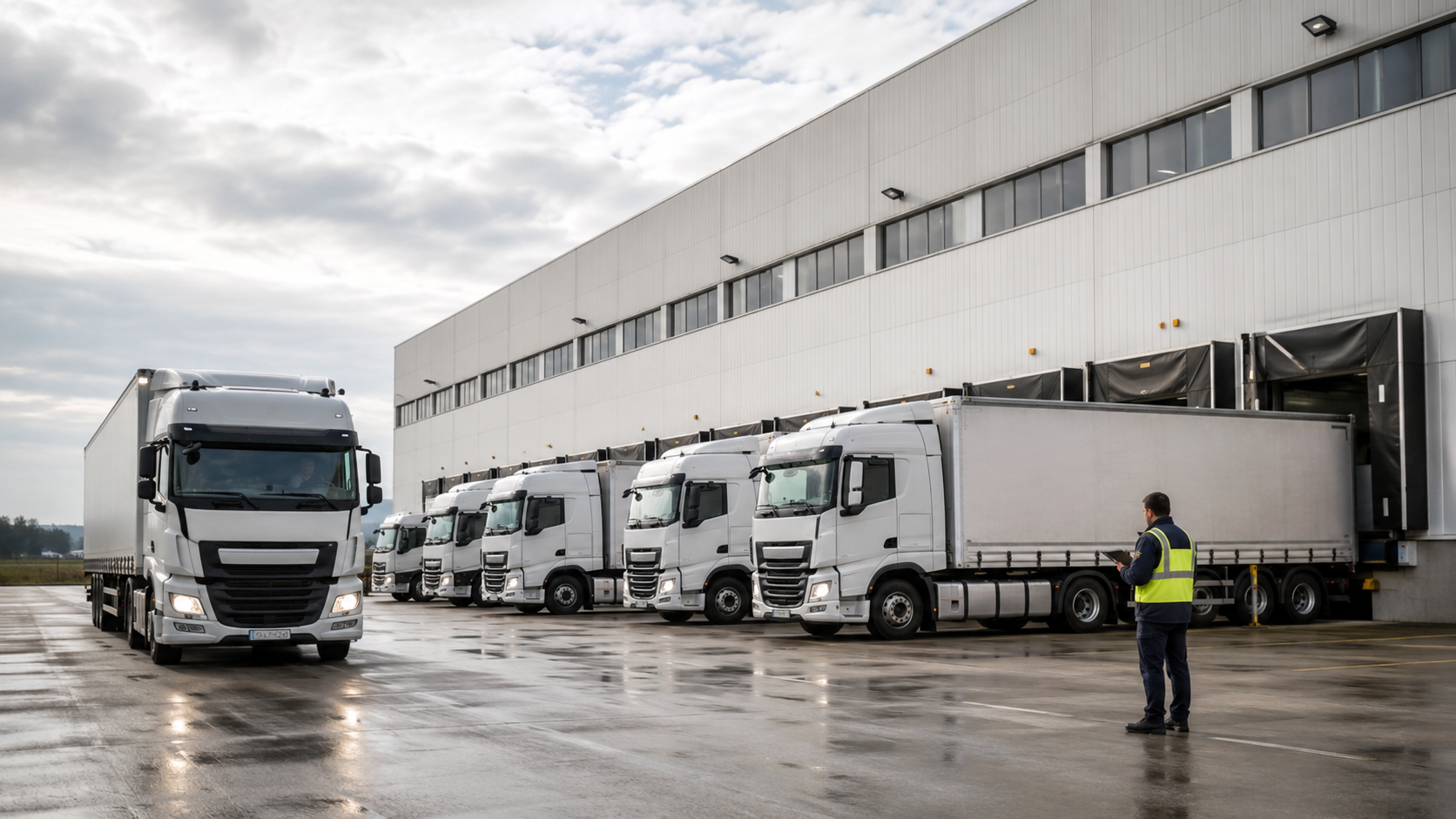
Dedicated Transport: Guaranteed Capacity and Stable Costs
Rising freight costs, a lack of loading space during peak periods and inconsistent service quality are everyday headaches for many logistics managers. Companies with regular shipping volumes, in particular, often face the same question: how can they secure transport capacity over the long term without constantly relying on the spot market? This is exactly where dedicated transport comes in.
Dedicated transport is not a short-notice express service, nor is it a traditional one-off booking. It is a strategic transport model in which vehicles, drivers and capacity are reserved exclusively for one company. This creates greater planning certainty, more stable processes and a higher level of service.
The Key Points at a Glance
Dedicated transport means that a logistics provider supplies vehicles and drivers exclusively for one specific customer.
The model is particularly suitable for companies with regular, predictable shipping volumes and recurring routes.
The biggest advantages are guaranteed capacity, stable costs, better service quality and less administrative hassle.
Drawbacks mainly arise when utilisation fluctuates, contract terms are too long or service level agreements are unclear.
Whether dedicated transport pays off depends less on a fixed number of shipments and more on regularity, predictability and the strategic importance of the transports.
What Is Dedicated Transport? A Clear Definition
Dedicated transport is a contractual logistics solution. A transport company provides specific vehicles, drivers and capacity exclusively for one shipper. These resources are not booked spontaneously on the open market, but are firmly planned for defined routes, locations or time windows.
A simple comparison helps explain it: classic spot market bookings work a bit like taking a taxi. You need a journey, ask for availability and a price at short notice, and use whichever provider happens to be available. Dedicated transport is more like having a vehicle with a regular chauffeur. The vehicle is ready for your recurring needs, the driver knows your processes, and the costs are agreed in the contract.
This clearly sets dedicated transport apart from on-demand transport. On-demand is flexible, short-term and usually focused on individual shipments. Dedicated transport is longer-term, more predictable and more closely integrated into the supply chain.
Typical core elements include:
Element
Meaning
Contractual commitment
Term, conditions, obligations and service levels are agreed in writing
Exclusive capacity
Vehicles and drivers are reserved for one customer
Fixed routes or time windows
Transport operations follow recurring processes
Predictable costs
Prices are usually based on fixed and variable components
Defined performance indicators
Punctuality, availability and quality are made measurable
In short: dedicated transport is a strategic middle ground between running your own fleet and outsourcing individual transport jobs in the traditional way.
Why Dedicated Transport Is Becoming More Strategically Important
Road freight remains under pressure. Across the European market, driver shortages, fluctuating capacity and volatile costs continue to be key issues. According to the IRU Global Driver Shortage Report 2025, the shortage of drivers in road transport has worsened further. In Germany, market observers also reported falling lorry capacity in 2026 alongside fluctuating demand.
For shippers, this means one thing: if you need regular transport, you are not only competing on price, but also on available capacity. Dedicated transport can therefore be a strategic tool for securing reliable loading space and reducing operational risks.
However, the model is not a magic fix. It only makes sense if transport demand, route structure and utilisation are stable enough. Otherwise, planning certainty can quickly turn into expensive fixed costs.
The 5 Key Benefits of Dedicated Transport
Dedicated transport is often reduced to the idea of “having fixed lorries”. That is far too simplistic. The real value lies in the combination of secured capacity, stable processes and better control over the supply chain.
Guaranteed Capacity: No More Scrambling for Lorries
The most important advantage is secured availability. When vehicles and drivers are planned exclusively for your company, you no longer have to search for free capacity for every single run. That significantly reduces operational uncertainty.
This can be crucial during peak seasons, end-of-month surges or in industries with tight delivery windows. While other shippers have to book capacity at short notice, your transport capacity is already in place.
This is especially relevant for companies with fixed production cycles, recurring store deliveries or time-critical customer requirements. If a late delivery can cause a production stoppage, contractual penalties or unhappy customers, guaranteed capacity is often worth more than the cheapest one-off price.
Stable and Predictable Costs: Budgeting Instead of Spot Market Guesswork
Dedicated transport creates more cost transparency. Instead of constantly changing daily rates, companies receive a contractually defined pricing structure. This may consist of monthly fixed costs, mileage rates, stop charges and surcharges.
For CFOs and logistics managers, this is a major advantage. Budgets can be planned more realistically, cost deviations become smaller and internal calculations become more reliable.
Of course, predictable does not automatically mean cheaper. At first glance, dedicated transport may look more expensive than individual spot market trips. What really matters is the overall picture: less time spent searching, fewer failures, fewer ad hoc surcharges and a more stable service level.
Better Service Quality and Stronger Brand Representation
When hauliers change all the time, service quality often varies too. Drivers do not know the loading sites, contacts keep changing and recurring special requirements have to be explained again and again. Dedicated transport reduces this friction.
Regular drivers get to know your processes, ramp times, safety rules and customer requirements. This improves not only punctuality, but also communication throughout the supply chain.
Vehicles can also be branded in the company’s corporate design. The lorry then becomes a moving brand space. This can be an additional advantage, particularly in retail, store logistics or B2B customer business.
Greater Efficiency Through Optimised Processes
A dedicated transport setup is much easier to optimise than constantly changing individual transport jobs. Routes can be planned over the long term, collection times can be standardised and routes can be improved continuously.
There is also less administrative workload. Instead of asking several providers for prices every day, comparing quotes and placing new orders, a large part of transport management runs through fixed processes.
That saves time in day-to-day operations. At the same time, it creates better data for KPI analysis, route optimisation and cost control.
Typical efficiency levers include:
Area
Optimisation Potential
Route planning
Better utilisation, fewer empty runs, fixed time windows
Communication
Known contacts, shorter coordination loops
Loading processes
Drivers know the sites, ramps and procedures
Administration
Fewer individual bookings, less invoice checking
Reporting
Clear KPIs instead of scattered individual data
Access to Specialist Equipment and Trained Staff
Not every type of freight can be moved with a standard lorry. Chilled goods, dangerous goods, sensitive components, machinery parts or high-value goods often require specialist equipment and qualified drivers.
This kind of capacity is not always available at short notice on the open market. Dedicated transport can close that gap. The provider supplies suitable vehicles, trained staff and defined safety processes.
This is especially important for sectors such as food, pharmaceuticals, chemicals, mechanical engineering, automotive, electronics and technical spare parts logistics.
Disadvantages and Risks: When Is Dedicated Transport the Wrong Choice?
Dedicated transport has strong advantages, but it also has clear limits. Anyone choosing the model purely because of supposedly stable prices, without checking their own utilisation, can make costly mistakes.
The biggest risk factor is low or heavily fluctuating utilisation. If a dedicated vehicle regularly stands idle, you still pay for the capacity provided. The model only works if there is enough predictable transport volume.
Another risk is reduced flexibility. Dedicated transport is designed for recurring processes. If your demand changes significantly from day to day, your routes are unpredictable or shipment volumes are hard to plan, a flexible FTL, LTL or on-demand model may be a better fit.
Dependency on the provider should not be underestimated either. The more closely a service provider is integrated into your processes, the more important contract quality, reporting, escalation routes and exit arrangements become.
Dedicated transport is less suitable if:
Situation
Why It Can Be a Problem
Very irregular shipping volume
Vehicles are not used enough
Constantly changing routes
There is no fixed route structure
Pure focus on price
The spot market may be cheaper for individual trips
Lack of reliable data
Demand analysis becomes inaccurate
Short planning horizon
Long-term commitment does not fit the situation
No internal transport controlling
Performance and costs become difficult to manage
The most important question is therefore not: “Is dedicated transport cheaper?” The better question is: “Is our transport structure stable enough for fixed capacity to be used economically?”
Dedicated Transport vs FTL vs LTL: A Direct Comparison
Dedicated transport, FTL and LTL are not interchangeable terms. They describe different models for different requirements.
FTL stands for full truckload. This means a full lorry is booked for a specific shipment or route. LTL stands for less than truckload. Here, your shipment shares loading space with goods from other customers. Dedicated transport goes one step further: not just one journey, but capacity, drivers and processes are reserved over the long term.
Criterion
Dedicated Transport
FTL
LTL
Cost structure
Contractual, often fixed costs plus variable elements
Per trip or route
Based on weight, volume, distance and handling
Capacity guarantee
High, because resources are reserved
Medium, depending on market availability
Low to medium
Flexibility
Medium, good for predictable requirements
High for individual trips
High for smaller shipments
Service level
Very high, as fixed processes are possible
Medium to high
Depends on the network
Speed
Predictable, depending on the contract
Usually direct and fast
Often slower due to transhipment
Administrative effort
Low after setup
Medium
Low to medium
Best suited for
Regular routes, high predictability
Full loads, individual routes
Smaller shipments
Risk
Underutilisation, contractual commitment
Price volatility
Longer transit times, more handling
When Does Each Model Make Sense?
Dedicated transport makes sense if you regularly carry out the same or similar transports, want to secure capacity and value service quality more than maximum short-term flexibility.
FTL is suitable if you ship full lorry loads but do not need a permanent capacity commitment.
LTL is a good fit if shipments are too small for a full lorry and longer transit times are acceptable.
Dedicated Transport Costs: What Should You Expect?
The costs of dedicated transport usually consist of several components. Unlike the spot market, you are not just buying a single trip, but a defined level of availability.
Typical cost factors include:
Cost Factor
Influence on Price
Vehicle type
Van, 7.5-tonne lorry, 12-tonne lorry, articulated lorry, refrigerated vehicle or specialist vehicle
Mileage
Kilometres per day, week or month
Operating time
Fixed shifts, multi-shift operation, night runs, weekend work
Driver
Qualification, working time model, expenses, training
A medium-sized manufacturer needs five fixed round trips per week between its plant, external warehouse and two major customers. A 12-tonne lorry with driver is planned exclusively for this purpose.
Item
Example Value
Monthly vehicle provision
€4,200
Driver and operating costs
€5,800
Average mileage costs
€3,600
Telematics, reporting and administration
€450
Reserve and flexibility surcharge
€750
Total costs per month
€14,800
This example calculation is deliberately simplified. In practice, costs depend heavily on the region, vehicle class, mileage, working time model, road tolls, fuel, contract length and service level.
What matters is comparing these costs with the true total cost of your current solution. That includes not only freight rates, but also internal processing time, failures, delays, special trips, complaints and safety stock.
Break-Even: When Does Dedicated Transport Pay Off?
There is no universal minimum volume. What matters is not just volume, but repeatability. A company with three to five regular full lorry loads per week on similar routes may be more suitable than a company with ten completely unpredictable one-off trips.
As a rough guide, dedicated transport should be considered if you regularly have fixed routes, recurring customer deliveries or predictable production dispatches.
The break-even point usually comes from a combination of:
Lever
Effect
Better utilisation
Fixed costs are spread across more transports
Fewer spot market surcharges
Costs become more stable
Fewer failures
Supply chain risks decrease
Less administration
Operational teams are relieved
Better punctuality
Fewer escalations and customer issues
Fewer process errors
Drivers and dispatch teams know the routines
A dedicated model rarely pays off purely through the lowest mileage rate. It pays off through stability, service quality and lower process costs.
Mini Case Study: Mechanical Engineering with Regular Spare Parts Transport
A medium-sized mechanical engineering company had struggled for years with recurring problems around short-notice spare parts transport. The routes were similar, but transports were awarded individually on the market. As a result, prices fluctuated, drivers were unfamiliar with the loading processes and delivery windows were regularly missed.
After an analysis, two fixed vehicles with trained drivers were scheduled for defined plant and customer routes. The vehicles were equipped with suitable load securing, telematics and clear escalation processes.
After six months, the effect was clear: delivery punctuality improved noticeably, internal coordination was reduced and the dispatch team had to deal with far fewer ad hoc enquiries. The most valuable factor was not the lowest individual price, but the new reliability in everyday operations.
This case study shows that dedicated transport works particularly well when transport processes are repeatable and service quality has a direct impact on customer relationships or production processes.
Checklist: Is Dedicated Transport Worth It for Your Company?
If you answer “yes” to several of the following questions, you should seriously consider dedicated transport.
Question
Yes / No
Do you have fixed, recurring transport routes?
Do you regularly ship several full or part-full lorry loads per week?
Do you often struggle with capacity shortages?
Are your freight costs difficult to plan because of spot market prices?
Do you need fixed collection or delivery time windows?
Do delays have a direct impact on production or customer satisfaction?
Do you need specialist equipment such as refrigerated vehicles, tail lifts or dangerous goods equipment?
Would a regular driver with process knowledge benefit your operations?
Do you want to reduce the administrative workload involved in transport allocation?
Can you realistically plan your transport requirements for at least several months?
Evaluation
If you answer “yes” to 0 to 3 questions, dedicated transport is probably not the first choice. Flexible FTL, LTL or on-demand solutions may be a better fit.
If you answer “yes” to 4 to 6 questions, a more detailed analysis is worthwhile. A hybrid model may make sense, with base volumes handled through dedicated capacity and peaks covered flexibly.
If you answer “yes” to 7 or more questions, there is a strong case for a detailed potential analysis. In this situation, dedicated transport can help stabilise capacity, costs and service quality strategically.
Not sure whether dedicated transport would pay off for your supply chain? Request a non-binding potential analysis and have your transport structure reviewed.
Courier Service > Blog > Dedicated Transport: Guaranteed Capacity and Stable Costs
 Dansk
Dansk
 Deutsch
 Eesti
Eesti
 English (GB)
 Español
 Français
 Hrvatski
 Italiano
 Latviešu valoda
 Lietuviškai
 Magyar
 Nederlands
 Norsk Bokmål
 Polski
 Português
 Română
 Slovenčina
 Slovenščina
 Suomi
Suomi
 Svenska
 Čeština
 Ελληνικά
 Русский
 Українська
 български
 العربية
 中文 (中国)
 English