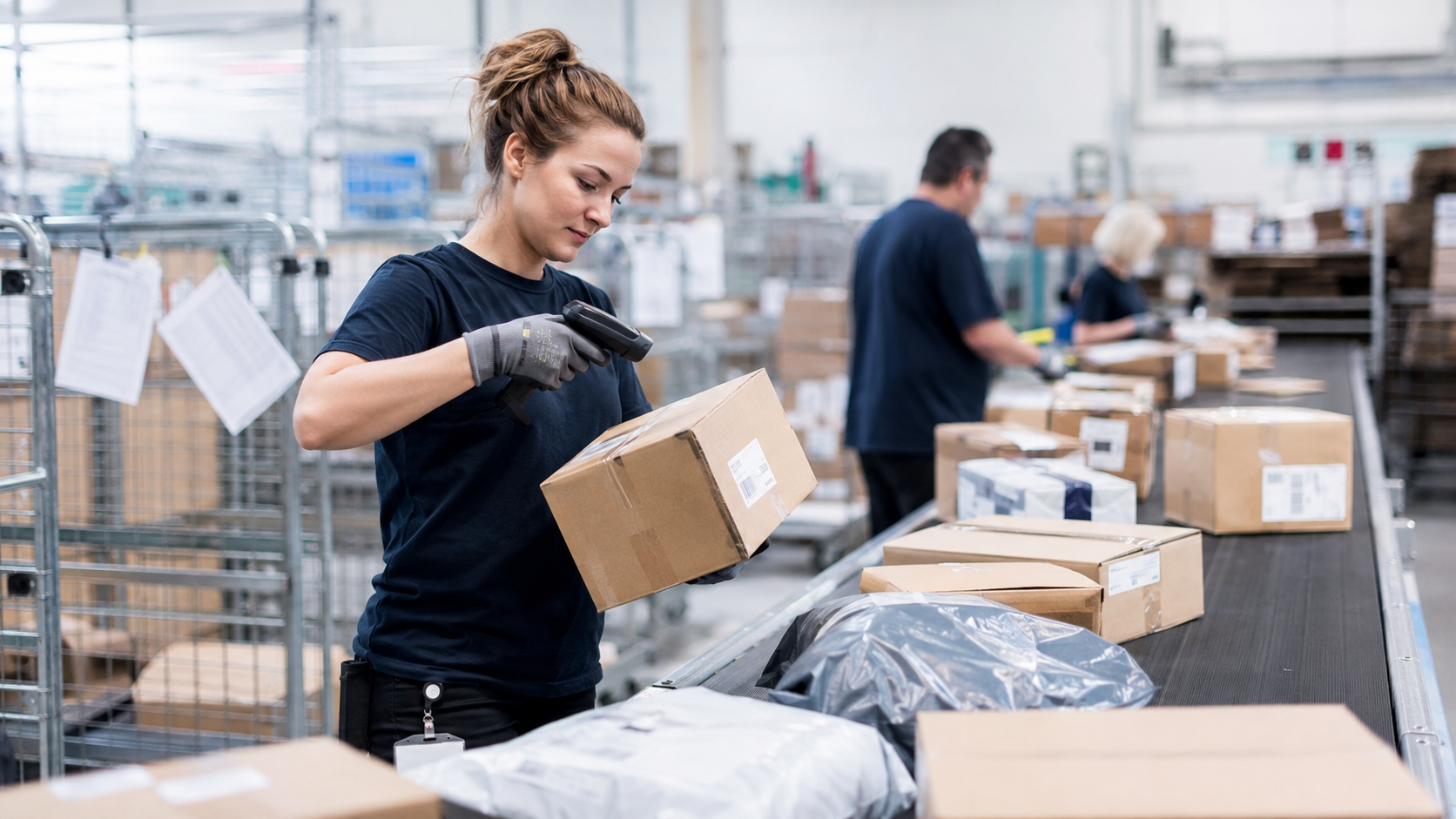
Returns logistics is far more than sending unwanted goods back. It connects customer service, warehouse management, transport, quality control and sustainable recovery. Especially in e-commerce, an organised returns process determines cost, resale value and customer loyalty. Returned products must be registered, inspected and assigned quickly to the most economical route: restocking, repair, refurbishment, parts recovery, recycling or disposal. Efficient returns logistics reduces losses, accelerates refunds and reveals product or process defects. Managed correctly, a return becomes a strategic advantage rather than a pure cost.
The key points at a glance
- Returns logistics covers every step from the return request to restocking, recovery or disposal.
- It is part of reverse logistics, which also includes recycling, reusable packaging, recalls and stock take-backs.
- Clear processes, digital traceability and fast quality checks reduce processing time and cost.
- Depending on condition, goods should be resold, repaired, refurbished, dismantled, recycled or disposed of correctly.
- Simple returns, transparent communication and fast refunds strengthen trust, satisfaction and repurchase rates.
What is returns logistics?
Returns logistics means planning, controlling and executing every process created when goods are returned. It starts with the customer’s request and ends with restocking, repair, refurbishment, recovery, return to the supplier or disposal. The objective is fast, economical, transparent processing that preserves as much value as possible.
What returns logistics means and which tasks it includes
The process usually begins with a customer request, followed by authorisation, a shipping label and return transport. Alternatively, goods may be handed in at a shop, parcel locker or partner. At the warehouse the shipment is identified, opened and matched to the original order. Staff or automated systems inspect the item before the company selects its next use.
Common reasons are damage, incorrect delivery, missing parts, poor quality, unsuitable size or unmet expectations. Online buyers cannot try on clothing or assess materials directly. Easy return options also lower the purchase barrier, encouraging customers to order several variants and retain only one.
Receipt at the warehouse is not the end. An undamaged item may be cleaned, repacked and restocked. Minor defects may justify repair or sale as B-stock. Unsaleable products may be dismantled, recycled, donated or disposed of. The best option depends on product value, condition and processing cost.
| Returns area | Typical task |
|---|
| Return request | Record the reason and approve the return |
| Return transport | Arrange collection or drop-off |
| Goods receipt | Match parcel and order |
| Inspection | Check condition, completeness and function |
| Decision | Select resale, repair or recovery |
| Refund | Repay the purchase price or send a replacement |
| Reintegration | Route goods to the right sales channel |
| Disposal | Dispose of unusable products lawfully |
Professional returns logistics aims to reduce cost per return, shorten processing time and retain value. Fast decisions keep saleable products from sitting in the returns area—especially important for seasonal goods, electronics and short-life products. Every lost day can reduce the achievable price, making throughput time a central KPI.
Difference between returns logistics and reverse logistics
Returns logistics is one part of reverse flows and focuses mainly on goods returned by customers to retailers or manufacturers: e-commerce returns, shop returns, complaints, collection, transport to the returns centre, inspection and sorting. The trigger is normally a specific customer return.
Reverse logistics covers all goods, material and information flows moving against the original supply chain. Alongside customer returns, it includes recalls, warranty returns, reusable packaging, pallets, containers, old equipment, recyclable material, production residues, seasonal surplus and discontinued stock.
| Feature | Returns logistics | Reverse logistics |
|---|
| Focus | Customer returns | All backward goods flows |
| Typical trigger | Cancellation, complaint or wrong order | Return, recall, recycling or stock reduction |
| Starting point | Customer, shop or drop-off point | Customer, retailer, warehouse, production or partner |
| Processes | Collection, inspection, refund and restocking | Take-back, dismantling, reuse and recycling |
| Main objective | Fast, customer-friendly return | Recover value and resources |
| Outcomes | Resale, repair or disposal | Reuse, remanufacture or raw-material recovery |
Returns logistics structures the handling of returned items. Reverse logistics adds environmental and resource objectives, keeping materials in circulation and extending product life. Companies decide whether to resell, refurbish, dismantle or recover parts; targeted recovery makes sense when residual value is high.
In practice, the two areas overlap. A customer return may go straight back on sale or start a recycling or refurbishment process. Shared data and clear decision rules are essential; isolated departments otherwise create unnecessary transport and value loss.
The biggest challenges in managing returns
Returns create cost without new revenue: shipping, labour, space, inspection, cleaning, repackaging, parts and repair. B-stock needs discounts, while unusable goods cause recycling or disposal costs. Companies therefore need the full cost per return.
Traceability is another challenge. Every shipment must be linked to a customer, order and item, with its current status visible. Without digital registration, parcels remain at goods-in, delaying refunds and blocking inventory. Modern warehouse systems provide real-time transparency and show the next step.
| Challenge | Possible consequence | Countermeasure |
|---|
| High transport cost | Lower margin | Consolidation and regional return points |
| Slow processing | Unhappy customers | Standardised inspection |
| Poor traceability | Loss and duplicate work | Barcode, RFID or serial-number capture |
| Unclear condition grading | Incorrect restocking | Uniform quality grades |
| Fluctuating volume | Staff and space shortages | Capacity planning and flexible teams |
| International returns | Customs and tax problems | Country-specific processes |
| Poor data quality | Wrong root-cause analysis | Mandatory return codes |
| Late refunds | Loss of trust | Automated approval rules |
Returns are less predictable than regular inbound goods. Volume, condition and workload fluctuate, with peaks after Christmas, promotions and fashion seasons. Warehouses need flexible space and staffing, and should separate straightforward from complex cases.
Quality control must cover condition, function, accessories and packaging. A wrongly approved item can create a second return. Electronics also require serial-number and stored-data checks; hygiene products and food need exclusion criteria. Uniform checklists ensure consistent grading.
Legal requirements add complexity. EU consumer rights apply to distance selling; cross-border returns can involve customs, duties and tax. Batteries, chemicals, dangerous goods and medical products require special handling and disposal rules. The permitted destination must be clear before international return transport starts.
The returns process from request to recovery
A digital return form captures order number, item and reason. The system checks the deadline and may approve standard cases automatically, while high-value or complex goods receive manual review. The customer then receives a label or drop-off code plus clear packing instructions.
Collection may take place at home, a shop, parcel station, own return point or partner outlet. The channel affects cost, convenience and lead time. Consolidated collection is usually cheaper, while valuable, bulky or urgent goods may need individual pickup. Tracking should begin with the first scan.
At arrival, label, order and item are matched. The package is opened and its contents documented; photos can record condition. Goods are pre-sorted by product group and inspection effort. Unopened returns enter a fast lane, while damaged or incomplete items undergo detailed checks.
| Process step | Main task | Possible result |
|---|
| Return request | Check entitlement and reason | Approval or query |
| Transport | Return goods safely | Arrival at returns centre |
| Registration | Match order and item | Complete record |
| Sorting | Pre-sort by condition | Correct inspection process |
| Quality control | Assess function and condition | Quality grade |
| Customer solution | Refund, replacement or credit | Case closed |
| Recovery | Select the most economical route | Resale through disposal |
| Data analysis | Analyse causes and costs | Process improvement |
Quality control determines residual value by assessing completeness, function, use marks, dirt and packaging damage. New goods return to stock, lightly damaged goods may be discounted, and defective goods move to repair or recovery.
| Route | Requirement | Typical destination |
|---|
| Restocking | Unused, complete and functional | Regular sale |
| Repackaging | Product intact, packaging damaged | Main inventory |
| Repair | Fault economical to fix | Resale |
| Refurbishment | Use marks or minor defects | Refurbished sale |
| B-stock | Cosmetic defects, full function | Outlet or special sale |
| Donation | Usable but hard to sell economically | Charitable use |
| Cannibalisation | Individual parts retain value | Spare-parts recovery |
| Recycling | Product no longer usable | Raw-material recovery |
| Disposal | No safe recovery possible | Compliant disposal |
Cannibalisation deliberately dismantles a product so usable components become spare parts. This is attractive for machinery, vehicle parts and electronics, reducing purchasing cost and waste. Removed components must be documented and safety-critical parts inspected carefully.
Refunds should not wait unnecessarily for every internal task. Many companies release them once receipt is registered and confirmed; trusted customers and low-value goods may justify earlier payment, while high-value items need inspection. Visible status updates reduce customer-service enquiries.
How to optimise returns logistics in the warehouse
Returns need a defined work area rather than an unstructured place in normal goods-in. Dedicated stations for registration, inspection and repacking shorten routes and clarify responsibility. Tools, replacement packaging and cleaning materials should be ready at product-specific stations, with safety and hygiene requirements built in.
Standard operating instructions and fixed quality grades improve consistency. Photos and examples help employees classify the same condition identically. Grades might range from A for as-new to E for unsafe or unusable, with the warehouse system suggesting the next action.
| Quality grade | Condition | Recommended treatment |
|---|
| A | Unopened or as new | Direct restocking |
| B | Damaged packaging, item perfect | Repack and sell |
| C | Minor signs of use | Refurbish or B-stock |
| D | Defective but repairable | Repair or parts assessment |
| E | Badly damaged or unsafe | Recycle or dispose |
Digital tools reduce manual errors. Barcodes and QR codes accelerate matching, serial numbers trace devices, RFID captures volume automatically and mobile scanners guide staff through checks. Photos, error codes and grades become available to purchasing, warehouse, service and accounting.
Automation can approve clear cases, generate labels, notify carriers and sort incoming parcels. Dimensions, weights and visible damage can be checked automatically, although complex and valuable items still require human judgement.
Segment returns by effort. Unopened goods enter a fast lane; defective devices need specialists; bulky goods need dedicated space and transport; dangerous goods remain strictly separate. This prevents complex cases delaying easy ones.
Prevention begins before the return. Accurate dimensions, realistic images, clear descriptions, data-based size charts, videos and pre-purchase digital support reduce avoidable returns by addressing root causes.
Measurement must go beyond return rate to include processing time, cost per return, resale and repair rates, write-downs and refund time. Standardised reason codes expose recurring weaknesses in products, packaging or shipping.
| KPI | Meaning |
|---|
| Return rate | Share of orders or items returned |
| Cost per return | Average logistics and operating cost |
| Throughput time | Receipt to completion |
| Refund time | Time until customer repayment |
| Resale rate | Share of returns sold again |
| Repair rate | Share economically repaired |
| Value-loss rate | Discount against original value |
| Repeat returns | Previously returned goods returned again |
| Reason distribution | Distribution of causes |
| Avoidable returns | Share reducible through better processes |
Practical examples, innovation and customer impact
Fashion retailers connect return reasons with size and product data. Repeated “too small” returns trigger clearer shop advice, while purchase and return history improves recommendations and assortment planning.
Electronics retailers use early diagnosis. Support or digital tools can resolve setup errors through updates, restarts or configuration, avoiding transport. If a return remains necessary, existing fault data accelerates warehouse processing.
For furniture and appliances, companies combine take-back with planned delivery routes: the driver delivers the replacement and collects the return, reducing empty kilometres and providing a clear appointment. Initial condition photos may be taken on collection.
Omnichannel retailers allow online purchases to be returned in a shop, where saleable items can be sold locally or redirected to a site with higher demand. Real-time inventory turns a return quickly back into available stock.
Time value is often overlooked. Seasonal goods, fast-moving electronics and trends lose achievable price every day. Prioritisation should combine product value, daily depreciation and processing effort—not just receipt date.
Customer value may guide the service route without restricting rights. A loyal customer with few returns may receive an immediate refund; unusual patterns merit closer checking. Abuse detection must not disadvantage ordinary customers and rules must remain transparent.
Regional recovery avoids unnecessary transport to a distant central warehouse. Saleable goods can go to a local outlet, repairable goods to a regional service partner and donations to nearby charities, supported by digital approvals and reliable partners.
The return is often the customer’s final contact with an order. A complicated process can undo a positive purchase, while clear rules, accessible options, receipt confirmation and fast repayment build trust.
| Customer need | Suitable measure |
|---|
| Easy return | Digital portal and QR code |
| Transparency | Status messages for receipt, inspection and refund |
| Speed | Fast inspection and automated repayment |
| Flexibility | Collection, parcel shop or shop return |
| Security | Tracked return and receipt |
| Clarity | Clear deadlines and readable terms |
| Problem solving | Choice of refund, replacement or repair |
Every return reveals information about the supply chain. Transport damage may expose poor packaging, wrong deliveries show picking or master-data errors, recurring defects point to purchasing or production, and variant-specific returns may indicate misleading product copy. Systematic analysis reduces future returns.
DAGO Express supports efficient returns logistics
Fast, reliable returns require flexible transport and short response times. DAGO Express supports industry, retail and e-commerce with Europe-wide return logistics solutions, express and special transport, and tailored industrial logistics solutions. Whether individual returns, high-value goods, spare parts or larger transfers between shops, warehouses and production sites, shipments travel safely and on time without unnecessary stops.
A large partner network, modern tracking and 24/7 availability also make time-critical returns reliable. Companies shorten processing, reduce storage cost and return saleable goods to circulation sooner, while customers benefit from fast handling and transparent communication.
 Dansk
Dansk
 Deutsch
 Eesti
Eesti
 English (GB)
 Español
 Français
 Hrvatski
 Italiano
 Latviešu valoda
 Lietuviškai
 Magyar
 Nederlands
 Norsk Bokmål
 Polski
 Português
 Română
 Slovenčina
 Slovenščina
 Suomi
Suomi
 Svenska
 Čeština
 Ελληνικά
 Русский
 Українська
 български
 العربية
 中文 (中国)
 English