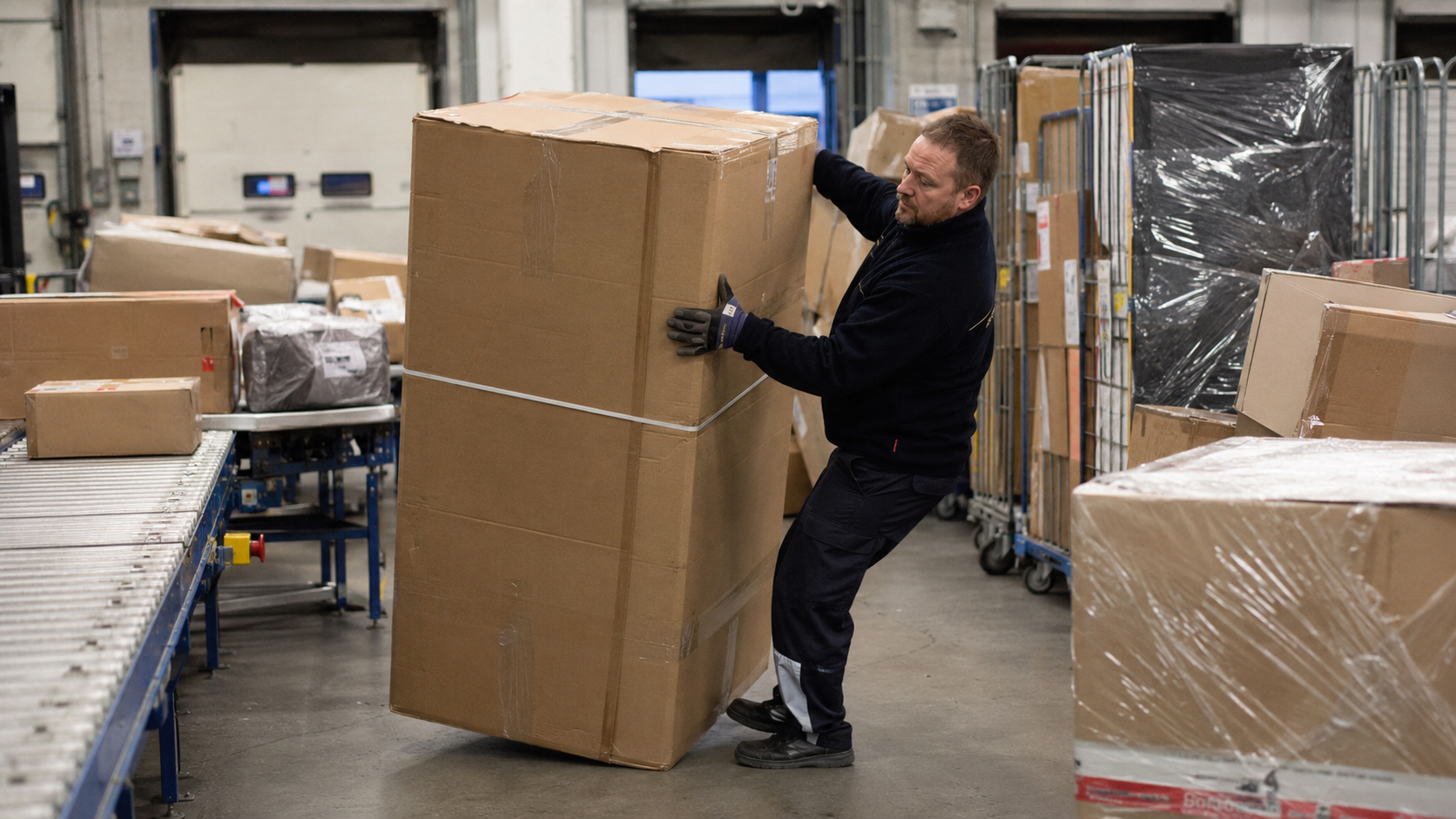
Heavy and bulky parcels could soon become a problem in conventional parcel shipping. DHL Group is calling for a statutory upper limit of 23 kilograms per parcel. Domestic DHL parcels may currently weigh up to 31.5 kilograms. If the limit is lowered, private customers and businesses will need new solutions for heavier goods. Specialist express providers such as DAGO Express can close this gap by transporting shipments that are too heavy, large or urgent for the standard parcel network. The change has not yet been adopted, but shippers should examine alternatives early.
The key points at a glance
- DHL Group is calling for a statutory weight limit of 23 kilograms for standard parcels.
- Domestic DHL parcels may currently weigh up to 31.5 kilograms.
- A reduction would particularly affect heavy, bulky and indivisible shipments.
- Freight forwarders and express services such as DAGO Express could close this transport gap.
- Direct runs are especially flexible for urgent or sensitive business goods.
Will DHL soon ban heavy parcels weighing more than 23 kilograms?
Not yet. The maximum weight in domestic DHL parcel shipping remains 31.5 kilograms. DHL is, however, campaigning for a statutory 23-kilogram limit. If policymakers agree, heavier shipments would need to travel via freight forwarders, groupage networks or specialist express services.
Why DHL is calling for a 23-kilogram limit
DHL cites the physical strain on delivery staff as the main reason. During each shift, employees lift many parcels from vehicles, carry them up stairs and deliver them to difficult addresses. A single parcel of more than 20 or 30 kilograms is already demanding; repeated every day, it raises the risk of back, shoulder and joint problems.
The proposed threshold would separate standard parcels more clearly from heavy transport. Light and medium parcels would remain in the normal network, while heavy goods would move to logistics operations equipped with pallet trucks, tail lifts and other aids. A second employee can also be scheduled more deliberately.
For customers this would be a major change. Many heavy goods could no longer be dropped at a branch with a standard label and would require individual planning. Specialist providers offering a direct courier service can collect at the shipper and drive directly to the recipient, including heavy, bulky or sensitive goods.
Current rules for heavy DHL parcels
DHL parcels within Germany may currently weigh up to 31.5 kilograms. Fixed length, width and height limits also apply. Oversized items may be classified as bulky goods and incur surcharges, so weight and dimensions must always be assessed together.
Special rules already apply. Parcels over ten kilograms must be clearly labelled. Shipments over 20 kilograms require special delivery measures, such as a second person or suitable technical equipment, to reduce employee strain.
There is not yet a general statutory 23-kilogram ceiling. DHL's proposal is therefore not binding, but it indicates the likely direction: standard shipping is becoming lighter, more automated and less physically demanding, while heavy and bulky goods move into specialist networks.
| Area | Current situation | Possible effect of a 23-kg limit |
|---|
| Domestic DHL parcel | Up to 31.5 kg | Limited to 23 kg |
| Parcels over 10 kg | Labelling required | Likely still required |
| Parcels over 20 kg | Special delivery measures | Standard shipping may cease |
| Bulky goods | Sometimes possible as bulky freight | Special transport needed more often |
| Indivisible goods | Possible depending on weight | Express service or forwarder required |
Which customers would be affected
Both private and commercial shippers would be affected. Consumers often send heavy goods sold through classifieds or marketplaces: wheels, car parts, tools, weights, appliances, furniture components and large moving boxes. Many cannot sensibly be divided.
Compact but heavy single pieces are especially difficult. An engine part, machine or solid component cannot be split into two parcels. Customers would need a provider that accepts higher weights, whether a freight forwarder or flexible express service.
Businesses would probably be affected even more because they regularly send spare parts, tools, devices and production components that are both heavy and urgent. If a machine fails, every hour of downtime can be expensive; a DAGO Express direct run can then provide a fast solution.
The express provider collects at the sender by arrangement and drives to the destination without unnecessary transshipment. This suits urgent and sensitive goods, while individual collection times are easier to accommodate than in a standard parcel network.
How DAGO Express can close the shipping gap
A 23-kilogram limit would create a clear gap between parcel services and large forwarders. Many consignments are too heavy for parcels but too small for a full truck. Express services organise individual transport for heavy, bulky and non-standard goods.
Flexible vehicle selection is a major advantage. Depending on size and weight, a car, van or larger commercial vehicle can be used. Customers do not automatically pay for a complete truck; matching the vehicle to actual need can be more economical.
Collection is also flexible. Heavy goods need not be taken to a parcel branch; the driver collects them at the requested location, useful when an item is awkward or will not fit in a normal car, and delivers it directly.
On a direct run, the goods normally remain in the same vehicle instead of passing through several parcel hubs. Fewer transfers reduce shocks, misrouting and damage—particularly relevant for machinery parts, electrical equipment and sensitive components.
When an express service is better than a forwarder
A conventional road freight service remains sensible for pallets, large furniture and planned deliveries. Groupage often passes through several hubs, creating multi-day lead times and fixed collection windows, which is less suitable for urgent goods.
Express is preferable when time is decisive: urgently needed spare parts and tools, or materials for an active construction site. One missing component can block several trades, whereas a direct run can cut downtime.
An express courier also suits goods that are difficult to pack. Unusual shapes and sensitive surfaces cannot always be secured on a Euro pallet, but can be fastened more deliberately in a dedicated vehicle. Accurate dimensions and weight remain essential.
For planned, non-urgent freight, groupage is often cheaper. For critical deadlines, express offers more certainty. Compare not only freight prices but also the potential cost of delay, machine downtime and missed appointments.
| Transport type | Especially suitable for | Typical strength |
|---|
| Standard parcel | Standard goods within the weight limit | Simple, inexpensive processing |
| Bulky-parcel service | Light but awkward items | Shipping outside standard dimensions |
| Groupage freight | Planned pallets and heavy goods | Economical with a longer lead time |
| Furniture forwarder | Furniture and appliances | Possible delivery to the place of use |
| Express run | Heavy, urgent or sensitive goods | Direct, flexibly planned transport |
Which heavy and bulky goods can be transported
Potentially affected private goods include fitness equipment, furniture parts, workshop equipment, large speakers, appliances and heavy gardening tools. Some are also oversized, so weight alone is not the only issue.
Commercial goods range from machine parts, pumps, engines and tools to control cabinets, exhibition components and technical equipment. Vehicle and production spare parts can be heavy and urgent; DAGO Express can provide an appropriate vehicle.
Actual weight and dimensions, stackability and loading aids must always be clarified. Very heavy goods may require a forklift or tail lift, so these details should be included in the enquiry.
Customers remain responsible for safe packaging. Heavy goods need sturdy cartons, crates or load carriers, must not move within the packaging, and require protected edges and surfaces. Fixing machinery to a pallet may be sensible.
Express does not replace proper preparation, but it offers more flexibility than standard parcels. Special dimensions can often be assessed individually, allowing goods outside conventional parcel services to travel safely.
Why direct runs are especially attractive for businesses
For businesses, the decisive factor is often the consequence of late delivery. A missing spare part can stop a production line, prevent technicians from working and jeopardise deadlines. Indirect costs can quickly exceed the price of express transport.
A direct run reduces these risks: after collection, the consignment travels straight to the recipient, without standard sorting or long storage. Its status is easier to follow, improving planning certainty.
This also applies cross-border. DAGO Express organises urgent runs within Germany and to other European countries, enabling heavy spare parts or production equipment to reach foreign sites quickly—crucial in tightly timed supply chains.
Individual communication is another advantage. Unlike highly automated parcel networks, express providers can incorporate fixed collection times, named contacts and special delivery instructions.
A future DHL limit would make this market more important. Businesses should check parcel eligibility before dispatch and keep an alternative in their shipping process to avoid rejected consignments and delays.
Conclusion: express services could become an important gap filler
Heavy parcels are not about to disappear immediately, but DHL's proposal shows that standard parcel shipping may change. A 23-kilogram ceiling would challenge consumers and businesses, particularly with heavy, bulky and indivisible goods. Express providers such as DAGO Express can fill the gap with flexible vehicles, direct collection and fast delivery, keeping demanding shipments reliably transportable.
 Dansk
Dansk
 Deutsch
 Eesti
Eesti
 English (GB)
 Español
 Français
 Hrvatski
 Italiano
 Latviešu valoda
 Lietuviškai
 Magyar
 Nederlands
 Norsk Bokmål
 Polski
 Português
 Română
 Slovenčina
 Slovenščina
 Suomi
Suomi
 Svenska
 Čeština
 Ελληνικά
 Русский
 Українська
 български
 العربية
 中文 (中国)
 English