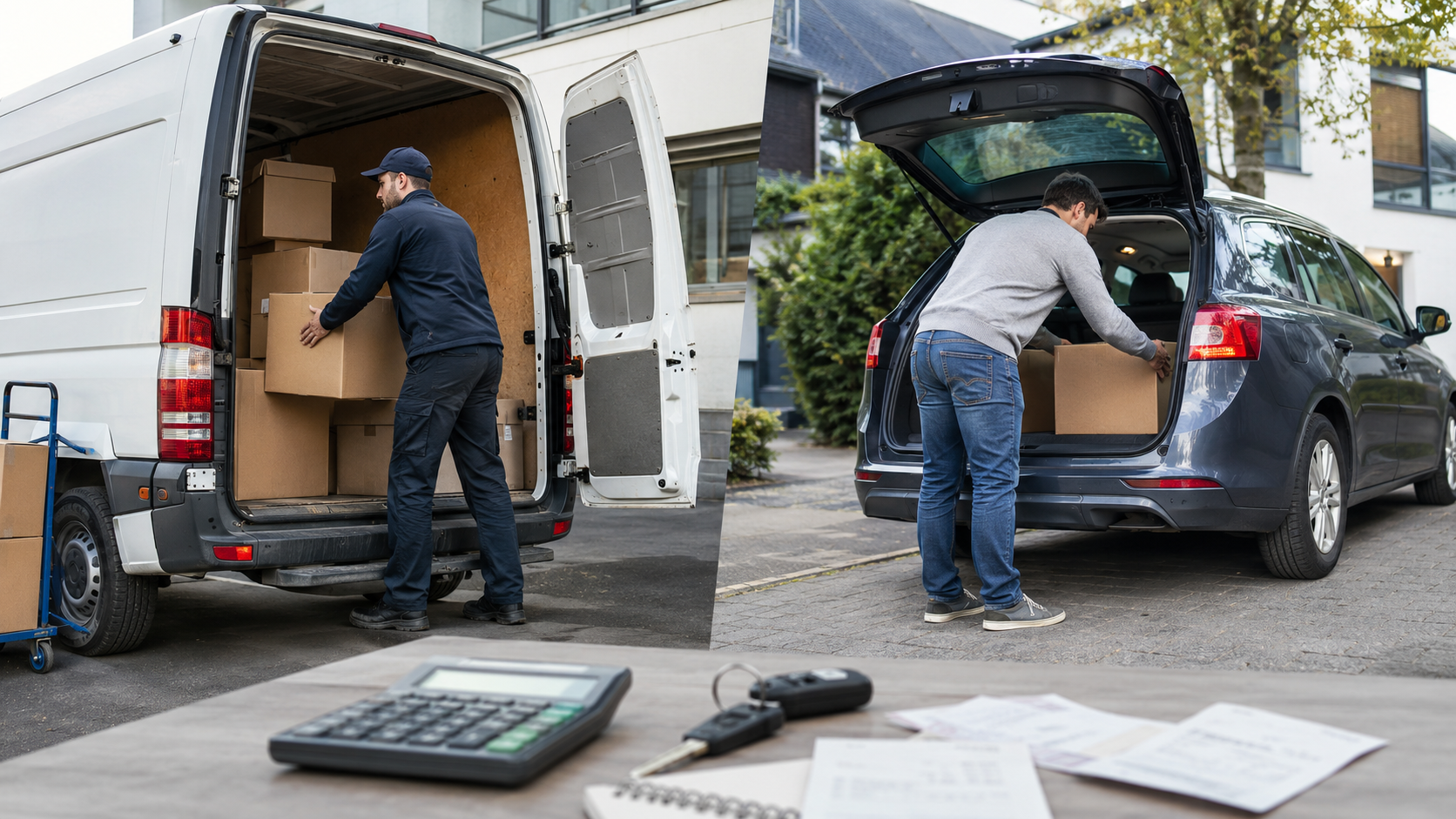
Whether you are collecting a sofa bought through the classifieds, moving office furniture to a second location or delivering sensitive goods to a customer, the same question soon arises: do courier prices make economic sense, or is hiring a van and handling the transport yourself cheaper?
The correct comparison is not the courier quote versus the rental price alone. A realistic calculation also includes the return journey, excess mileage, fuel, packaging, insurance, load securing and the value of your own working time. This guide shows you how to calculate both options and identify the break-even point.
The key facts about courier prices at a glance
- A courier becomes economically attractive when its binding quote is no higher than, or only slightly higher than, the full cost of self-transport.
- Self-transport can be worthwhile for short, simple journeys if a suitable vehicle, helpers and sufficient time are already available.
- Long distances, bulky or valuable goods, time pressure and lost working hours often shift the calculation in favour of a direct courier.
- Carrier liability is not automatically full-value insurance. The value and nature of the goods should be disclosed before booking.
- For flexible dates, a part load can be a cost-effective alternative to an exclusive vehicle.
When is a courier better value than self-transport?
A courier is financially worthwhile as soon as its quote is equal to or below the complete cost of transporting the goods yourself. Even a slightly higher courier price may be reasonable when it saves a full working day, provides reliable timing or transfers organisational and transport risks to a professional provider.
Short local journeys with uncomplicated goods may favour self-transport. For longer routes, bulky items, urgent deadlines or high-value shipments, a direct courier frequently offers the better overall result.
Courier or self-transport: a direct comparison
| Factor | Self-transport | Courier |
|---|
| Visible cost | Vehicle hire, fuel and possibly excess kilometres | Agreed fixed price or kilometre-based quote |
| Hidden cost | Packaging, insurance, parking, tolls, helpers and meals | Possible surcharges for waiting, carrying or special handling |
| Time | Planning, collection, loading, driving, unloading and returning the vehicle | Mainly coordination and handover |
| Return journey | Usually unavoidable with a rental vehicle | Included in the provider’s calculation |
| Vehicle choice | Your responsibility | Selected according to dimensions, weight and goods |
| Load securing | Your responsibility | Handled professionally if correctly commissioned |
| Liability | Often limited or unclear for your own goods | Statutory carrier liability; extra cover can be arranged |
| Flexibility | High if vehicle and helpers are available | High, especially for direct and urgent transport |
| Appointment reliability | Depends on your planning and traffic | Defined pickup and delivery windows |
| Physical effort | Usually high | Can be booked with carrying or loading assistance |
| Best suited to | Short, simple, low-risk jobs | Long, urgent, bulky, sensitive or business-critical jobs |
The true cost of self-transport
Direct costs
The rental price is only the starting point. Check how many kilometres are included and calculate the entire route: from the rental station to the pickup point, on to the recipient and back to the rental station.
Fuel cost = total kilometres × consumption in litres per 100 km ÷ 100 × fuel price
A van consuming 12 litres per 100 kilometres uses 60 litres over a 500-kilometre route. Add any excess-kilometre charge, optional reduction of the rental excess and the liquidity tied up in the deposit.
Packaging and securing equipment may include:
- moving blankets;
- lashing straps;
- edge protectors;
- stretch film;
- boxes or wooden crates;
- anti-slip mats;
- padding material.
German road traffic rules require loads to be secured so that they cannot slip, tip, roll or fall even during emergency braking or evasive manoeuvres. Vehicles over 3.5 tonnes may also incur German truck tolls; foreign routes can require vignettes or additional toll payments.
Remember helpers, carrying straps, a sack truck, a furniture lift, parking fees, food, rest stops and, on long routes, an overnight stay.
Opportunity costs
Your time has an economic value, even when no invoice is issued for it.
Time cost = hours required × personal hourly value
Employees can use their approximate net hourly pay. Self-employed people should normally use the contribution margin or billable rate that they lose. Include all steps:
- searching for and reserving a vehicle;
- travelling to the rental station;
- collecting and inspecting the vehicle;
- buying packaging and securing equipment;
- driving to the pickup point;
- loading and unloading;
- driving to the destination;
- returning to the rental station;
- refuelling and completing the return process.
For private time, calculate several scenarios—for example EUR 10, EUR 20 and EUR 30 per hour. This makes the decision transparent even if leisure time has no formal hourly wage.
Risk costs
Self-transport also exposes you to costs that are uncertain but real:
- damage to the goods;
- scratches or dents on the rental vehicle;
- damage to stairwells, doors or floors;
- overloading the vehicle;
- insufficient load securing;
- late return charges;
- illness or injury;
- a missed business appointment;
- parking fines or towing fees.
Check the vehicle payload, not only the loading-space volume. Household contents insurance does not necessarily cover goods in transit. A practical estimate is:
Full self-transport cost = rental + excess kilometres + fuel + insurance + packaging + tolls and parking + helpers + time + risk buffer
A risk buffer of five to ten percent can cover minor uncertainties, but it is not a substitute for suitable insurance.
Compact calculation template
| Cost item | Your amount |
|---|
| Vehicle rental | EUR ___ |
| Excess kilometres | EUR ___ |
| Fuel | EUR ___ |
| Insurance or excess reduction | EUR ___ |
| Packaging and load securing | EUR ___ |
| Tolls, vignettes and parking | EUR ___ |
| Helpers and equipment | EUR ___ |
| Value of your time | EUR ___ |
| Risk buffer | EUR ___ |
| Total self-transport cost | EUR ___ |
Compare this total with a binding courier quote. Confirm whether VAT, loading, waiting time, insurance and other extras are included.
How are courier prices calculated?
There is no universal price per kilometre. Published examples may start around EUR 0.85 per kilometre plus a basic charge, while caddy or van services can be around EUR 1.70 to EUR 2.00 per kilometre and larger vehicles cost more. Such figures are not directly comparable because some providers bill loaded kilometres, others all kilometres, and some add approach charges or fuel surcharges.
Distance and kilometre pricing
The route length remains an important factor, but the pickup location, empty approach, return planning and cross-border costs also affect the quote. For a reliable comparison, request an all-inclusive figure for the exact pickup and delivery addresses.
Vehicle size
A car, caddy, panel van, Sprinter or truck has different operating costs. A larger vehicle generally means higher provision, fuel consumption, kilometre rates, tolls and driver costs. Provide exact dimensions, weight, number of packages and photos so that the vehicle is not oversized or too small.
Urgency and delivery time
An immediate, exclusive direct journey normally costs more than a flexible shipment. Price factors include pickup within a few hours, night work, weekends or public holidays, a guaranteed delivery time, waiting time and multiple stops. If timing is flexible, ask for standard service or a part load.
Type and value of the goods
Art, musical instruments, medical samples, machine parts, electronics, glass and temperature-sensitive goods may require special packaging, handling or insurance. Declare these characteristics before receiving the final quote.
Loading, waiting and carrying time
Clarify whether the driver only transports the goods or also helps with loading, carrying and positioning them. Ask whether stairs, a lift, long carrying distances, waiting at the pickup point, a second helper, tail-lift use or delivery to a specific room incur surcharges.
Fixed price, kilometre billing or part load
A fixed price provides the greatest planning certainty. Kilometre billing can be transparent if the kilometre basis and all surcharges are clear. A part load uses spare capacity on an existing route and can reduce the price when the delivery window is flexible.
The break-even point: when does a courier pay off?
Courier quote ≤ full self-transport costs
This is the financial break-even rule. A slightly higher courier quote may still be the better decision if convenience, punctuality, lower physical effort and professional liability are valuable to you.
Your personal break-even calculation
- Request a binding courier quote for the exact job.
- Calculate the complete rental route, including pickup and return.
- Add fuel and excess kilometres.
- Add insurance, packaging, tolls, parking and helpers.
- Estimate the total hours required.
- Multiply those hours by your realistic hourly value.
- Add an appropriate risk buffer.
- Compare the totals and the non-financial advantages.
Example calculation: a sofa from Berlin to Hamburg
Assumptions
- 290 kilometres one way and 580 kilometres for the round trip;
- van rental: EUR 120;
- 250 kilometres included;
- 330 excess kilometres at EUR 0.30: EUR 99;
- fuel consumption: 12 litres per 100 kilometres;
- fuel price: EUR 1.75 per litre;
- additional insurance: EUR 25;
- blankets, film and straps: EUR 35;
- parking and miscellaneous costs: EUR 15;
- total time: 11 hours;
- personal time value: EUR 20 per hour;
- no separate charge for a helper.
Self-transport costs
| Item | Amount |
|---|
| Van rental | EUR 120.00 |
| Excess kilometres | EUR 99.00 |
| Fuel | EUR 121.80 |
| Additional insurance | EUR 25.00 |
| Packaging and securing equipment | EUR 35.00 |
| Parking and miscellaneous | EUR 15.00 |
| Value of 11 hours | EUR 220.00 |
| Total | EUR 635.80 |
Without valuing your time, the direct cash cost is EUR 415.80. If an illustrative direct courier quote is EUR 470, self-transport initially appears EUR 54.20 cheaper. Once the 11 hours are included, however, the courier is approximately EUR 165.80 cheaper. It also removes the need to collect and return the rental vehicle and reduces the risk of rental-vehicle damage. Carrying the sofa into the home must be agreed separately.
Example calculation: business goods over 50 kilometres
Assumptions
- 50 kilometres each way and 100 kilometres in total;
- half-day van rental: EUR 70;
- 100 kilometres included;
- consumption: 10.5 litres per 100 kilometres;
- fuel price: EUR 1.75 per litre;
- packaging: EUR 10;
- parking: EUR 5;
- 3.5 hours of work at a billable rate of EUR 65.
Self-transport costs
| Item | Amount |
|---|
| Van rental | EUR 70.00 |
| Fuel | EUR 18.38 |
| Packaging | EUR 10.00 |
| Parking | EUR 5.00 |
| Lost billable work | EUR 227.50 |
| Total | EUR 330.88 |
The direct cash outlay is only EUR 103.38. Nevertheless, an illustrative courier quote of EUR 165 is economically better once the lost billable work is included. For businesses, opportunity cost is often the decisive factor.
Rules of thumb for a quick decision
Self-transport is more likely to be worthwhile if:
- the distance is short;
- a suitable vehicle is already available;
- the goods are robust and easy to handle;
- helpers are available at no extra cost;
- there is no time pressure;
- your time has a low opportunity cost;
- the transport risk is limited.
A courier is more likely to be worthwhile if:
- the journey is long or cross-border;
- a rental vehicle would have to make a full return trip;
- the goods are bulky, heavy, fragile or valuable;
- pickup or delivery is time-critical;
- lost working hours are expensive;
- professional load securing is important;
- a documented handover or proof of delivery is required;
- planning and physical effort should be minimised.
Is a courier always cheaper above 150 kilometres?
No fixed distance threshold applies. A 150-kilometre one-way journey already means roughly 300 kilometres with a returned rental van, so time, fuel and excess kilometres become significant. If you own a suitable van and ignore your time, self-transport can still be cheaper. The individual calculation remains decisive.
Safety, liability and insurance
Carrier liability and transport insurance are not the same. In German domestic road transport, section 431 of the German Commercial Code generally limits liability to 8.33 Special Drawing Rights per kilogram of gross weight. The conversion rate of the International Monetary Fund changes over time.
Domestic transport under the German Commercial Code
A weight-based limit can be far below the actual value of light, expensive goods. Packaging duties, exclusions and the exact circumstances of loss or damage also matter.
International transport under the CMR
International carriage by road is generally governed by the CMR Convention, which also uses a limit of 8.33 Special Drawing Rights per kilogram of missing gross weight. The phrase “CMR insured” does not automatically mean that the full value of the goods is covered.
Why weight and goods value must be compared
Consider a specialist component weighing 10 kilograms but worth EUR 12,000. A statutory limit calculated from 8.33 Special Drawing Rights per kilogram may cover only a small fraction of that value. Ask about value declaration, additional transport insurance or an individual liability agreement.
Information the courier needs
- an exact description of the goods;
- the replacement or sales value;
- weight and dimensions;
- the number of packages;
- the type and quality of packaging;
- fragility, temperature requirements or other sensitivities;
- the need for additional insurance;
- conditions at the pickup and delivery locations.
Always disclose art, antiques, electronics, glass and other high-value or unusually sensitive goods before booking.
When is a part load the better solution?
A part load is useful when the shipment does not require an immediate exclusive vehicle and the pickup and delivery windows are flexible.
- single pieces of furniture;
- pallets without an urgent deadline;
- trade-fair materials planned in advance;
- machine parts that are not production-critical;
- regular goods flows with flexible dates;
- shipments that use only part of a vehicle.
The lower price comes from sharing vehicle space with other shipments. In return, transit can take longer, there may be more stops and the collection window can be wider. Sensitive, confidential or urgent goods are usually safer in an exclusive direct vehicle.
Eight questions for the right decision
- What is the complete round-trip distance for self-transport?
- How many hours will planning, loading, driving and returning take?
- What is the realistic value of those hours?
- Which vehicle and payload are required?
- What packaging and load securing are necessary?
- What is the value of the goods and which liability limit applies?
- How strict are the pickup and delivery deadlines?
- Could a flexible part load reduce the courier price?
Conclusion: compare total costs, not the rental price with the courier price
A sound decision includes every relevant cost. Rental, excess kilometres, fuel, packaging, insurance, tolls, helpers, time and risk belong on the self-transport side. The courier side should be based on a binding, transparent quote with all requested services.
For a quick comparison, enter the route and shipment details on the DAGO Express UK landing page and price calculator. State dimensions, weight, value, time window and required assistance as accurately as possible.
Checklist: courier or transport it yourself?
Self-transport checklist
- Have I calculated the complete round trip?
- How many kilometres are included in the rental?
- What are the excess-kilometre charges?
- What is the realistic fuel consumption?
- What is the rental excess?
- Do I need additional insurance?
- Is the payload sufficient?
- Which securing materials are required?
- Do I need helpers or lifting equipment?
- Are tolls, vignettes or parking charges due?
- How many hours will the job take?
- What risk buffer is appropriate?
Courier quote checklist
- Which vehicle class is included?
- Is the price gross or net?
- Is collection included?
- Is delivery included?
- How are loading and waiting times billed?
- Is carrying assistance included?
- Has the goods value been declared?
- What liability limit applies?
- Can additional insurance be arranged?
- Is proof of delivery provided?
Frequently asked questions
Are goods automatically insured at full value with a courier?
No. Statutory carrier liability under the German Commercial Code or CMR is often limited by weight. For valuable goods, ask for additional transport insurance or a separate value declaration.
Is hiring a van with no driver always cheaper?
No. The visible rental price can be lower, but fuel, excess kilometres, insurance, packaging, return travel and your own time must be added. After these items, the courier may be the cheaper option.
How should I value my own time?
Employees can use an approximate net hourly rate. Self-employed people should use their lost billable rate or contribution margin. Private customers can calculate several scenarios, for example EUR 10, EUR 20 and EUR 30 per hour.
Can transport costs be deducted from tax?
Business-related transport costs are generally operating expenses under section 4 of the German Income Tax Act. For a private work-related move, actual eligible costs may be deductible. Tax treatment depends on the individual case; seek advice from a tax professional.
What is a part load? A part load is a shipment that shares available vehicle capacity with other compatible consignments. It can reduce the price, but usually requires more flexible collection and delivery times.
 Dansk
Dansk
 Deutsch
 Eesti
Eesti
 English (GB)
 Español
 Français
 Hrvatski
 Italiano
 Latviešu valoda
 Lietuviškai
 Magyar
 Nederlands
 Norsk Bokmål
 Polski
 Português
 Română
 Slovenčina
 Slovenščina
 Suomi
Suomi
 Svenska
 Čeština
 Ελληνικά
 Русский
 Українська
 български
 العربية
 中文 (中国)
 English