Safe Transport Guide: Costs, Preparation & Expert Tips
Preparing a Safe for Transport
A safe is more than just a heavy piece of furniture – it is a promise of security. However, that promise quickly turns into a major logistical challenge when moving house, purchasing a new safe, or dealing with an inheritance. The question “How do I move this safe from A to B?” marks the beginning of a process that involves far more than brute strength. It is about protecting your valuables, preventing damage to your property, and most importantly, safeguarding your health.
This guide provides a clear and honest basis for making the right decision. We examine the significant risks of moving a safe yourself, explain the costs and process of professional safe transportation, and give you the information you need to choose the safest and most practical option.
The Key Question: DIY Safe Moving or Professional Transport?
The first and most important question is whether to attempt the move yourself or leave the heavy lifting to professionals. The answer depends on the weight of the safe, the transport route, and your willingness to accept risk. Many people dramatically underestimate the complexity involved. The following comparison outlines the facts clearly.
Criterion
Professional Transport (Recommended)
DIY / Self-Transport
Safety
Very high: trained specialists, professional equipment, and proven processes minimise risk.
Extremely low: high risk of serious injuries and severe property damage.
Insurance
Fully insured: transport and liability insurance covers damage to the safe, building, and third parties.
Usually uninsured: household insurance policies rarely cover such risks.
Equipment
Specialist tools available: electric stair climbers, heavy-duty rollers, lifting straps, floor and edge protection.
Equipment must be rented and is often unsuitable or inadequate.
Costs
Transparent and predictable with fixed quotations.
Difficult to calculate due to rental fees and potential repair costs.
Time Required
Minimal thanks to experienced teams and efficient handling.
Extremely time-consuming and physically demanding.
The Clear Recommendation
DIY transport is only a realistic option for very small safes under 80 kg on short, level routes. Once stairs, valuable flooring, or heavy safes are involved, professional transportation becomes the only sensible and cost-effective solution.
How Much Does Professional Safe Transport Cost?
The price of professional safe transportation is based on several logical factors rather than a flat fee. Transparency is essential. A reputable company will always discuss the following details before providing a quotation.
Weight of the Safe
This is the main pricing factor. Companies often use weight categories such as:
Up to 150 kg
151–300 kg
301–500 kg
Heavier safes require more personnel and specialist equipment such as electric stair climbers.
Access Route and Carrying Distance
The number of floors involved significantly affects the price. Narrow hallways, tight staircases, or awkward access routes may also increase costs.
Transport Distance
The distance between collection and delivery addresses is included in the calculation.
Base Service Fee
This covers travel costs, vehicle deployment, and the specialist transport team.
Additional Services
Optional services may include:
Professional anchoring at the new location
Door removal
External lifts or cranes
Special protective measures
Example Prices for Typical Safe Moves
The following examples provide realistic estimates. Final costs will always depend on the individual circumstances.
Scenario 1: Small Office Safe (150 kg)
Ground floor to ground floor within the same city (approximately 20 km).
Estimated Cost: £220 – £350
Scenario 2: Private Safe (250 kg)
Transport from the second floor without a lift to the first floor of another building, including anchoring.
Estimated Cost: £400 – £650
Scenario 3: Heavy Security Safe (500 kg)
Transport from a basement via a narrow staircase to a third-floor office.
Estimated Cost: £750 – £1,300+
The Professional Safe Moving Process
Professional safe transportation follows a structured process designed to maximise safety and efficiency.
Initial Enquiry and Consultation
The process starts with your enquiry. You provide:
Safe model, dimensions, and weight
Collection and delivery addresses
Information about stairs, lifts, and access restrictions
Photos and videos are highly useful.
Planning and Quotation
Based on the information provided, you receive a detailed quotation. Complex moves may require a site inspection.
Protection of Floors and Walls
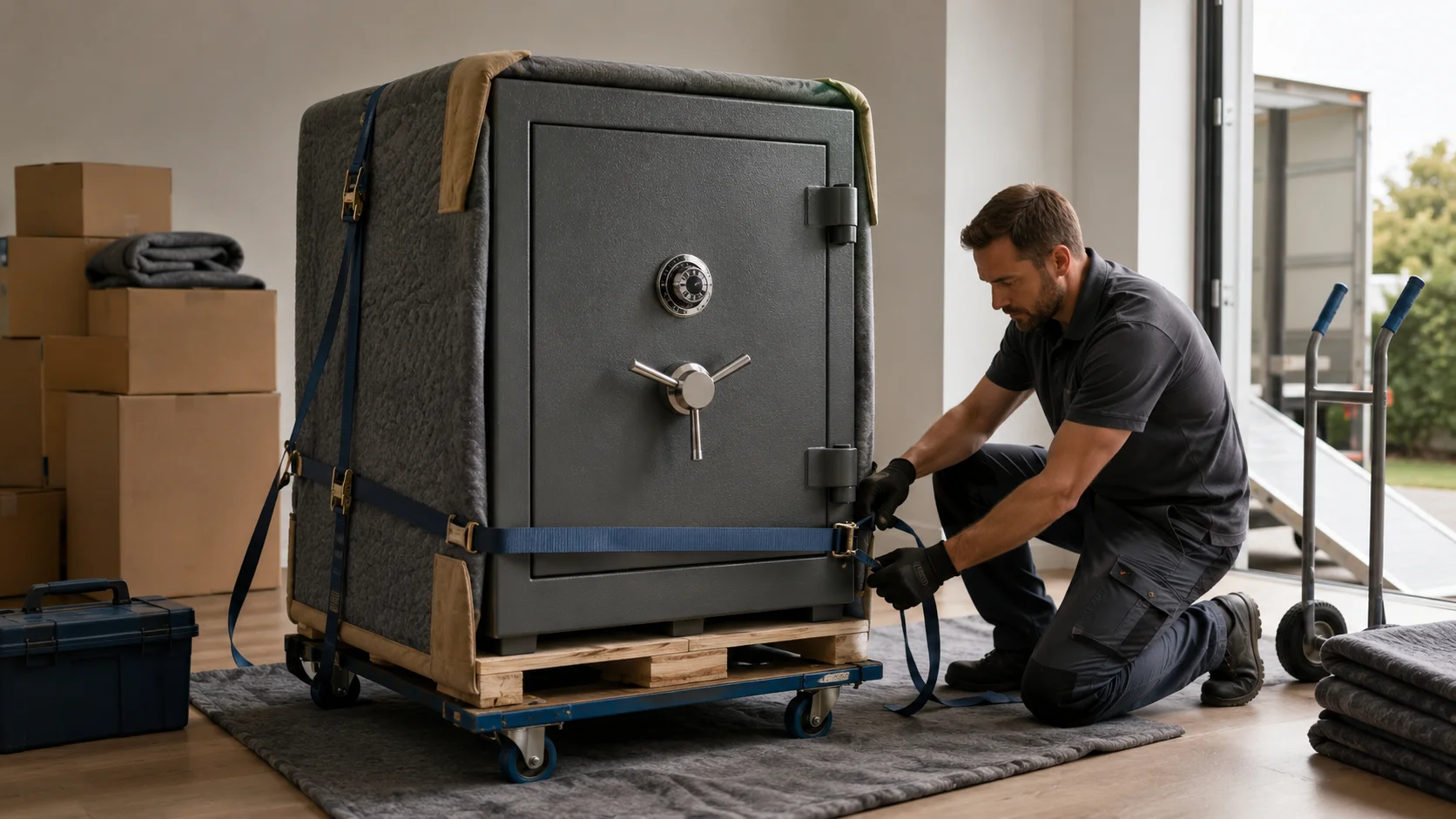
Before moving begins, the team protects floors, walls, and door frames using professional protective materials.
Moving and Loading
The safe is moved using heavy-duty rollers, lifting straps, and electric stair climbers where necessary. It is then securely strapped inside the transport vehicle.
Delivery and Positioning
At the destination, the safe is carefully positioned exactly where required.
Professional Anchoring
If requested, the safe is professionally anchored according to manufacturer and insurance requirements. This is often essential for burglary protection and insurance compliance.
Checklist: How to Identify a Reputable Safe Transport Company
The specialist transport market can be confusing. Use this checklist to separate professionals from amateurs.
Specialist Expertise
Choose companies specialising in safe transportation or heavy-load logistics.
Insurance Verification
Always request proof of transport and public liability insurance.
Professional Equipment
Ask specifically about:
Electric stair climbers
Heavy-duty rollers
Floor protection systems
Professional lifting equipment
Transparent Pricing
Detailed quotations are a good sign. Vague flat-rate offers are not.
Experience and References
Look for customer reviews, case studies, and examples of previous work.
Expert Advice
A genuine specialist will immediately ask detailed questions about weight, access routes, and anchoring requirements.
DIY Safe Transport (At Your Own Risk)
We strongly advise against self-transport. However, if you are considering moving a very light safe yourself, careful preparation is essential.
Warning: Hidden Risks and Insurance Problems
One of the biggest misunderstandings concerns insurance. If you damage a staircase, flooring, or injure someone while moving a 200 kg safe yourself, private liability insurance may refuse to cover the costs. In many cases, the incident may be classified as gross negligence.
The resulting financial consequences can be severe.
Required Equipment: Much More Than a Sack Truck
A standard sack truck is not enough. At minimum, you will require:
Heavy-duty stair climber or transport trolley
Professional lifting straps
Furniture dollies or machinery rollers
Protective blankets and floor coverings
A suitable transport van with proper securing points
Preparation Is Essential
Proper preparation reduces risks significantly.
Empty and Secure the Safe
Remove all contents before transport. Loose items can shift unexpectedly and alter the balance during movement.
Lock the safe door and secure handles or keypads with padding and tape.
Measure the Entire Route
Measure:
Doorways
Staircases
Hallways
Corners and landings
Allow at least 5–10 cm of clearance on each side.
Protect Floors and Walls
Use protective fleece, blankets, or edge protection to prevent damage to flooring and walls.
Prepare Information for the Transport Company
Keep the following information ready:
Safe model and dimensions
Exact weight
Photos or videos of the route
Details of flooring and obstacles
Positioning and anchoring requirements
Heavy Problem, Simple Solution: Choose Safety
Moving a safe is not a task for amateurs. The potential risks – from severe injuries to expensive property damage – rarely justify the perceived savings of a DIY move.
Professional safe transportation is not a luxury. It is an investment in safety, efficiency, and peace of mind.
By trusting experienced specialists with the proper equipment and expertise, you protect your property, your building, and yourself from the potentially disastrous consequences of an unsuccessful move.
 Dansk
Dansk
 Deutsch
 Eesti
Eesti
 English (GB)
 Español
 Français
 Hrvatski
 Italiano
 Latviešu valoda
 Lietuviškai
 Magyar
 Nederlands
 Norsk Bokmål
 Polski
 Português
 Română
 Slovenčina
 Slovenščina
 Suomi
Suomi
 Svenska
 Čeština
 Ελληνικά
 Русский
 Українська
 български
 العربية
 中文 (中国)
 English