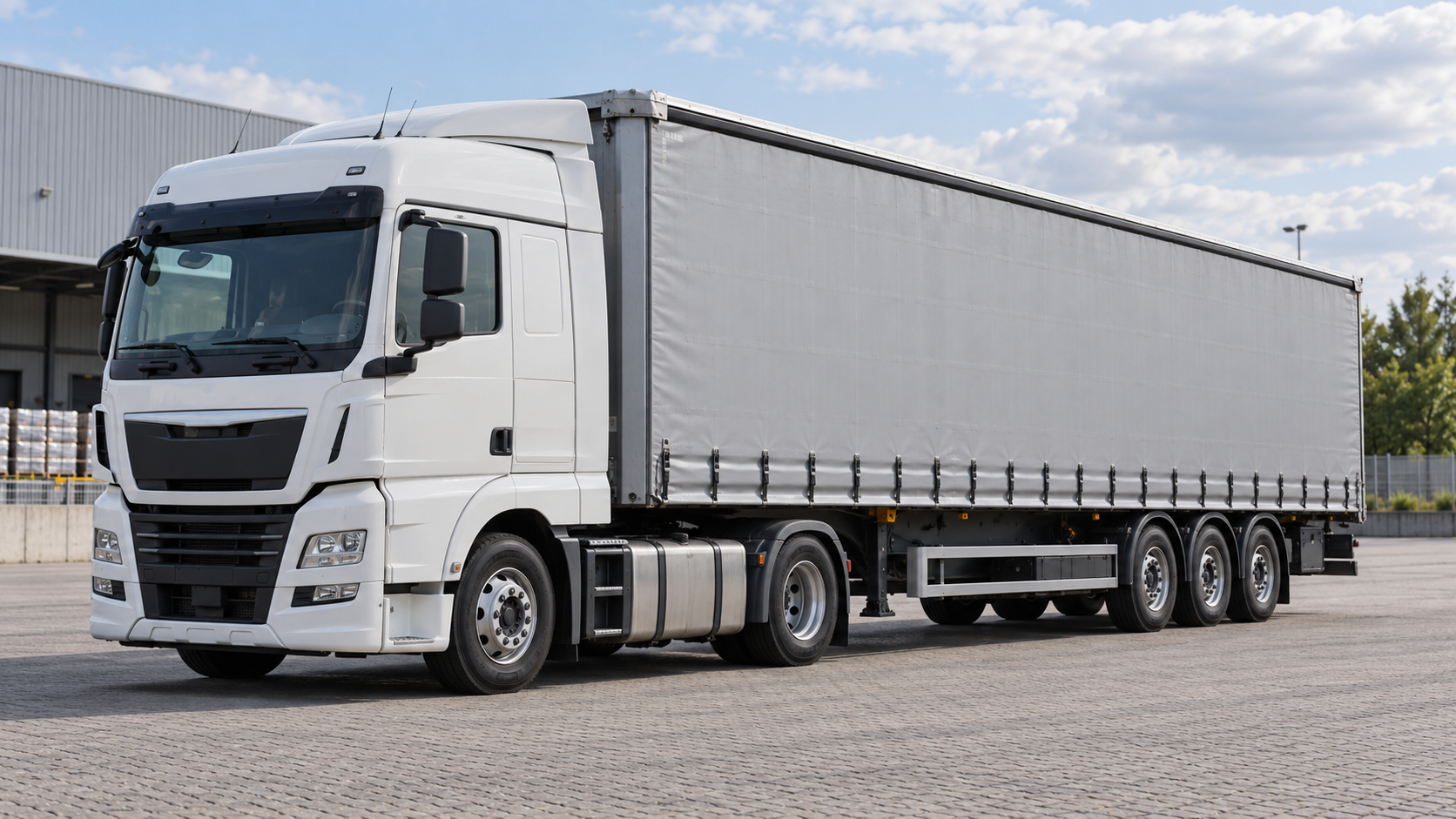
When it comes to lorry dimensions, three pieces of information are crucial: external dimensions for site access, internal dimensions for the freight and the clear loading opening for loading. The permissible external dimensions depend on the country of use and the vehicle combination. The actual loading area, however, depends on the specific body.
This guide helps with choosing a vehicle, pallets and bulky packages. Do not use legal maximum dimensions as the guaranteed loading space dimensions of a booked vehicle.
Table of contents
Great Britain: Lorry length and headroom
The British overview states 12 m for a single lorry, 16.50 m for the usual articulated lorry and 18.75 m for a lorry with a trailer. Approved longer semi-trailers have their own operating requirements: up to 15.65 m trailer length and 18.55 m total length. Sources:Department for Transport: Vehicle lengthsandGuide to longer semi-trailers.
The German limit of 4m must not be adopted as a general British height limit.Transport Scotlandexplains that there is no general legal vehicle height limit. The actual running height and the height signage determine route planning. When travelling to mainland Europe, the rules of all transit countries also apply.
Vehicle dimensions: the EU framework at a glance
Vehicle or dimension
Regular EU reference value
Rigid lorry: length
12.00 m
Articulated lorry: overall length
16.50 m
Lorry with trailer: total length
18.75 m
General outside width
2.55 m
Temperature-controlled construction under the prescribed conditions
2.60 m
Total height
4.00 m
The values in the table come from Directive 96/53/EC, Annex I. Vehicle design, individual component lengths and exceptions also matter. The 16.50 m figure includes the tractor unit and semi-trailer. It is not the length of the cargo floor.
The following EU values are a reference for regular cross-border transport. Special national rules, permitted longer combinations and local restrictions must be additionally examined. A permissible vehicle height is not a guarantee of free passage.
AI illustration of a European articulated lorry. Not a scale drawing or a specification for a particular vehicle.
How big is the loading area of a semi-trailer?
A concrete example is the Schmitz Cargobull S.CS UNIVERSAL – KP+. Its data sheet states 13.62 m internal length, 2.48 m internal width, 2.68 m internal height and 2.60 m side loading clearance. These values apply to the configuration described there. Other trailers may have different dimensions.
Dimension in the manufacturer example
Value
For planning
Inside length
13.62 m
Length of usable loading area
Inside width
2.48 m
Clear internal width
Interior height
2.68 m
Free space above the loading floor
Side loading opening: height
2.60 m
Limitation when loading from the side
The specification is an example, not a universal trailer size. A package 2.65 m high can fit below a ceiling 2.68 m high, but cannot pass upright through a side opening only 2.60 m high. Confirm the loading method before booking.
Interior length, width between wheel arches, door opening and remaining payload
7.5 or 12 tonne lorry
Body dimensions, axle loads and, if applicable, load capacity of the tail lift
Curtainsider semi-trailer
Internal dimensions, side opening and distances between the stanchions
Refrigerated trailer
Usable interior space after deducting the insulation and cooling technology
Lorry with trailer
Dimensions of each loading area individually; no continuous cargo space via the coupling
Rigid lorries and articulated lorries have different cargo layouts. A weight category does not define cargo dimensions. Request the measurements of the actual vehicle.
Width with mirrors and space for manoeuvring
The width of the body is not automatically the entire width including mirrors and attachments. For a gate you need the actual vehicle width and sufficient space for movement. A straight driveway and a right-angle driveway are different situations. Photograph narrow gates and driveways and indicate their clear width.
Differentiate between interior height, door height and loading floor height
Total height: Distance from the road to the highest relevant point of the loaded vehicle.
Internal height: Free space between the loading floor and limiting components.
Door or loading height: Actually usable opening when loading.
Loading floor height: Distance from the road to the loading floor; important for ramps, pallet lorries and tail lifts.
When specifying “loading height” it must be clarified which of these sizes is meant. Damage, removed parts, a lifting device or other loading can change the loading path. Measure the cargo in the intended transport position.
Checklist: Does your shipment fit in the lorry?
Record the length, width and height of each package including pallet, packaging and protruding parts.
Specify gross weight per package and total weight. Permissible total mass and payload are different values.
Determine stackability, transport position and sensitive surfaces.
Check door opening, stanchion distances and the complete loading path.
Coordinate loading and unloading: ramp, forklift, crane, pallet lorry or tail lift.
Plan space for securing loads, load distribution and necessary distances.
Check access roads, clearance heights, curves and manoeuvring areas at both addresses.
In the event of excess dimensions, it must be clarified before the journey whether permits, accompaniment or an alternative route are required. A simple volume calculation does not replace this check.
Request transport to suit the dimensions
Before booking, provide the dimensions and weight of every item, the collection and delivery addresses, and the loading equipment available at both locations. Ask DAGO Express to confirm the usable cargo space and door openings of the vehicle assigned to your shipment.
Do all lorries of the same weight class have the same loading area?
No. Wheelbase, body, cabin and equipment influence the usable area. The vehicle class alone is not a sufficient indication.
Is the semi-trailer length the same as the overall articulated vehicle length?
No. The total length includes the tractor unit. Interior length, exterior trailer length and the entire vehicle combination must be considered separately.
Is the internal height sufficient to inspect tall packages?
No. The doorway may be lower than the interior ceiling. The forklift or other lifting equipment also needs enough space, and the goods must remain in a safe position.
Do the European dimensions also apply in the USA?
No. US vehicle and trailer classes as well as state and federal requirements vary. Information in feet and inches must be converted neatly into metres. A US shipment requires its own vehicle and route verification.
More freight planning guides are available in the DAGO logistics blog. Sources checked on 11 November 2026. Each regulation and equipment specification applies only to the scope described.
 Dansk
 Deutsch
 Eesti
 English (GB)
 Español
 Français
 Hrvatski
 Italiano
 Latviešu valoda
 Lietuviškai
 Magyar
 Nederlands
 Norsk Bokmål
 Polski
 Português
 Română
 Slovenčina
 Slovenščina
 Suomi
 Svenska
 Čeština
 Ελληνικά
 Русский
 Українська
 български
 العربية
 中文 (中国)
 English