When a shipment ends up at the wrong store
Click & Collect has long been standard for many retailers. Customers order online and collect their goods from a store shortly afterwards. The process seems simple, but in practice it is prone to operational errors. The situation becomes particularly critical when a shipment is accidentally delivered to the wrong store.
This is a typical use case for a same-day direct courier: a single shipment has to be moved from one store to another at short notice, often within the same city or region. The aim is to deliver the goods to the correct location before closing time on the same day. For retailers, this is not only a logistical correction but also an important part of customer satisfaction, service quality and process reliability.
The scenario: a misdelivery within the Click & Collect network
A retail company operates a Click & Collect store network in several European countries. In exceptional cases, a parcel carrier delivers a shipment to the wrong store. The goods may, for example, be in one Berlin branch but need to reach another Berlin branch on the same day. Similar cases can occur in Paris, Madrid, Brussels, Milan, Amsterdam or Copenhagen.
The volume of these transports is usually low and difficult to predict. These are not regular routes but ad hoc cases. A conventional scheduled service or fixed daily collection is therefore only partly suitable. What is needed is a flexible courier network that can respond at short notice while still offering transparent prices, clear processes and reliable delivery.
The logistical challenge
Time is the key factor in this use case. The shipment must not simply be forwarded at some point; it should arrive on the same day wherever possible. Often there is only a narrow window between detecting the error, placing the order, collecting the goods and store closing time.
There are also several operational requirements:
The order confirmation must be issued quickly, ideally within no more than 120 minutes of the booking. Collection and delivery should take place on the same day. The shipment must be handed over personally to a named contact at the destination store. Delivery to an alternative address may take place only with explicit approval. The client also needs digital proof of delivery, for example a signature, scan or photograph.
This proof is particularly important for retailers. It provides transparency for internal teams, store management, customer service and, where applicable, the end customer.
Why a same-day direct courier is a better fit than standard shipping
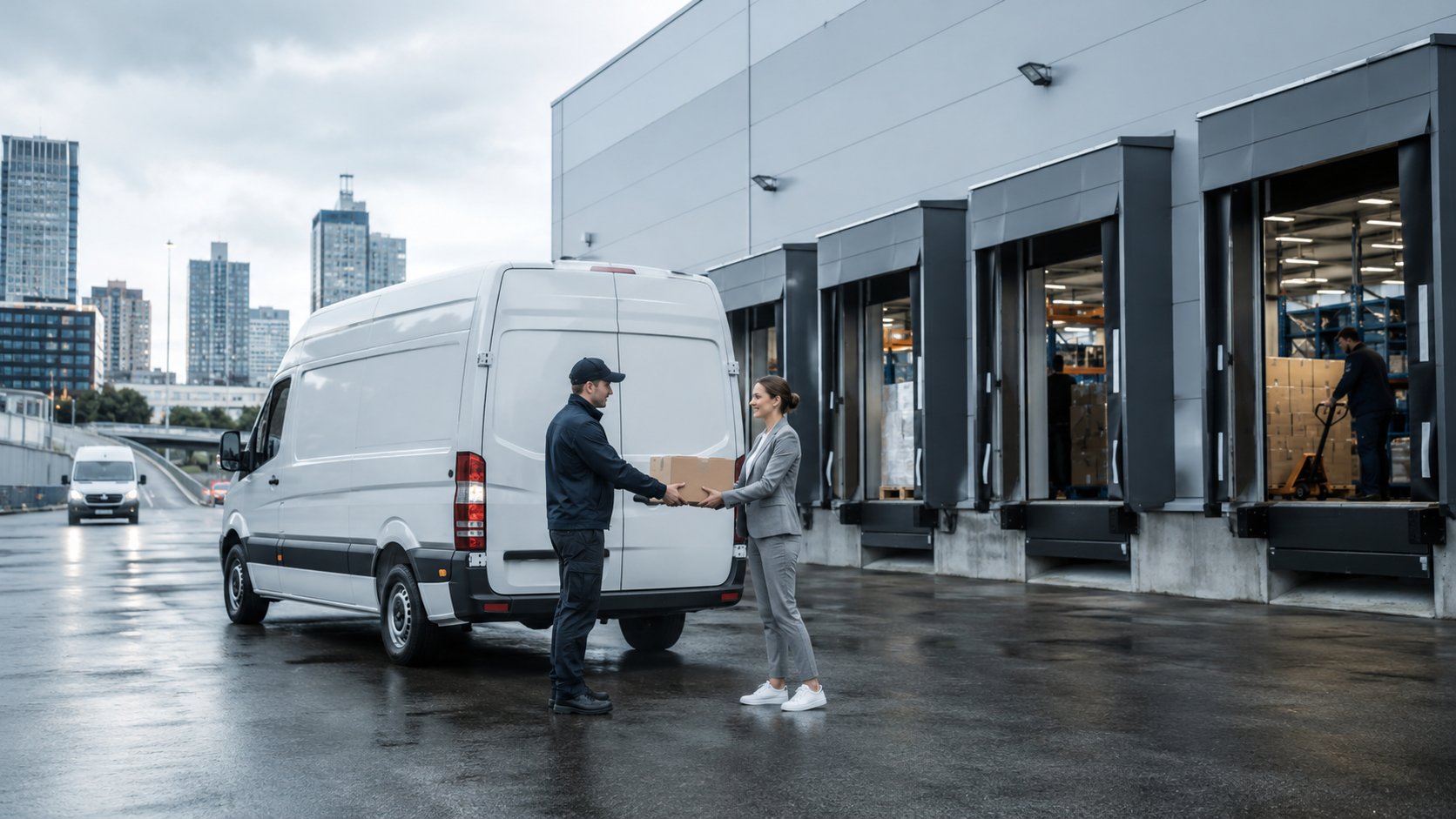
When a store or customer needs urgent regional supplies, professional on-demand delivery transports the shipment without additional handling points.
Standard shipping is often too slow after a misdelivery. Even express services are not always suitable when goods must be moved from store to store within the same city at short notice. A same-day direct courier takes the shipment straight to its destination without unnecessary intermediate stops.
The advantage lies in direct control. The shipment is collected, transported and handed over personally. There is no further sorting at a parcel hub and no uncertain transit time. This speed can be decisive in sensitive Click & Collect processes.
For retailers, this means fewer customer-service escalations, fewer cancellations, fewer disappointed customers and greater last-mile reliability.
Typical requirements for the courier partner
For short-notice stock transfers, replacement parts and binding store deliveries, industrial logistics solutions provide a direct route and clearly defined responsibilities.
A suitable logistics partner for this use case must do more than provide a vehicle at short notice. A resilient network spanning several European countries is essential. Germany, the Netherlands, Belgium, Luxembourg, France, Spain, Italy, Poland, Sweden and Denmark are particularly relevant.
Local availability is important in cities with several stores. These include major cities such as Paris, Berlin, Barcelona, Madrid, Brussels, Marseille, Lyon, Stockholm, Amsterdam, Milan, Rome, Copenhagen, Antwerp and Bordeaux.
A professional courier partner should cover the following points:
- same-day collection and delivery before store closing time
- order entry by telephone, email or portal
- the option of API or portal integration
- digital proof of delivery with a signature, scan or photograph
- transparent fixed-price calculation for each journey
- no minimum volumes for irregular ad hoc orders
- clear communication in the event of delays or delivery problems
Fixed price instead of a complicated tariff structure
Price transparency is particularly important in this use case. Because the transport volume cannot be planned, a framework agreement without a minimum volume is suitable. The client does not need complex tiered tariffs but a simple fixed-price calculation for each journey.
The price can, for example, be based on distance, urban area, vehicle type or urgency. This predictability is crucial for retailers because misdeliveries do not occur regularly but must be resolved quickly when they happen.
A clear fixed price reduces internal coordination. Customer service or store management immediately knows the cost involved. This allows the decision to arrange a direct journey to be made more quickly.
Digital ePOD as a safeguard
Digital proof of delivery, or POD, is a central part of the store-delivery process. It records when, where and to whom the shipment was handed over. Depending on the requirements, the evidence can include a signature, scan or photograph.
This is especially valuable in Click & Collect cases. The retailer can verify internally that the goods actually reached the correct store. It also gives customer service certainty. If the customer asks later, the status can be documented clearly.
An electronic proof of delivery turns a simple courier journey into a transparent, controllable logistics process.
How a typical order works
For misdeliveries or urgent store requirements, same-day delivery enables direct replenishment within the agreed time window.
A possible process looks like this:
First, the store or customer-service team reports the misdelivery. The courier partner is then commissioned by email, telephone, portal or API. The courier confirms the order within the agreed period and arranges collection.
The driver then personally collects the shipment from the incorrect store. Delivery goes directly to the correct store, where the goods are handed over to a named contact. Finally, the client receives digital proof of delivery.
This transforms a potential customer problem into a properly documented correction process.
Which companies is this use case relevant for?
For retail networks and urgent transfers across several regions, a European courier network coordinates direct deliveries between stores and customers.
This use case is particularly relevant to retailers with multiple stores, a Click & Collect offering and high expectations of service quality. These include fashion retailers, electronics shops, pharmacies and drugstores, furniture suppliers, sports retailers, opticians, pharmacy chains, DIY stores and other retail companies with a physical network.
Fulfilment providers, e-commerce platforms and the logistics departments of large retail groups can also benefit from such a solution. Wherever individual shipments have to be corrected or redirected at short notice, a flexible same-day courier is a useful complement to the existing parcel carrier.
Benefits for retailers and customers
The greatest benefit is rapid error correction. A shipment delivered to the wrong store does not automatically have to result in a poor customer experience. If the goods reach the correct store on the same day, the service promise can often still be kept.
Retailers gain further advantages: fewer manual escalations, less work for customer service, better traceability and greater process reliability. The model also remains flexible because no regular minimum quantities are required.
This flexibility is particularly important in European retail operations. Every market, city and store structure is different. A courier network with Europe-wide coverage can help resolve local problems quickly and professionally.
Conclusion: a small shipment with a major impact
Misdeliveries in the Click & Collect process may appear to be isolated incidents. In practice, however, they can have a significant impact on customer satisfaction, internal processes and brand perception. A same-day direct courier provides a fast, transparent and controllable solution.
The combination of short-notice availability, personal handover, digital proof of delivery and fixed-price calculation makes this use case especially relevant to retailers with European store networks. Companies that handle these exceptional cases professionally protect not only individual shipments but also customers' confidence in the entire Click & Collect process.
 Dansk
Dansk
 Deutsch
 Eesti
Eesti
 English (GB)
 Español
 Français
 Hrvatski
 Italiano
 Latviešu valoda
 Lietuviškai
 Magyar
 Nederlands
 Norsk Bokmål
 Polski
 Português
 Română
 Slovenčina
 Slovenščina
 Suomi
Suomi
 Svenska
 Čeština
 Ελληνικά
 Русский
 Українська
 български
 العربية
 中文 (中国)
 English