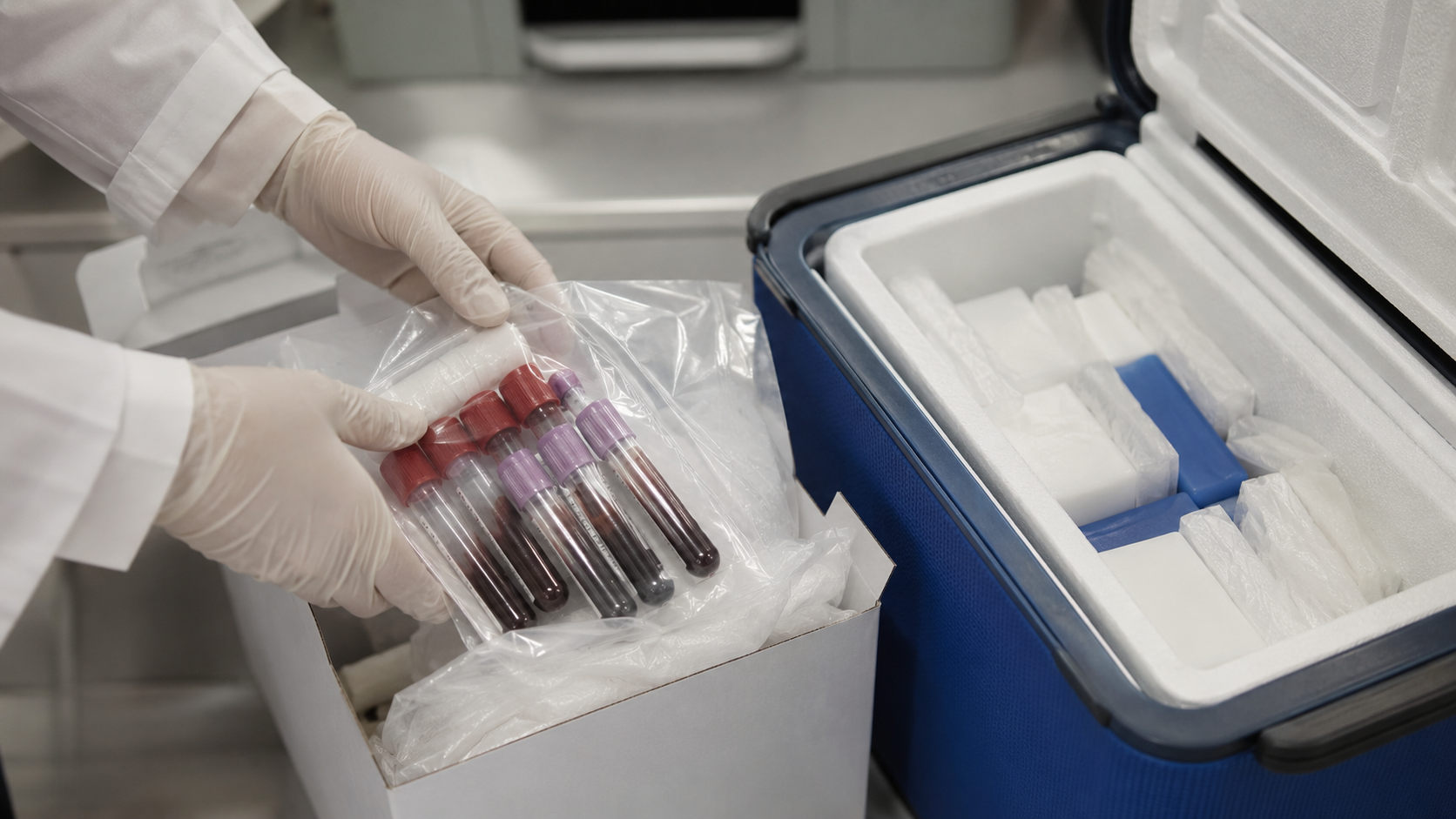
Blood Sample Transport – Temperatures, Chilling and Packaging
Blood samples can be transported safely within 24 hours. But the temperature, sample material and test method all need to match. Simply chilling every tube to 2–8 °C is not the right answer. Centrifuged serum is often transported chilled, while many whole blood samples need to stay at 15–25 °C. Coagulation samples, on the other hand, often have much shorter stability times. Some specialist tests may even require frozen transport on dry ice.
So it is not just the journey time that matters. Proper preparation, suitable packaging and fully documented temperature control are just as important.
The key points at a glance
Centrifuged serum and many plasma samples are often transported at 2–8 °C.
Uncentrifuged whole blood usually stays at 15–25 °C for many tests and should not be chilled as a blanket rule.
Coagulation samples may remain stable for far less than 24 hours and often need special preparation.
Samples must not come into direct contact with frozen cold packs, as this can cause local freezing.
Before dispatch, always check the destination laboratory’s requirements for temperature, centrifugation and maximum transport time.
How should blood samples be transported over 24 hours?
Blood samples are transported either chilled at 2–8 °C, at room temperature between 15 and 25 °C, or frozen, depending on the test required. Centrifuged serum often needs chilling. Many whole blood samples, however, must not be heavily chilled or frozen. The binding transport conditions are set by the laboratory carrying out the test.
The right temperature depends on the blood sample
There is no single ideal temperature for transporting blood samples over 24 hours. The material inside the tube decides how the sample needs to be stored and moved. For many tests, centrifuged serum is kept at 2–8 °C. Uncentrifuged serum tubes are often stored at room temperature between 15 and 25 °C. The same can apply to EDTA blood intended for full blood counts, HLA testing or lymphocyte typing.
EDTA blood for viral load testing, however, may need chilled storage. Blood cultures are usually transported at room temperature and should not be put in the fridge. These differences show why the phrase “blood samples must be chilled” is far too vague.
The following table gives a general guide:
Sample material or test
Common transport temperature
Important note
Uncentrifuged serum tube
15–25 °C
Do not chill or freeze as a blanket rule
Centrifuged serum
2–8 °C
Transport separated from the blood clot
EDTA blood for full blood count
15–25 °C
Analyse as quickly as possible
EDTA blood for certain viral loads
2–8 °C
Follow the laboratory’s instructions
Blood culture
15–25 °C
Do not refrigerate
Citrate blood for PT/Quick or aPTT
15–25 °C
Often stable for only up to 8 hours
Citrate plasma for specialist coagulation testing
Sometimes frozen
Stability is often only around 4 hours at room temperature
Specialist molecular tests
Chilled or frozen, depending on the method
Check with the lab before dispatch
This table should not be used as a universal shipping instruction. Even within the same sample group, requirements can vary. The tube system, anticoagulant and analyser can also affect sample stability. That is why the sender should always check the current test directory or sample requirements of the destination laboratory.
Preparing serum, plasma and whole blood properly
Preparation starts straight after the blood draw. The first thing to clarify is whether whole blood, serum or plasma is needed. If serum is being sent, the blood must be allowed to clot fully first. During this clotting phase, the sample should not be chilled. For certain antibody tests, virology guidance recommends a clotting time of around 30 to 60 minutes at room temperature. The sample can then be centrifuged and the serum separated from the blood clot.
Only separated serum can then be stored chilled or frozen, depending on the test. Transporting serum while it is still sitting on the blood cells may change individual measurement values.
Plasma is made from blood with an anticoagulant added. Its handling therefore also depends on the tube used. EDTA, citrate and heparin tubes are not interchangeable. For some molecular biology tests, for example, heparin must not be used. Otherwise, the anticoagulant may interfere with the later test. EDTA whole blood for certain viral detection tests should be sent to the laboratory as quickly as possible, sometimes without chilling.
In many cases, the transport time should not exceed 24 hours.
Mixing after collection is also important. Tubes containing additives should be gently inverted according to the manufacturer’s instructions. Vigorous shaking should be avoided. It can mechanically stress the blood cells and encourage haemolysis. The tubes must also be clearly labelled. At a minimum, this includes reliable sample identification, the collection time and the requested test.
When blood samples need to be chilled
Chilling to 2–8 °C is often required for centrifuged serum, certain plasma samples and selected molecular biology tests. It can slow down metabolic processes and the breakdown of temperature-sensitive components. Even so, a chilled sample must not accidentally freeze. Even brief direct contact with a very cold ice pack can create local temperatures below 0 °C. That is why there should always be an insulating layer between the sample and the cooling medium.
Suitable options include foam inserts, cardboard, bubble wrap or other approved spacers. The cool box must also be designed for the full transport time.
For a 24-hour transport, improvised cool bags often are not enough. The internal temperature depends on the outside temperature, the insulation and the number of cold packs used. The amount of free air inside the packaging also matters. A nearly empty box can warm up faster than a properly designed transport pack. In summer, the packaging must therefore protect against high temperatures. In winter, accidental over-chilling can be a problem.
A sample can even freeze without a cold pack if it is left for too long in an unheated vehicle.
Cold packs for the 2–8 °C range should be used only after the intended conditioning process. A normal freezer pack taken straight from a freezer can be far colder than required. It should therefore not be placed directly next to the tubes without proper checking. Validated cooling systems or specially conditioned cooling media are the better option. For sensitive consignments, the packaging concept should be tested under realistic summer and winter conditions.
Why whole blood should not automatically be chilled
Whole blood still contains intact blood cells. These react sensitively to the wrong temperatures and to mechanical stress. That is why uncentrifuged whole blood for many routine tests is stored at 15–25 °C. This can include serum tubes before centrifugation and EDTA blood for full blood counts. Too much cooling can cause changes to the cells. Freezing often destroys the cell structures completely.
Whole blood that has not first been separated into serum or plasma must therefore not be frozen.
Even seemingly careful chilling is not automatically a good idea. If a sample intended for cellular analysis is cooled to 2–8 °C even though the laboratory requires room temperature, the results may be affected. Excessive heat in summer is just as problematic. Room temperature therefore does not mean the sample can simply be left unprotected in a vehicle. It means a controlled range, usually between 15 and 25 °C.
In extreme outside temperatures, a temperature-controlled insulated container may be needed.
For various virology tests, chilling is not required if the transport time is no more than 24 hours. Depending on the laboratory, this may include certain antibody tests and nucleic acid detection tests from serum or EDTA blood. Even so, the sample should arrive as quickly as possible. For longer transport times, centrifugation followed by separation of the serum may be required.
Coagulation and specialist tests need their own rules
Coagulation samples are among the most time-critical blood samples. For citrate blood used for PT/Quick or aPTT, stability at room temperature may be limited to around eight hours. This means an unprocessed sample is not automatically suitable for 24-hour transport. If storage is longer, the material often needs to be centrifuged. The citrate plasma is then sent frozen, depending on the test.
For specialist coagulation testing, stability at room temperature may be only around four hours.
Standard chilled shipping at 2–8 °C does not always solve this issue. Chilling does not replace required centrifugation or freezing. Some coagulation parameters may also be altered by incorrect processing. The correct fill level of the citrate tube is important too. The ratio between blood and anticoagulant must be right. Underfilled tubes may therefore be unsuitable.
Complement diagnostics and selected molecular biology methods also have special requirements. In some cases, serum or plasma must be separated immediately and frozen. Depending on the test, temperatures of around minus 18 to minus 70 °C may be needed. Transport then takes place using a suitable frozen-shipping system, often with dry ice. The sample must remain frozen throughout the entire journey.
Dry ice is not a replacement for standard cold packs. It creates temperatures of roughly minus 78 °C and can completely freeze unsuitable samples. There are also specific packaging and labelling requirements for shipping dry ice. It should therefore only be used when the laboratory explicitly requires frozen transport.
Cool box, safety packaging and temperature control
The transport packaging must protect the sample both biologically and mechanically. The primary container is the sealed sample tube. It must be leak-tight, shatter-resistant and suitable for the test material. Around this, there should be a leak-tight secondary packaging layer. This should contain any leaking liquid if a tube is damaged. For liquid samples, enough absorbent material is also required. The outer packaging protects the consignment against knocks and external influences.
A simple cool box on its own does not automatically meet all requirements. What matters is the entire packaging system. Samples should stand upright and be secured against movement. Tubes must not sit loose between cold packs. Foam holders or suitable sample racks reduce breakage and prevent direct cold contact. Documents and request forms should be packed separately from the sample material. This keeps them clean and readable if there is a leak.
Patient data must also be protected from unauthorised access.
For critical blood samples, a temperature data logger is useful. It records the temperature profile throughout the entire transport. This makes it possible to see later whether there was only a short spike or a longer deviation. A simple maximum-minimum indicator provides less detail. Even so, it can show whether a defined limit has been exceeded. The logger must be placed in a representative position.
If it is positioned right next to a cold pack, it may measure a lower temperature than the sample itself.
The data logger should also be activated before dispatch. Ideally, its identification number should be recorded in the accompanying documents. On arrival, the laboratory can check the temperature profile. If there has been a deviation, the lab decides whether the sample is still usable based on analyte stability. For sensitive tests, simply saying that the sample “arrived chilled” is often not enough.
Process for safe 24-hour transport
Transport starts by confirming the test order. The destination laboratory needs to know which analysis is to be carried out. It then confirms the required sample material, tube and temperature. It is just as important to clarify whether the sample must be centrifuged beforehand. The permitted time between collection and analysis also needs to be checked. Only then can the right transport packaging be selected.
After collection, the tubes are mixed correctly and labelled. Serum samples are given enough time to clot. If required, they are then centrifuged. The serum is separated from the blood clot according to the laboratory’s instructions. It is then stored at the specified temperature. Whole blood samples, by contrast, remain uncentrifuged if this is required for the analysis.
Before the samples are placed inside, the transport box is prepared. Cold packs must have reached their intended temperature state. The samples are placed in the secondary packaging. An insulating layer is then added between the tubes and the cooling medium. A temperature monitor is positioned so that it reflects the actual sample temperature as closely as possible. Finally, the box is securely closed and correctly labelled.
Dispatch should be planned so that the sample arrives without avoidable interim storage. Weekends, bank holidays and late collection times increase the risk of delays. Collection should therefore take place as early as possible on the dispatch day. Delivery within 24 hours also does not automatically mean the pre-analytical requirements have been met. The relevant time starts with the blood draw. It does not end at collection, but only when the sample is processed or analysed in the laboratory.
Often overlooked: transport time starts at collection
One point that is often missed is the sample’s real timeline. Many senders only count the time from handover to the courier or parcel service until arrival at the lab. Medically, however, the time since blood collection is what matters. If a sample is taken in the morning but not collected until the evening, several hours have already passed. A promised 24-hour delivery can then become a total sample time of 30 hours or more.
The time after delivery is just as important. A parcel may arrive at reception but only be opened later in the laboratory. Acceptance times and internal routes must therefore be taken into account. The safest planning calculates the total time from collection to actual sample processing. This total duration should remain below the permitted stability time.
Temperature deviations should not be viewed as a single limit value either. A brief rise to 9 °C may be assessed differently from several hours at 15 °C. A short period of cooling is also different from full freezing. A data logger therefore offers more reassurance than a sticker saying “chilled”. It shows not only whether a limit was exceeded, but also for how long.
Why DAGO Express is a good choice for transporting blood samples
When medical samples are on the move, every minute counts. DAGO Express offers direct courier runs across Germany without transhipment, helping blood samples reach their destination quickly and safely. By avoiding sorting hubs and unnecessary handovers, the risk of delays and unwanted temperature fluctuations during transport is reduced. Depending on the requirement, suitable cool boxes and validated transport containers can be used to help maintain the required temperature reliably.
Companies, GP surgeries, laboratories and clinics also benefit from 24/7 availability, fast response times and transparent shipment tracking. For time-critical laboratory samples, diagnostics or medical emergencies, a specialist direct courier is often the safest way to get sensitive blood samples to the destination laboratory within the required transport time and without unnecessary stops.
Courier Service > Blog > Blood Sample Transport – Temperatures, Chilling and Packaging
 Dansk
Dansk
 Deutsch
 Eesti
Eesti
 English (GB)
 Español
 Français
 Hrvatski
 Italiano
 Latviešu valoda
 Lietuviškai
 Magyar
 Nederlands
 Norsk Bokmål
 Polski
 Português
 Română
 Slovenčina
 Slovenščina
 Suomi
Suomi
 Svenska
 Čeština
 Ελληνικά
 Русский
 Українська
 български
 العربية
 中文 (中国)
 English