Sending a Balcony Solar Kit: The Complete Guide to Packaging, Freight & Costs
Moving home, selling a used kit on Facebook Marketplace or returning a system to the supplier: there are plenty of reasons why a balcony solar kit may need to be shipped. The tricky bit is not just the weight. It is the mix of large glass solar panels, awkward dimensions, sensitive electronics and, in some cases, battery storage with extra transport rules.
With the right preparation, though, shipping a plug-in solar kit can be planned properly. The key is to disconnect and dismantle the system safely, pack the panels so they are protected from knocks and pressure, choose the right carrier and make sure the insurance cover is not left to chance.
This guide explains step by step how to send a balcony solar kit safely, clearly and as cost-effectively as possible.
The key points in brief
Solar panels are usually too large for standard parcel services. Many panels exceed typical parcel size limits and are better suited to pallet freight or a specialist courier.
Packaging is the make-or-break factor. Edge protection, strong cardboard, padding and firm fixing are essential.
The inverter, cables and mounting parts can often be shipped separately. Smaller components are usually cheaper to send as parcels.
Battery storage is a special case. Lithium-ion batteries may fall under dangerous goods rules and should not simply be put into an ordinary parcel.
Documentation protects you if something goes wrong. Photograph dismantling, packaging, the condition of the panels and handover to the carrier.
How do you send a balcony solar kit safely?
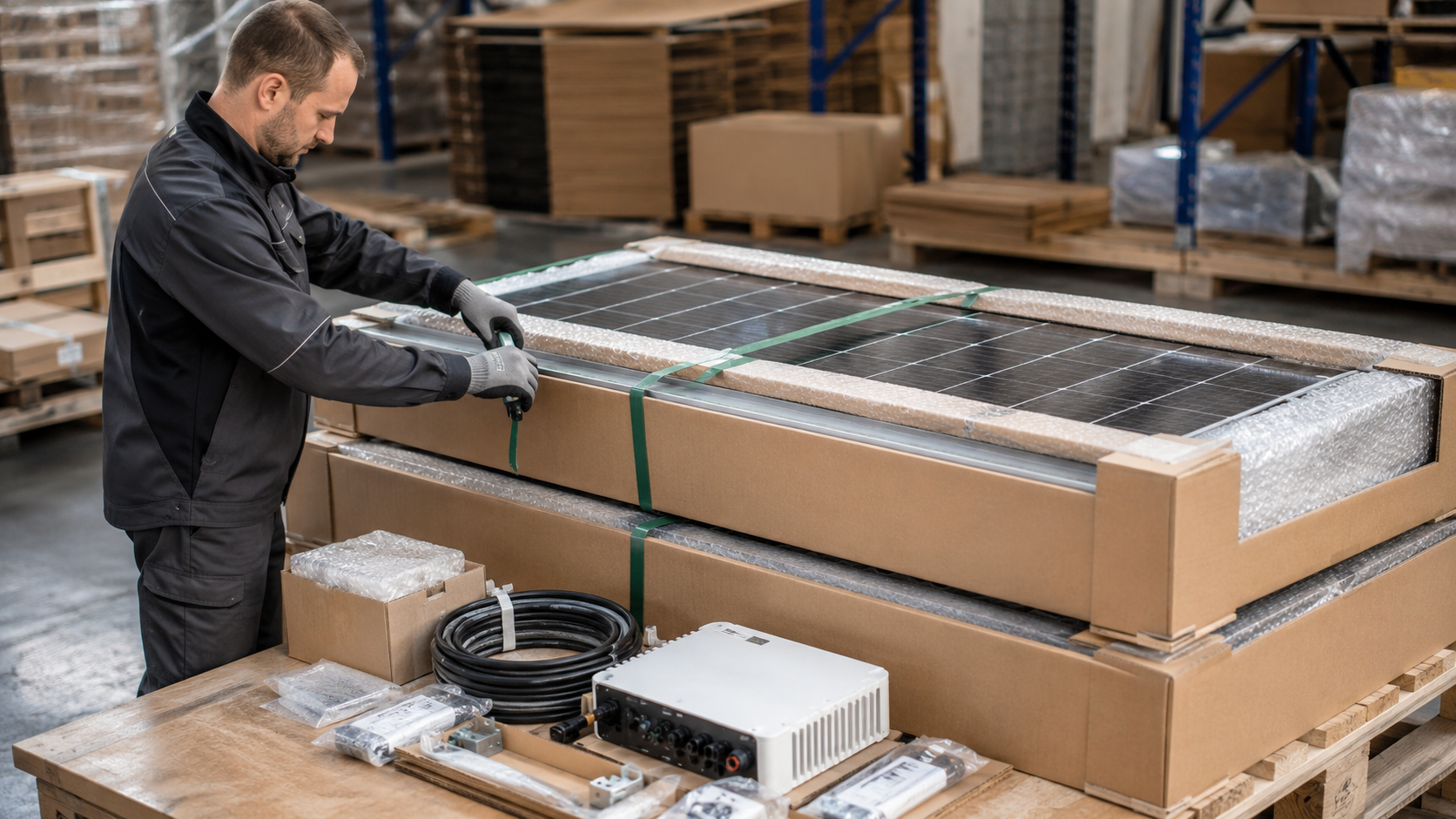
To send a balcony solar kit safely, first disconnect it from the mains supply, then carefully remove the panels, micro-inverter, cables and mounting system. Each part should be packed separately. Solar panels should be protected with edge guards, padding and solid cardboard or timber boards in a “sandwich” style package.
For the panels themselves, pallet freight or a specialist transport service is usually more sensible than a standard parcel carrier. The inverter and accessories can often be sent separately as a normal parcel.
Before booking transport, state the goods value honestly, check the level of insurance cover and take photos of the condition and packaging.
When is it worth shipping a balcony solar kit?
Shipping a balcony solar kit is usually worthwhile if the system still has a decent value, if you are moving home, selling the kit on, or returning it to a retailer or manufacturer. Newer 800-watt plug-in solar systems with two high-output panels, a micro-inverter and a mounting kit can still be worth several hundred pounds. A poorly organised shipment can therefore end up costing more than proper pallet transport.
For older, low-value systems, it is worth doing the sums honestly. If packaging materials, collection, freight and insurance cost almost as much as the remaining value of the kit, local collection may be the better option. When selling privately, it often makes sense to offer collection first and only offer shipping if the buyer covers the full cost.
Returns are a different matter. If the kit is going back to a supplier, check the return terms carefully. Some retailers require the original packaging or give specific packing instructions. If you ignore those instructions, you may have problems with a refund if the goods are damaged in transit.
Step 1: Prepare and dismantle the balcony solar kit properly
Safety first: disconnect the system from the mains
Before you remove anything, the balcony solar kit must be fully disconnected from the electrical supply. Unplug the feed-in connection first. Then disconnect the solar panels from the micro-inverter. Do not work in rain, damp conditions or strong wind.
Even small PV panels can generate voltage when exposed to light, so do not leave connectors lying around unnecessarily. If you are not confident, ask a competent person for help.
Safety matters more than a quick dismantle.
Remove panels, inverter, cables and brackets in order
Dismantle the kit in a clear sequence. First disconnect the feed-in side, then remove the inverter, cables, panel connectors and finally the mounting system. Put each part down in an organised way rather than throwing everything into one box.
Pay particular attention to MC4-style connectors, connection leads and screw fittings. These small parts are fairly robust, but they can still be damaged by bending, crushing or moisture. Solar panels should always be moved by two people where possible.
A panel may not be extremely heavy, but it is awkward and can crack if handled badly.
Label small parts and pack them securely
Label screws, clamps, brackets, cables and adaptors as soon as you remove them. Small zip bags or resealable freezer bags are useful for sorting accessories by assembly group.
For example, label bags as “left panel clamps”, “balcony rail bracket”, “inverter screws” or “connection cable”. This makes reassembly much easier for the recipient. It also avoids questions, disputes after a private sale or missing parts during a return.
Pro tip: photograph the system before and during dismantling. Take pictures of the wiring, connectors, mounting points and the condition of the glass surfaces. These photos help with reassembly and provide useful evidence if there is later a transport damage claim.
Step 2: Pack solar panels so they are protected from breakage
Why packaging is the most important step
The solar panels are the most delicate part of the kit. They contain glass, frames, solar cells and a rear backing layer. From the outside they may look sturdy, but point pressure, hard impacts or incorrect storage can cause broken glass, microcracks or frame damage.
That is why a simple cardboard box is usually not enough. The panel must be packed so that the edges are protected, the glass surface is not directly loaded and the whole package cannot slide around during transport.
Materials for safe packaging
Edge protection: cardboard, rigid foam or foam profiles for all four sides and corners.
Bubble wrap or foam wrap: as the first protective layer against scratches and light impacts.
Strong cardboard sheets: larger than the panel surface, ideally double-wall cardboard.
Optional timber or OSB boards: useful for longer distances, higher-value panels or pallet freight.
Stretch wrap: to hold the full package together.
Strong parcel tape: for closing and securing.
Straps: for pallet shipping, but never directly over the glass without load distribution.
Warning labels: for example “Glass”, “Do not stack” or “Fragile”.
The sandwich method for solar panels
The safest method for private senders is the sandwich packaging method. The panel is not just wrapped. It is placed between two solid protective sheets.
First, wrap the solar panel completely in bubble wrap or foam wrap. Then add edge and corner protection to all sides. After that, place a strong cardboard sheet or timber board on both the front and the back.
These boards should be larger than the panel itself so the glass and edges are not directly exposed to pressure.
Then secure the whole package with stretch wrap and tape. Nothing should be able to move. If you are sending two panels, never put glass directly against glass. There must always be a firm separating layer between them.
Ideally, panels should be fixed upright or slightly angled on a pallet. Panels lying flat are more vulnerable to pressure from above, especially if other goods are placed on top during handling.
Rule of thumb: a solar panel should not be treated like a normal board. Protect the edges first, then the surfaces, and finally the whole unit against movement.
Pack the inverter and accessories separately
The micro-inverter should not be loose between the panels. Pack it separately in a strong box with plenty of cushioning. Cables, plugs, screws and brackets should go into separate bags or smaller boxes.
Heavy metal parts must not be able to knock against the inverter or the back of the panel. If accessories are included in the same freight shipment, secure the accessories box firmly to the pallet so it cannot come loose.
Step 3: Pallet freight or parcel courier – which is better?
When a parcel courier is enough
A parcel courier may be suitable if you are only sending the inverter, cables, brackets or very small solar components. Standard parcel services have fixed size and weight limits. In the UK, carriers such as Royal Mail, Parcelforce, DPD, Evri and UPS all have their own limits and surcharges.
Many balcony solar panels, however, are longer than standard parcel dimensions. That means they may not be accepted as ordinary parcels.
Even “large parcel” or “oversized” services are not automatically ideal. Parcel networks involve conveyor belts, sorting depots and repeated handling, which can be risky for glass panels.
Why pallet freight is usually safer for solar panels
For solar panels, pallet freight is usually the safer option. Freight companies and pallet networks are better set up for bulky, awkward and fragile goods than standard parcel couriers.
Transport may run through a pallet network, part load service or direct courier route. A pallet makes handling easier with pallet trucks and forklifts. This reduces the need for panels to be carried individually, dragged around or moved through parcel sorting systems.
For very valuable systems or urgent shipments, a dedicated courier or direct transport service can also make sense. With direct transport, the goods travel from sender to recipient with fewer handling points. This is more expensive than standard pallet freight, but it reduces the risk linked to repeated reloading.
For a low-value private sale, that may be over the top. For high-value kits, business returns or urgent replacement deliveries, it can be worth considering.
Comparison: parcel courier, oversized parcel, pallet freight and direct courier
Shipping method
Suitable for
Advantages
Disadvantages
Typical UK cost
Parcel courier
Inverters, cables, small parts
Cheap, easy to book, tracking available
Size limits, more mechanical handling, not ideal for glass panels
Approx. £6 to £25
Large / oversized parcel
Larger accessories, unusual formats
More flexible than standard parcels
Not automatically safe for fragile panels, surcharges possible
Approx. £25 to £70
Pallet freight
One or two solar panels, complete kits
Better for bulky goods, collection possible, easier handling
More packaging work, collection windows needed
Approx. £80 to £250
Direct courier
Valuable, urgent or highly fragile shipments
Fewer handling points, direct delivery, more control
More expensive than standard shipping
Depends heavily on distance and vehicle
Step 4: Calculate the shipping costs
What affects the price?
The cost of sending a balcony solar kit depends on several factors. The most important are dimensions, weight, distance, packaging type, collection address, delivery address and insurance value.
Whether the goods are already palletised also affects the price. Collection from an easily accessible address is usually cheaper than collection from a tight courtyard, a block of flats or an upper floor.
Timed delivery, tail-lift collection, phone-ahead delivery or difficult access can also add extra costs.
Realistic price examples
Small components such as the inverter, cables and mounting parts can usually be sent at normal parcel rates. The panels are the difficult part.
A single panel may count as an oversized item or pallet freight depending on its size, packaging and carrier. For one or two panels within mainland Great Britain, a rough estimate of £80 to £250 is realistic. Direct courier runs, island deliveries, international routes or very large panels can cost considerably more.
Shipment
Recommended shipping method
Rough cost estimate
Inverter and cables only
Parcel courier
Approx. £6 to £20
One solar panel
Pallet freight or oversized service after size check
Always compare several quotes. Freight platforms, pallet networks, specialist couriers and local transport firms can vary widely in price.
If you are flexible on timing, part load transport is often cheaper than a dedicated same-day courier. You should also pack the shipment as compactly as possible without cutting corners on protection. Oversized packaging increases volume, handling effort and cost.
When selling privately, be transparent in the advert. For example: “Pallet delivery possible at buyer’s cost.” That avoids arguments and allows the final price to be calculated based on the buyer’s postcode.
Step 5: Book transport and check insurance
What details does the freight company need?
For a freight quote, you need accurate details. These include collection and delivery addresses, number of packages, dimensions, weight, goods value and packaging information.
If the kit is on a pallet, give the pallet size and total height. Also state whether a tail lift is required. Not every private address has a forklift or pallet truck available.
The more accurate your information is, the lower the risk of extra charges later.
Do not forget transport insurance
Many transport options include only limited liability. That may not be enough for a complete balcony solar kit.
Before booking, check how much the shipment is covered for and which types of damage are excluded. State the realistic value of the goods and keep purchase receipts, sales records or invoices. Without proof of value, a claim can be difficult.
Document condition and handover
Before handover, take photos of every panel, the inverter, the packaging and the fully secured shipment. Also photograph labels, freight documents and the pallet.
The recipient should inspect the goods immediately on delivery. Visible damage should be recorded on the delivery note or with the driver before signing. Damage reported later is often harder to prove.
Important: labels such as “Fragile” or “Glass” do not replace proper packaging. They may help the driver, but they will not automatically protect you from a rejected claim if the packaging was unsuitable.
Special case: sending a balcony solar kit with battery storage
More and more balcony solar kits are used with storage batteries. This is where shipping becomes more complicated.
Many storage units contain lithium-ion batteries. These may be treated as dangerous goods under transport rules. You should therefore never place a battery storage unit into a normal parcel without checking first.
Damaged, swollen, overheated or faulty batteries are especially critical. In many standard transport networks, they may not be accepted at all.
Before shipping, check the manufacturer’s information, the safety data sheet, the UN number and the carrier’s rules. If in doubt, ask the retailer, manufacturer or a dangerous goods freight specialist. For returns, reputable suppliers will usually provide clear packaging and labelling instructions. Follow them exactly.
If the battery is damaged, do not improvise.
Pro tip: send solar panels, inverter and battery storage separately if different transport rules apply. This makes the process clearer and reduces the risk of the whole shipment being refused because of one component.
Common mistakes when sending a balcony solar kit
Wrapping panels only in bubble wrap: this does not protect enough against pressure or edge impacts.
Placing glass against glass: two panels always need a firm separating layer between them.
Taking no photos: without documentation, damage is much harder to prove.
Declaring the goods value too low: this may save a small amount upfront but can be expensive if the shipment is lost.
Treating a battery like normal accessories: lithium batteries may be dangerous goods and need proper checks.
Giving inaccurate measurements: wrong dimensions can lead to surcharges or refusal.
Putting loose small parts in the panel box: screws and brackets can damage glass, frames or the rear side of the panel.
Checklist: preparing a balcony solar kit for shipping
Disconnect the system from the mains.
Take photos while it is still installed.
Remove panels, inverter, cables and brackets separately.
Sort and label small parts.
Pack solar panels with edge protection, padding and strong boards.
Pack the inverter separately in a padded box.
Check battery storage for dangerous goods requirements.
Measure package dimensions and weight accurately.
Compare several shipping quotes.
Check goods value and insurance cover.
Photograph the finished packaging.
Tell the recipient to inspect the shipment immediately on delivery.
FAQ: Common questions about sending a balcony solar kit
Can I send a balcony solar kit with Royal Mail, Evri, DPD or Parcelforce?
Small parts such as the inverter, cables or mounting materials can often be sent with a parcel courier. For solar panels, standard parcel services are usually not ideal because of the size, glass surface and breakage risk. Always check the current size limits, weight limits and oversized item rules of the chosen carrier.
Can I reuse the original packaging?
Yes, if it is complete, stable and undamaged. However, some of the internal padding is often missing after unpacking. Add extra edge protection, cardboard and cushioning before sending the panels again.
Do I have to send a balcony solar kit on a pallet?
For solar panels, a pallet is often the safest option. It makes handling easier and reduces the risk of panels being carried around individually or stacked incorrectly. Many freight companies prefer or require palletised shipping for bulky goods.
How much does it cost to send a balcony solar kit?
For the inverter and accessories, normal parcel costs may be enough. For one or two solar panels by pallet freight, you should roughly expect £80 to £250 within mainland Great Britain. The exact price depends on distance, size, weight, insurance and collection conditions.
Is my balcony solar kit automatically insured?
Not always sufficiently. Many standard transport tariffs include limited liability or exclude certain types of damage. State the realistic goods value and check whether extra transport insurance is sensible.
How long does pallet freight take?
Within mainland Great Britain, two to five working days is often realistic. Part load transport, remote areas, islands or busy periods can take longer. A direct courier is faster but usually costs more.
What should I do if the balcony solar kit arrives damaged?
The recipient should record visible damage immediately at delivery. They should then take photos of the packaging, the damage and the delivery documents. The carrier, seller and insurer should be informed as soon as possible.
Can I simply include a battery storage unit in the shipment?
No, not without checking first. Lithium-ion storage units may be classed as dangerous goods and can be subject to special rules. Check the manufacturer’s instructions, shipping conditions and, if necessary, request a dangerous goods transport quote.
Conclusion: sending a balcony solar kit is possible, but it is not an ordinary parcel
Sending a balcony solar kit is manageable, but it needs more care than an everyday parcel shipment. Solar panels are large, fragile and easily damaged if packed incorrectly. That is why you should not cut corners on packaging and should usually choose pallet freight or specialist transport for the panels.
The inverter, cables and smaller components can often be shipped separately as parcels.
Accurate measurements, clear documentation and suitable insurance are especially important. If a battery storage unit is included, possible dangerous goods rules must also be checked. Anyone who takes these points seriously will greatly reduce the risk of transport damage and can send their balcony solar kit safely to its new home, buyer or supplier.
Shipping feels like too much hassle?
If you do not want to pack or transport the balcony solar kit yourself, a professional freight or courier service may be the better option. This is especially true for valuable panels, tight delivery windows or longer distances.
Tip: before requesting a quote, have the dimensions, weight, collection postcode, delivery postcode, goods value and photos of the system ready. This helps you get a realistic transport price much faster.
Courier Service > Blog > Sending a Balcony Solar Kit: The Complete Guide to Packaging, Freight & Costs
 Dansk
Dansk
 Deutsch
 Eesti
Eesti
 English (GB)
 Español
 Français
 Hrvatski
 Italiano
 Latviešu valoda
 Lietuviškai
 Magyar
 Nederlands
 Norsk Bokmål
 Polski
 Português
 Română
 Slovenčina
 Slovenščina
 Suomi
Suomi
 Svenska
 Čeština
 Ελληνικά
 Русский
 Українська
 български
 العربية
 中文 (中国)
 English