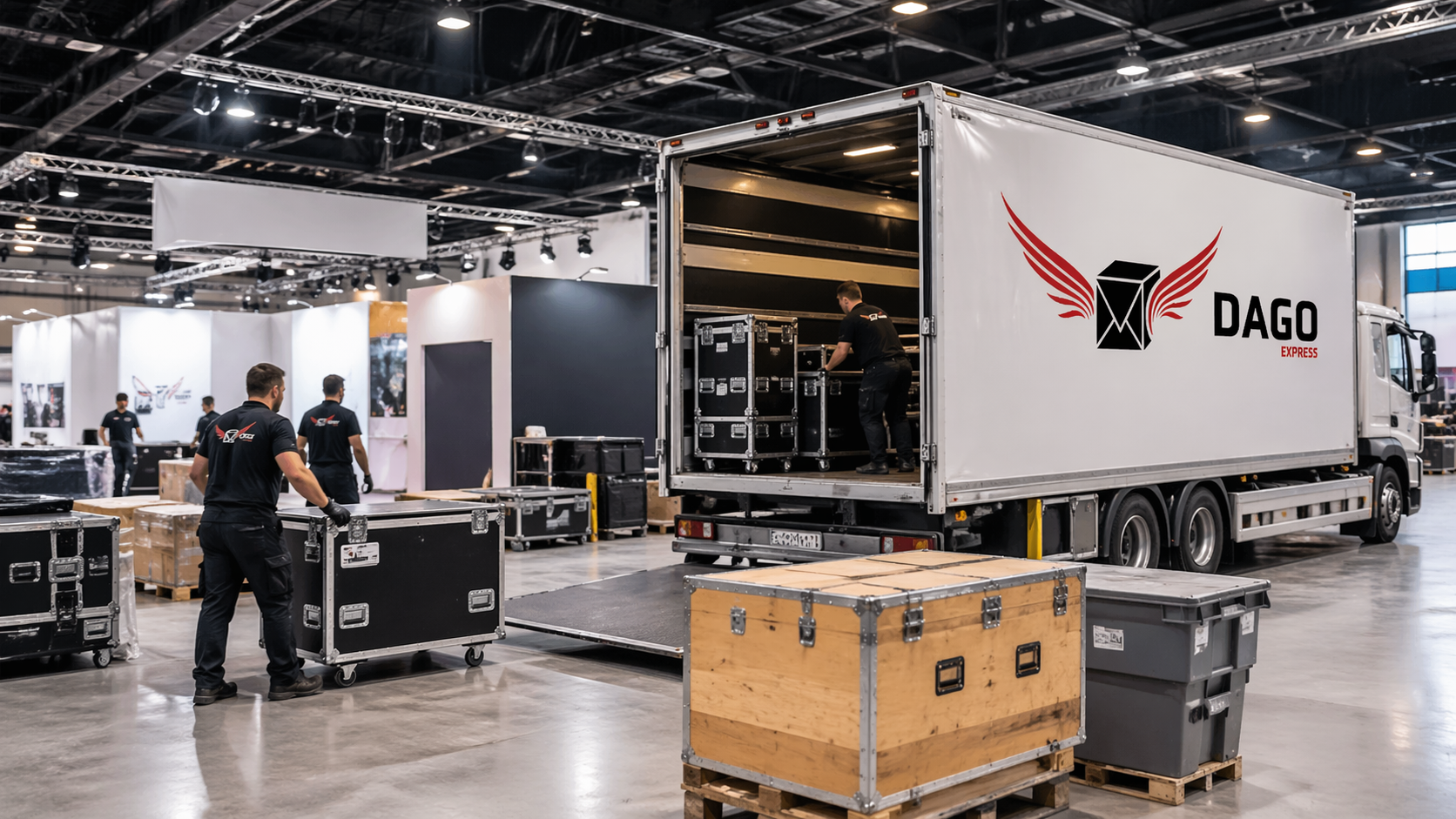
Exhibition Transport Checklist: The Complete Guide to Exhibition Logistics
A successful trade fair appearance depends heavily on well-organised logistics. If you plan early, coordinate transport properly and prepare every step in a structured way, you avoid expensive mistakes and last-minute stress. From the first planning stage through to dismantling, every detail matters if everything is to run smoothly. Accurate scheduling, clear packing lists and working with experienced exhibition logistics partners are especially important.
This guide shows you how to structure your exhibition logistics properly and avoid the most common problems.
Quick Check: Exhibition Logistics at a Glance
Efficient exhibition logistics can save up to 30% in unplanned costs. Keep an eye on these five key points:
Deadline check: Book loading and unloading time slots at least four weeks in advance.
Special handling: Use courier services with experience in exhibition deliveries and on-site coordination with the official exhibition freight forwarder.
Document set: Keep delivery notes, stand plans and, for non-EU countries, the ATA Carnet ready both digitally and in printed form.
Insurance: Check whether your transport insurance also covers the stand period and the return transport.
Top-up logistics: Plan a same-day service for emergency supplies, brochures, giveaways or missing display material.
What Matters Most in Exhibition Logistics?
The most important foundation is early planning with clear time windows, detailed packing lists, professional packaging, correct paperwork and a reliable transport provider. This is the only way to avoid delays, damage and organisational headaches.
Preparation and Strategic Planning for Exhibition Logistics
The planning phase should ideally begin several months before the trade fair. This is when the groundwork for every later step is laid. First, choose a transport company that specialises in exhibition logistics. These providers understand the complex requirements of exhibition centres and event venues.
Next, check all organiser deadlines carefully. These include build-up times, delivery windows and dismantling periods. At the same time, you should prepare all necessary documents.
For international exhibitions, customs paperwork plays a central role. One commonly used document is the ATA Carnet. You should also arrange suitable transport insurance. This protects sensitive exhibits against damage or loss. Structured planning saves time later and significantly reduces risk.
Packaging and Structured Logistics Processes
The right packaging is crucial for getting your exhibition goods to the venue safely. Start by creating a detailed packing list. This should list every item clearly and make checking much easier.
The next step is choosing suitable packaging materials. Particularly delicate exhibits need specialist crates. These protect against knocks, moisture and rough handling. Correct labelling is just as important.
Professional Packaging: So There’s No Chaos at the Stand
Packaging is about more than protection. Use a smart colour-coding system for your crates:
Shock indicators: Use shock indicators on sensitive exhibits, such as machinery or glass items. This makes damage documentation much easier when goods are received by the exhibition freight forwarder.
Coloured labels: Mark boxes for “start of build-up” items such as tools and cables in green, “exhibits” in blue and “marketing” in yellow.
Contents list on the outside: Attach a laminated contents list to each crate. That way, helpers know immediately where the brochures are without opening everything.
Packaging & Logistics Overview
Area
Measure
Packing list
Complete list of all contents
Packaging
Specialist crates for sensitive exhibits
Labelling
State company name, hall and stand number
Palletising
Secure and strap goods in line with recognised standards
Coordinating Transport and Delivery Properly
The transport phase is time-sensitive and needs precise planning. Many exhibitions work with fixed delivery time windows. These slots must be booked early. Without a reservation, delays are very likely.
You should also organise the build-up team in good time. This includes staff, tools and any machinery needed on site. The team’s own travel and transport must also be planned.
Time Slot Management: Punctuality as a Success Factor
Modern exhibition centres, such as Frankfurt, Berlin or Hanover, often manage access via digital booking systems.
Courier advantage: For time-critical individual parts, such as last-minute exhibits, use a direct courier who can deliver straight to the loading bay or even to the stand, provided the access rules allow it.
Avoiding waiting times: Without a booked time slot, drivers may face hours of waiting in external holding areas. This can throw delivery schedules off completely and cause problems with drivers’ working time rules.
Pre-advice to the exhibition freight forwarder: Make sure your logistics partner informs the official exhibition freight forwarder in advance.
Managing Empty Packaging and Exhibition Operations Efficiently
Empty Packaging Logistics: Cutting Hidden Costs
For fire safety reasons, packaging material often cannot be stored at the stand.
Alternative: Folding boxes or collapsible transport crates can often be stored behind stand walls, which may save expensive storage fees.
Advance registration: Register empty packaging, such as pallets and crates, with the official exhibition service provider. Collection usually takes place directly after build-up has finished.
Labelling: Use “empty” labels. Only clearly marked empty packaging will be collected and prioritised for return after the exhibition.
Planning Dismantling and Return Transport Professionally
Once the exhibition ends, return logistics begin. This stage is often underestimated, but it is just as important as the build-up phase.
First, organise the dismantling team. Then make sure all exhibits are packed safely again. The packing list comes back into play here. It helps ensure that every part is accounted for. All return transport documents must also be ready.
For international exhibitions, customs documents are especially important. A structured process prevents delays. It also helps avoid damage. Anyone who plans dismantling early saves time, money and stress.
Dismantling & Return Transport Overview
Area
Measure
Dismantling team
Plan and coordinate early
Packaging
Safe and complete repacking
Documents
Prepare return transport and customs paperwork
Transport
Organise efficient return delivery
Customs Documentation and the ATA Carnet
When exhibits are transported across EU borders, bureaucracy is often the biggest hurdle. Add the ATA Carnet to your exhibition transport checklist. This international customs document allows temporary duty-free import of goods.
It saves time and avoids the need to lodge cash deposits or security payments at borders. Also make sure that all pro forma invoices and packing lists are completed accurately. This helps prevent expensive waiting times at customs.
Insurance Cover: More Than Standard Liability
Standard freight forwarder liability often covers only a fraction of the real value of high-quality exhibits. That is why specialist transport insurance is essential for a complete exhibition transport checklist.
Ideally, this insurance should not only cover the journey itself, but also the time during the exhibition, including the period when goods are on the stand, as well as the return transport.
Check carefully whether “nail-to-nail” cover is included. This ensures your equipment is protected from the moment it leaves your warehouse until it returns, including against damage and theft.
The Underrated Success Factor: Invisible Logistics Processes
One crucial but often overlooked aspect is the invisible logistics happening behind the scenes. This includes internal communication channels, emergency plans and digital tracking systems.
Modern companies now use real-time tracking to monitor shipments. This reduces uncertainty and makes it easier to react quickly. Backup plans are also essential.
What happens if there is a delay or damage? If you are prepared, you have a clear advantage. Coordination between marketing, logistics and sales also plays a major role. Only when all departments work together does the exhibition appearance feel joined up and professional.
These invisible processes often decide whether a trade fair appearance runs smoothly or turns into a stressful mess.
Conclusion
Successful exhibition logistics require precise planning, clear processes and professional partners. Those who organise everything early reduce risks and improve efficiency.
Structured processes for transport, packaging and documentation are especially important. Even small details, such as empty packaging management or time slot bookings, can make a big difference.
With the right strategy, your trade fair appearance becomes not only less stressful, but also far more successful.
FAQ
When should I start planning exhibition transport?
Ideally, planning should begin three to six months before the exhibition date. This gives you a much better chance of securing transport capacity and unloading slots at the venue.
What is an ATA Carnet and do I need one?
An ATA Carnet is an international customs document for the temporary import of goods into non-EU countries. You need it if you want to move exhibits across international borders without paying import duties.
Is normal freight forwarder liability enough for my exhibits?
Legal freight forwarder liability is often limited to a maximum amount per kilogram and usually does not cover the full value of expensive equipment. Additional exhibition insurance is therefore strongly recommended for valuable goods.
What does “nail-to-nail” insurance cover mean?
This type of cover protects your equipment for the entire period from packing at your own warehouse through to unpacking after return transport. It can also include installation time and the period when goods are displayed at the stand.
What is the best way to pack sensitive exhibition equipment?
Use sturdy flight cases or custom-built wooden crates with sufficient padding. Make sure the packaging is suitable for forklift handling and can be stacked safely.
What should be included on an exhibition transport packing list?
The list should include every single item, including quantity, weight, dimensions and goods value. For international shipments, the customs tariff number, also known as the HS code, must also be included.
Who coordinates unloading at the exhibition centre?
This is usually handled by the official exhibition freight forwarder for the venue. They are responsible for forklifts, lifting equipment and on-site handling. Your logistics partner should coordinate with them in advance and book the required time slots.
Can I handle exhibition transport myself?
Technically, yes. In practice, private individuals or inexperienced companies often lack the access permits and unloading equipment needed on site. Professionals usually save time, stress and unnecessary hassle through established venue contacts.
What happens if something is damaged during transport?
Damage must be noted immediately on the consignment note when the goods are received and should be documented with photos. Inform your insurer and the freight forwarder in writing straight away.
Courier Service > Blog > Exhibition Transport Checklist: The Complete Guide to Exhibition Logistics
 Dansk
Dansk
 Deutsch
 Eesti
Eesti
 English (GB)
 Español
 Français
 Hrvatski
 Italiano
 Latviešu valoda
 Lietuviškai
 Magyar
 Nederlands
 Norsk Bokmål
 Polski
 Português
 Română
 Slovenčina
 Slovenščina
 Suomi
Suomi
 Svenska
 Čeština
 Ελληνικά
 Русский
 Українська
 български
 العربية
 中文 (中国)
 English