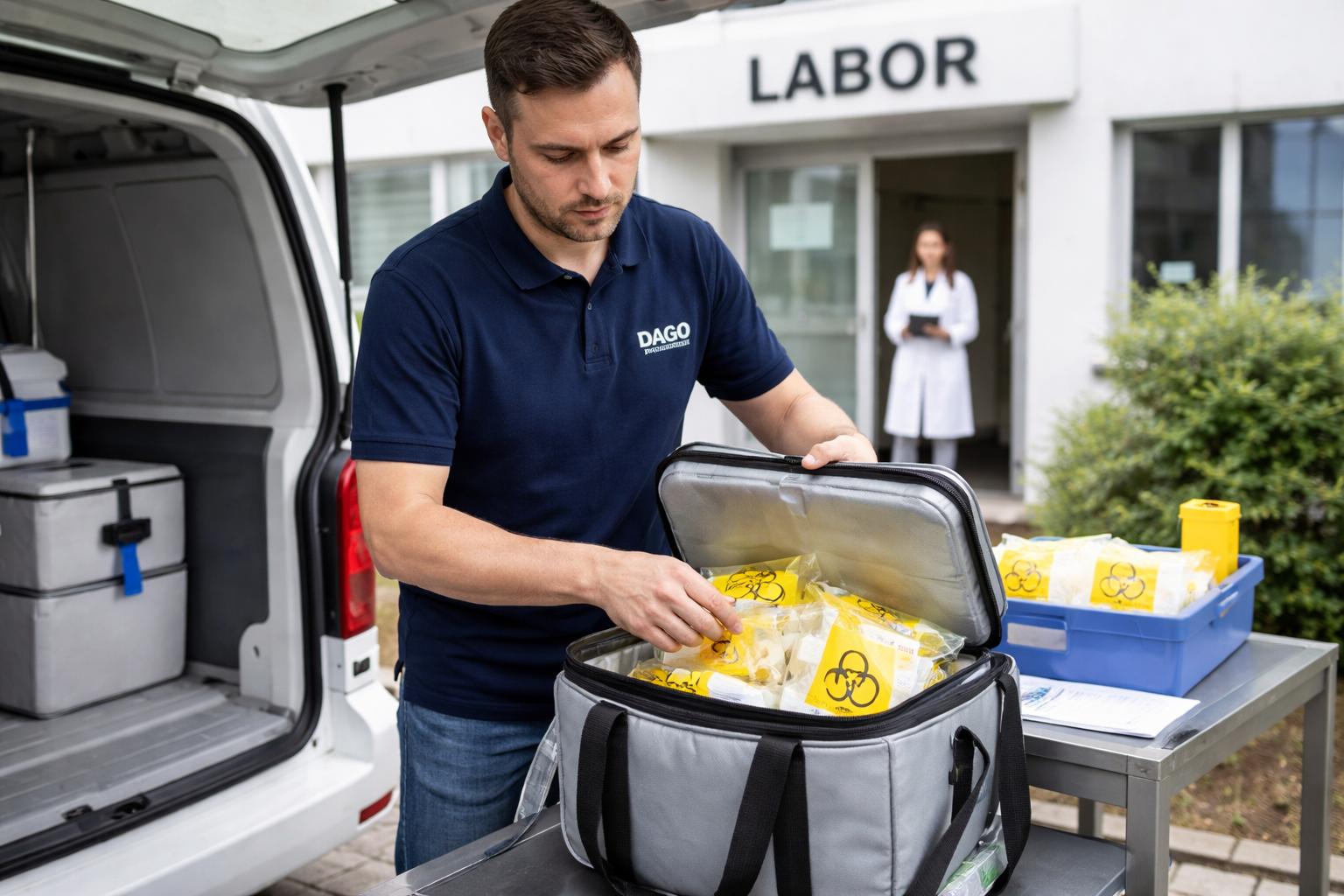
Medical couriers perform one of the most important yet often invisible roles in healthcare. In the video, Damian from DAGO Express accompanies a real transport assignment and provides authentic insights into daily operations. It becomes clear what types of shipments are transported, how precisely processes are organized, and what level of responsibility is involved. Because behind every trip lies more than logistics – it’s about diagnoses, therapies, and often people’s health.
Key Takeaways
Medical couriers mainly transport laboratory samples and urgent medications
Shipments are small but highly medically relevant
Laboratory transports follow strictly defined procedures without opening shipments
Packaging and safety are fully handled before handover
Time is critical, as diagnoses and treatments depend on it
What Do Medical Couriers Transport and Why Is It So Important?
Medical couriers primarily transport laboratory samples and urgently needed medications. These shipments are essential because they form the basis for diagnoses and treatments and often must be delivered under significant time pressure.
What Types of Shipments Do Medical Couriers Handle?
In medical courier services, there are two main types of transport. Damian explains that laboratory samples and urgent medications dominate daily operations. Laboratory samples include blood, urine (e.g., for abstinence testing), swabs, and sometimes tissue samples. These are collected directly at medical practices and then professionally packaged. Each sample is assigned a barcode for clear identification, ensuring there is no mix-up. Additionally, the samples are placed in special shipping bags.
Urgent medications form the second key category. These are required when pharmacies or practices are not sufficiently supplied at short notice. In such cases, fast direct delivery is crucial. Traditional parcel services are too slow for this purpose. Both shipment types share that they are usually small and lightweight, yet extremely important. They can determine diagnoses and therapies.
Table: Types of Medical Courier Shipments
Shipment Type
Content
Special Feature
Laboratory Samples
Blood, urine, swabs, tissue
Basis for diagnoses
Urgent Medications
Medications for pharmacies/practices
Time-critical direct delivery
How a Typical Laboratory Transport Works
The process of a medical transport is clearly structured. Damian demonstrates this using a real example. First, the courier receives an order, which includes picking up a sample from a general practitioner’s office. Upon arrival, the courier is handed a fully packaged shipping bag. It is important that the courier does not open or inspect it. Responsibility for the contents lies entirely with the practice.
The handover is then documented, either digitally or via signature. After that, the courier drives directly to the laboratory. Time delays must be avoided. At the laboratory, the shipment is handed over to sample reception. There, the barcode is scanned, the receipt is confirmed, and the job is completed.
The entire trip often takes only 40 to 50 minutes. Nevertheless, it can be decisive. Without the sample, there is no analysis. Without analysis, there is no diagnosis.
Safety, Packaging, and Legal Regulations
Many people wonder whether medical transports are dangerous. Damian provides a clear answer: safety is ensured through strict regulations. Laboratory samples fall into the category “biological substances category B” and must be secured according to packaging instruction P650.
The packaging consists of multiple layers. First, there is the actual sample container. This is surrounded by absorbent material. Then follows a leak-proof inner packaging. Finally, a sturdy outer packaging protects the contents. Even in the event of an accident, nothing can leak.
For temperature-sensitive shipments, cooling packs are used. These maintain a constant temperature between 2 and 8 degrees Celsius, which is crucial for sample quality. Importantly, all these measures are completed before pickup. The courier only transports the finished package. This ensures safety and standardization.
Why Time Is Critical in Medical Transport
Time is the most important factor in medical courier services. Damian emphasizes that about 70 percent of all diagnoses are based on laboratory values. This means: without a sample, no diagnosis. Without a diagnosis, no treatment. Every minute counts.
If a sample arrives late at the laboratory, the entire process is delayed. This can have direct consequences for patients. It becomes particularly critical in acute conditions, where speed is essential.
The same applies to medications. Behind every delivery is usually a patient who often needs the medication on the same day. That is why these transports are carried out as direct deliveries. Traditional shipping solutions are not suitable here. Speed is not just an advantage – it is a medical necessity.
Requirements for Medical Couriers
Many people assume that medical couriers need specialized medical knowledge. However, this is not the case. Damian explains that neither a medical degree nor hazardous materials training is required. This is due to the professional preparation of the shipments.
More important are practical requirements. A clean vehicle is essential. The cargo area must be dry and must not overheat. This ensures stable transport conditions.
Punctuality is also crucial. Delays can have serious consequences. Equally important is careful handling during handover. The courier must ensure that every shipment reaches the correct recipient. Errors are not acceptable.
Damian makes it clear that this is not a simple side job. The level of responsibility is high. Every shipment can impact a human life.
Responsibility and Importance in Everyday Courier Work
The profession of a medical courier is often underestimated. However, the video clearly shows how important this work is. Couriers are a central part of the medical supply chain. Without them, much would not function.
The responsibility does not lie in the weight of the shipment, but in its significance. A small sample can determine a diagnosis. A medication can relieve pain or save a life.
Damian demonstrates that every transport has a direct connection to a patient. This perspective changes how the job is perceived. It is not just about logistics. It is about trust, precision, and reliability.
At the end, he provides a preview of further insights in the series “DAGO Express In Motion” and invites interested individuals to apply. He also answers questions personally, showing how approachable and transparent the profession is.
Conclusion
Medical couriers are an indispensable part of the healthcare system. They connect practices, laboratories, and pharmacies in real time. Every trip can be decisive. Those who perform this job carry responsibility for human lives. That is exactly what makes it so special. DAGO Express demonstrates impressively how professional and important this field is – and why it is far more than just transport.
 Dansk
Dansk
 Deutsch
 Eesti
Eesti
 Español
 Français
 Hrvatski
 Italiano
 Latviešu valoda
 Lietuviškai
 Magyar
 Nederlands
 Norsk Bokmål
 Polski
 Português
 Română
 Slovenčina
 Slovenščina
 Suomi
Suomi
 Svenska
 Čeština
 Ελληνικά
 Русский
 Українська
 български
 العربية
 中文 (中国)
 English