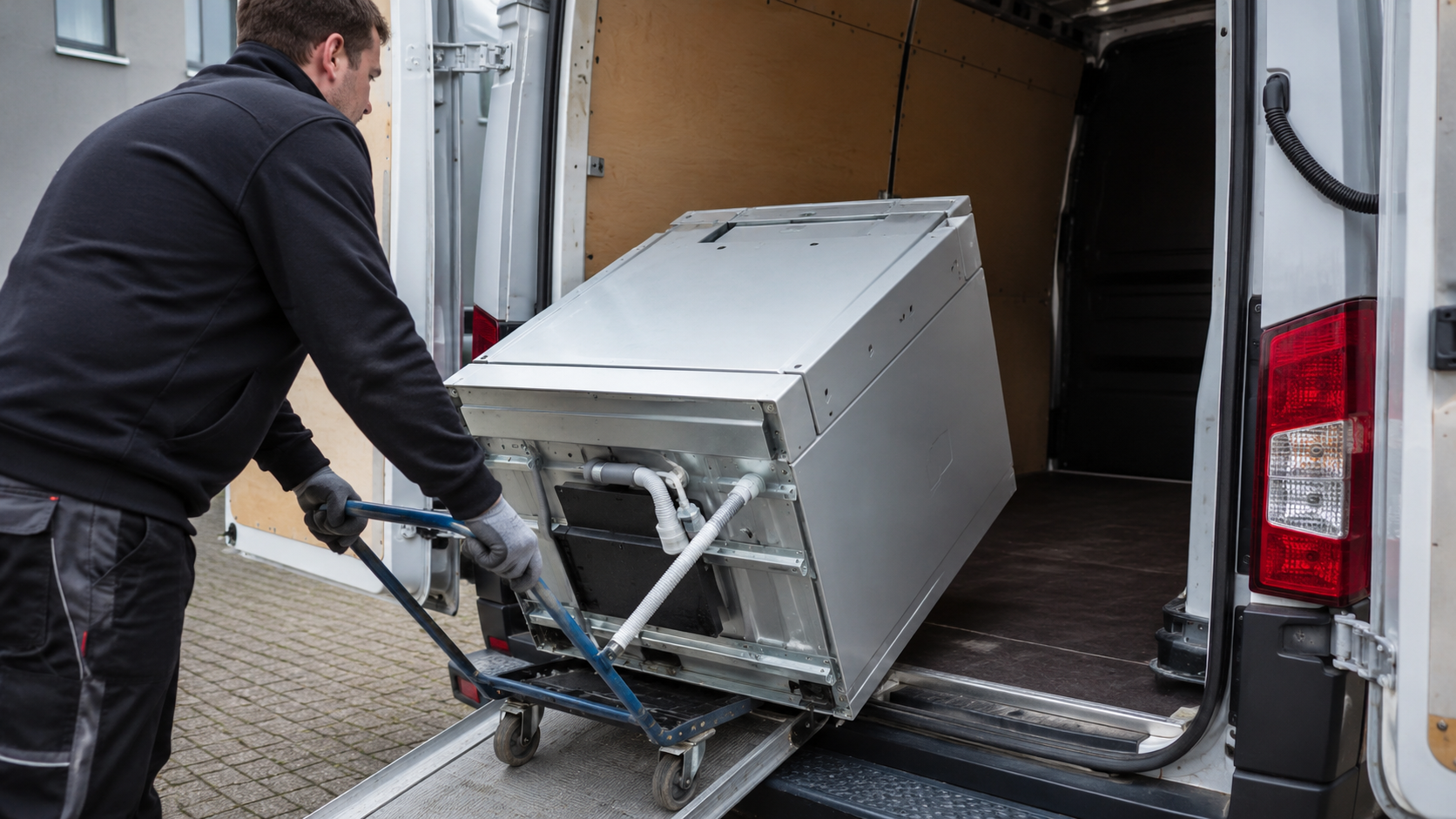
A dishwasher should be transported upright whenever possible. Moving a used appliance on its side can be risky because water, brine and moisture often remain inside. When tilted, these liquids can reach areas not designed to get wet and damage electronics, pumps or insulation. If space makes horizontal transport unavoidable, follow the manufacturer’s instructions, drain and secure the appliance completely, and use only the permitted side.
The key facts at a glance
- The safest position for a used dishwasher is upright.
- Residual water and dishwasher salt can damage electronics when the appliance lies flat.
- New appliances in their original packaging can often be transported horizontally.
- The manufacturer’s operating and transport instructions always take priority.
- If the appliance must lie down, keep the rear on a padded surface and the front facing up.
Can a dishwasher be transported on its side?
Yes, under certain conditions, but upright transport is safer. Drain used appliances and remove brine first. Only place the machine horizontally if the manufacturer permits that transport position.
When may a dishwasher be transported horizontally?
A new appliance is usually protected by its original packaging, which secures the door, hoses, baskets and sensitive components. Many new dishwashers may therefore travel horizontally, but check the package for arrows and transport symbols. An explicit manufacturer requirement for upright transport overrides general advice and ignoring it can cause damage and complicate later claims.
A used dishwasher is different. Water almost always remains in the pump sump, hoses and water-softening unit. Tilting can send it across cables, contacts and electronic modules. Used appliances should therefore normally remain upright. Horizontal transport is only an emergency option when the vehicle offers no alternative and the manual does not prohibit it.
| Dishwasher condition | Recommended position | Risk |
|---|
| New, original packaging | As specified by manufacturer | Usually low |
| New, no original packaging | Preferably upright | Medium |
| Used and drained | Preferably upright | Medium |
| Used with residual water | Upright only recommended | High |
| Unknown condition | Transport upright | High |
Why residual water is dangerous during horizontal transport
Residual water collects in the pump sump, drain hose, inlet system and softener. The softener also contains regenerating salt. Tilting allows this liquid to escape into the housing, where electrical wiring, contacts and controls are located.
Salty water is particularly critical because it accelerates corrosion on metal and electrical contacts. Damage may appear only later as error messages, short circuits or pump faults. Damp insulation can also create odours. Drain the machine as thoroughly as possible and leave the door open to dry.
Water can also enter the base tray and trigger the float switch used by many leak-protection systems. The machine may then run only the drain pump and appear defective. Do not open electronics or side panels without expertise; use a qualified technician.
How to prepare the dishwasher for transport
Disconnect the power, close the water tap and carefully remove inlet and drain hoses. Place a shallow container or absorbent cloth underneath because significant water may escape. Check filters, spray arms and pump sump, remove visible water with a sponge or cup and leave the door open for several hours.
Remove or secure cutlery baskets, holders and other loose inserts. Remove the racks or fix them with cable ties, prevent spray arms from moving and secure the closed door with straps or transport tape. Do not place adhesive tape directly on sensitive painted, film-coated or stainless-steel fronts.
Attach hoses in wide loops at the rear without kinking or crushing them. Protect the AquaStop unit so it cannot hang from the hose or strike the housing. Wrap the appliance in blankets or bubble wrap, but do not seal a still-damp underside airtight. For professional assistance, the DAGO Express direct courier service can provide a suitable transport solution.
Which side may the dishwasher lie on?
Never place the front face down: the door, control panel, hinges and handles are not designed to support the appliance’s weight. Usually the machine is carefully tilted backwards so its rear rests on several padded moving blankets and its front faces upward.
The rear is not automatically approved for every model. Pumps, electronics and water diverters are positioned differently by each manufacturer. Check the manual or contact customer service, especially for premium built-in appliances or models with complex zeolite drying. If no reliable instruction exists, keep it upright.
During the journey, secure the appliance against a stable wall or loading surface with straps that do not cross sensitive controls. Never stack heavy furniture or boxes on it. Pressure can deform the side panels and later prevent the door from sealing correctly.
What damage can horizontal transport cause?
Moisture can reach plugs, sensors or the control board, causing short circuits, corrosion and unclear error messages. Mechanical damage is also possible because hoses, plastic mounts and pump housings are pressure-sensitive.
Placing the appliance on its front can bend the door, damage hinges, lock and seal, or scratch an attached furniture panel. Remove a fitted kitchen front when the manufacturer permits. Crushed inlet hoses may leak, a damaged AquaStop must not be reused and a kinked drain hose can cause backflow or incomplete drainage.
What matters after transport and before connection?
Stand the dishwasher upright for several hours in a warm, ventilated room, especially after horizontal transport. Unlike a refrigerator, the wait is not about refrigerant or compressor oil; it allows moisture to run down or evaporate. Leave the door slightly open and wait longer if moisture is visible.
Inspect the power cable, hoses, connections, rear and base for cracks, crushing, kinks or water. Position the appliance level and stable before connecting inlet and drain. Tighten fittings securely but not excessively.
Run the first test without dishes using a short or manufacturer-recommended programme. Watch all connections during filling and draining. If water, unusual pump noises or errors appear, switch off, disconnect the power and ask a technician to inspect the appliance.
Manufacturer instructions, warranty and documentation
The manual is the primary source for draining, securing and approved transport positions. Packaging arrows and warning symbols also matter. Construction differs between models, so general advice cannot replace model-specific instructions.
Incorrect transport does not automatically void every claim, but obvious transport damage can make a free repair unlikely. Photograph the appliance, packaging and securing before and after the journey and report visible damage immediately.
Check whether a mover’s or transport insurance covers self-packed household appliances. Provide correct weight and dimensions and agree on horizontal transport in advance. Secure the load properly during a self-organised trip to protect both the dishwasher and everyone in the vehicle. Enter the shipment details on the DAGO Express UK page for an individual quote.
Conclusion: upright remains the safest choice
A dishwasher can be moved horizontally in an emergency, but upright remains much safer. Used appliances almost always contain water and brine that can reach sensitive components. If it must lie down, keep the rear padded underneath and the front up, secure hoses, door and baskets, follow the manual and monitor the first test run carefully.
 Dansk
Dansk
 Deutsch
 Eesti
Eesti
 English (GB)
 Español
 Français
 Hrvatski
 Italiano
 Latviešu valoda
 Lietuviškai
 Magyar
 Nederlands
 Norsk Bokmål
 Polski
 Português
 Română
 Slovenčina
 Slovenščina
 Suomi
Suomi
 Svenska
 Čeština
 Ελληνικά
 Русский
 Українська
 български
 العربية
 中文 (中国)
 English