Shipping a lawn mower may seem complicated at first glance. It is bulky, heavy and contains operating fluids that are classified as hazardous materials. However, with the right preparation and a suitable transport provider, the process is straightforward, safe and affordable. This guide walks you through every step – from draining the fuel tank correctly to booking the most cost-effective freight company. Whether you sold a mower online, are moving house or sending it to family or friends, this guide helps you save time, money and unnecessary stress.
Lawn Mower Shipping: The Essentials in 60 Seconds
In a hurry? These are the four key steps for shipping a lawn mower successfully. To transport a lawn mower safely, you must first remove all petrol and oil completely, as these are considered hazardous materials and shipping is otherwise prohibited. Next, clean the machine thoroughly and secure all loose parts. The safest shipping method is usually to strap the mower securely onto a pallet. In most cases, transport is carried out by a freight company, as parcel services such as DHL or Hermes often refuse lawn mowers due to their size, weight and traces of fuel residue. Compare freight prices online to find the best deal.
Preparation: Completely remove petrol and oil. This is a legal requirement and non-negotiable.
Packaging: Secure the mower onto a pallet using ratchet straps. This is the safest and most common solution.
Choosing a provider: Use a freight forwarding company. Standard parcel couriers are rarely suitable.
Booking: Enter the exact dimensions and weight of the packaged mower to avoid additional charges.
Step 1: Preparing the Lawn Mower for Shipping (Safety First)
The most important and unavoidable step is removing all operating fluids. A lawn mower containing petrol or oil – even small residues – is classified as hazardous cargo. Shipping such equipment is legally prohibited and will be rejected by any reputable transport company. This is not only about regulations but also about ensuring the safety of everyone involved in the transport process and protecting other cargo.
Shipping a lawn mower with petrol or oil still inside the tank is not only a breach of the carrier’s terms and conditions, but can also result in substantial fines and loss of insurance cover in the event of damage. Do not take any risks here.
How to Drain Petrol and Oil Correctly
Take enough time for this step. Careful preparation is essential for smooth transport.
Remove the Fuel
Run the lawn mower until the fuel tank is empty. Alternatively, use a simple fuel pump to siphon the petrol into an approved fuel container. Afterwards, briefly restart the engine so that any remaining fuel in the carburettor and fuel lines is used up until the engine switches off by itself.
Drain the Engine Oil
Run the engine for one or two minutes so the oil becomes thinner and drains more easily. Place an oil collection tray underneath the drain plug, usually located beneath the engine. Open the plug and allow all oil to drain out completely. Tilt the mower slightly if necessary to ensure all oil is removed. Tighten the drain plug securely afterwards.
Dispose of Fluids Properly
Dispose of used engine oil and any leftover petrol responsibly at a local recycling centre or hazardous waste collection point.
Thoroughly Clean the Lawn Mower
A clean lawn mower is easier to package and is often a requirement for freight companies. Remove dirt, soil and grass clippings from the housing, wheels and cutting deck. This prevents debris from spreading during transport.
Secure or Remove Loose Parts
Anything that could move or fall off during transport must be secured. Fold down the handlebar and fasten it if possible. The grass collection box should either be firmly attached to the mower using cable ties or tape, or packed separately in a cardboard box alongside the shipment.
Step 2: Proper Packaging – Protection Against Transport Damage
Strong and transport-safe packaging is essential to ensure your lawn mower arrives undamaged. In most situations, shipping on a pallet is the safest and most practical method.
Option 1: Shipping on a Pallet (The Professional Solution)
For around 95% of petrol lawn mowers, pallet shipping is the only sensible option. It offers stability and allows the freight company to move the shipment safely using pallet trucks.
How to Prepare the Pallet Shipment
Obtain a Suitable Pallet
A one-way pallet or standard Euro pallet in an appropriate size, such as 80 x 120 cm, works perfectly. These are often available at low cost from DIY stores or local businesses.
Position the Lawn Mower
Place the prepared mower centrally on the pallet. Apply the wheel brake if the mower has one.
Secure with Ratchet Straps
Fasten the mower firmly to the pallet using at least two or three strong ratchet straps. Run the straps over the engine block or frame rather than fragile plastic components. The wheels should remain firmly in place and unable to move.
Wrap with Protective Film
Wrap the mower and pallet generously with stretch film. This protects against scratches, dirt and moisture.
Option 2: Shipping in a Strong Cardboard Box (Only for Small Models)
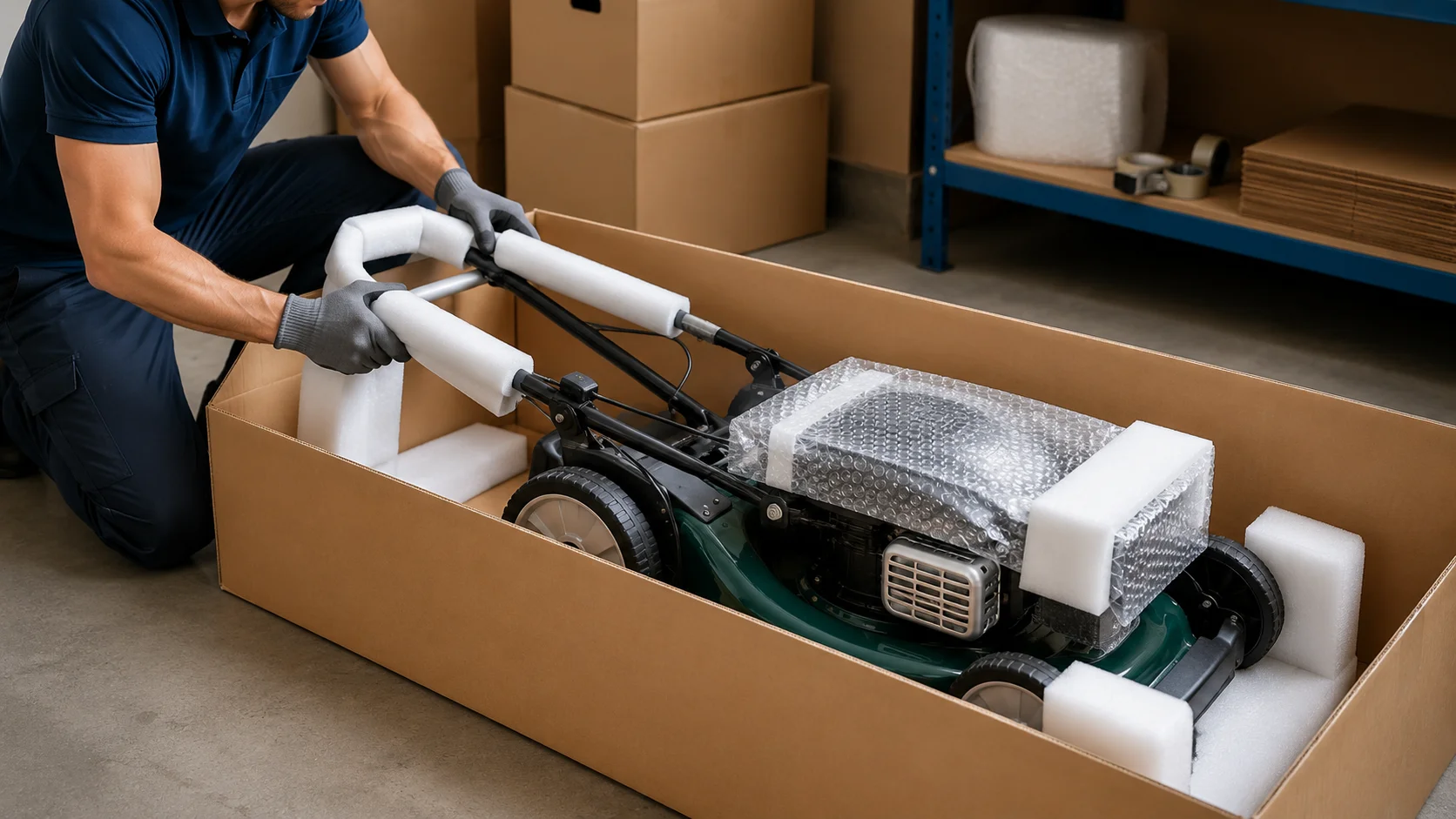
This option is suitable only for very small and lightweight electric or battery-powered lawn mowers. Use a heavy-duty double-walled cardboard box and fill all empty spaces with bubble wrap or polystyrene padding to prevent movement inside the package. In practice, this method is less secure and more prone to transport damage than pallet shipping.
Step 3: Compare Providers and Costs – Freight Company vs Parcel Courier
Choosing the correct transport provider is crucial. In most cases, shipping a lawn mower without a freight company is impractical.
Why Parcel Couriers Are Usually Unsuitable
Although sending a lawn mower as a parcel may sound convenient, several obstacles usually prevent it:
Size Restrictions
Most lawn mowers exceed the maximum parcel dimensions accepted by standard couriers.
Weight Limits
Many parcel services impose a maximum weight of around 31.5 kg. Petrol lawn mowers are often considerably heavier.
Hazardous Goods Exclusions
The terms and conditions of major parcel services generally exclude items that contain or previously contained petrol or oil. Even an emptied fuel tank can create complications.
When a Freight Company Is the Right Choice
Freight forwarding companies specialise in transporting large, heavy and bulky items. For lawn mower shipping, they are usually the safest and most reliable option. Collection is commonly carried out directly from your address using a lorry equipped with a tail lift. The shipment is professionally secured and insured.
Shipping Cost Examples: What Does Lawn Mower Transport Cost?
The cost of freight shipping within the UK depends on distance, dimensions and weight. The following table provides a realistic estimate:
Lawn Mower Type
Typical Packaged Weight
Estimated Shipping Costs
Small electric or battery mower
up to 30 kg
approx. £60 – £90
Standard petrol lawn mower
30 – 50 kg
approx. £80 – £140
Large ride-on mower
over 100 kg
from £180
Step 4: Creating and Booking the Shipment Correctly
Accurate information is essential when booking transport. Incorrect measurements and weight details are among the most common causes of unexpected additional charges.
Measure Dimensions and Weight Precisely
Measure and weigh the mower only after it has been fully packaged and secured on the pallet. Enter the exact external dimensions (length × width × height) and the total weight including the pallet and packaging materials. Freight companies verify these details and often apply additional charges if the information is inaccurate.
Check Collection and Delivery Addresses
Ensure all addresses are correct and that somebody is available on the collection day to hand over the shipment. Freight companies usually provide a collection window of several hours. The packaged mower should be easily accessible at ground level so the driver can move it safely with a pallet truck.
Insurance Cover: Is My Lawn Mower Insured?
Yes. Freight transport usually includes basic liability insurance by law. However, this compensation is often limited to a certain amount per kilogram and may not cover the full value of expensive equipment. Check the value of your lawn mower and consider additional transport insurance if necessary. This is generally inexpensive and provides full cover in case of damage.
Checklist: Shipping a Lawn Mower in 7 Steps
Here is the complete process summarised in a simple checklist:
Drain operating fluids completely: remove all petrol and engine oil.
Clean the mower thoroughly: remove dirt and grass residue.
Secure loose parts: fold down the handle and secure the grass box.
Package safely: place the mower centrally on a pallet.
Strap down securely: use at least two ratchet straps.
Book a freight company: compare online quotes and enter exact dimensions and weight.
Prepare for collection: place the packaged mower at ground level on the agreed date.
Special Cases: Shipping Ride-On Mowers and Robotic Lawn Mowers
While the process is similar for standard lawn mowers, special equipment types require additional considerations.
Shipping Ride-On Lawn Mowers and Garden Tractors
Due to their size and weight, ride-on lawn mowers can only realistically be transported by freight company. Preparation remains the same: drain all fluids and clean the machine thoroughly. The mower must be secured on a sufficiently large and stable pallet. When booking, confirm whether additional loading requirements such as ramps are needed. Costs are naturally higher and usually start from around £180.
Shipping Robotic Lawn Mowers
Robotic lawn mowers are much easier to ship. Ideally, use the original manufacturer packaging. The most important consideration is the battery. Lithium-ion batteries are subject to special transport regulations. As long as the battery remains installed inside the device, shipping as a parcel or bulky item is generally permitted by most providers. However, always check the carrier’s specific battery transport policies in advance.
Conclusion: Lawn Mower Shipping Made Simple
Shipping a lawn mower is not as complicated as it first appears when you follow the correct steps. The most important factors are completely removing petrol and oil and packaging the mower securely on a pallet. By choosing a professional freight company and providing accurate shipping details, you can ensure safe, smooth and cost-effective transport. Investing time in proper preparation is always worthwhile.
Courier Service > Blog > Lawn Mower Shipping: Guide, Costs & Freight Forwarding
 Dansk
Dansk
 Deutsch
 Eesti
Eesti
 English (GB)
 Español
 Français
 Hrvatski
 Italiano
 Latviešu valoda
 Lietuviškai
 Magyar
 Nederlands
 Norsk Bokmål
 Polski
 Português
 Română
 Slovenčina
 Slovenščina
 Suomi
Suomi
 Svenska
 Čeština
 Ελληνικά
 Русский
 Українська
 български
 العربية
 中文 (中国)
 English