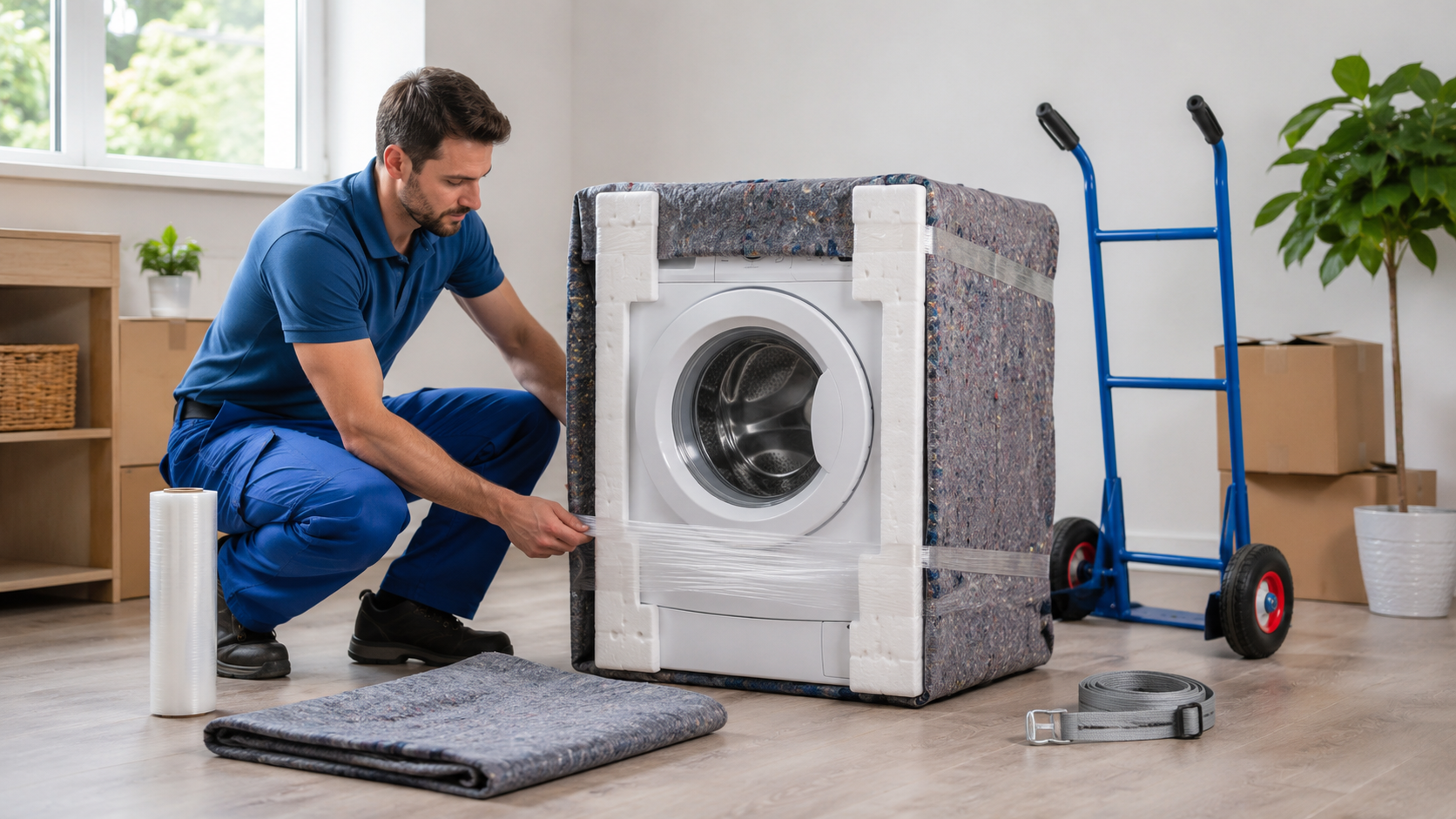
Are you moving house, or have you just bagged a bargain on a second-hand washing machine online? Congratulations! Now you're facing the most critical part: transporting it. It's completely normal to worry about damaging your expensive appliance with one small mistake. A poorly moved washing machine can quickly become a complete write-off.
But don't worry. This guide is your field-tested roadmap for a safe and stress-free move. We'll not only walk you through the seven essential steps but also show you how to avoid the most common and costly errors – even if you don't have the original transit bolts.
The key steps at a glance: To transport a washing machine safely, disconnect it from the power and water supply and drain all residual water. Secure the drum with the original transit bolts – this is the crucial step. Ideally, transport the appliance upright on a sack truck and secure it in the vehicle with ratchet straps. Let the machine rest at its new location for several hours before removing the bolts and connecting it again.
Calculate your online price in just 1 minute and book shipping now <<
Preparation: what you'll need before the move
Good preparation is half the battle and the best way to avoid stress and damage. Before you even touch a spanner, make sure you have everything you need close at hand. This will save you from frantically searching for things while your helpers are waiting.
Tool and material checklist
- Original transit bolts: The long screws or bolts that came with the appliance. If you don't have them, read the section "What to do without transit bolts".
- Spanner or ratchet set: To fit the transit bolts and the water connection.
- Pipe wrench: In case the water connection is stuck fast.
- Shallow bucket or baking tray: To catch residual water from the filter.
- Old towels or cloths: To wipe up any spills immediately.
- Strong tape (e.g., gaffer tape): To secure hoses and the power cable.
Equipment for a safe move
- Sack truck: Absolutely essential. Choose a model with rubber tyres and a loading plate that is large enough.
- Ratchet straps: At least two, to secure the machine on the sack truck and later in the vehicle.
- Old blankets or dust sheets: To protect the appliance and floors from scratches.
- Lifting straps (optional): Very helpful for carrying the machine up or down stairs.
Organise helpers: never do it alone!
A washing machine weighs between 60 and 90 kilograms. Never attempt to move it by yourself. Arrange for at least one other strong person to help you. This isn't a question of strength, but of safety and control.
Guide: getting your washing machine ready to move in 4 steps
Precision is key here. Each step builds on the last and ensures that your appliance arrives at its destination undamaged. Take the time to carry out each point carefully.
Step 1: Disconnect from the power and water
Safety first. Before you start, unplug the washing machine from the mains. For added safety, switch off the corresponding circuit breaker in your fuse box to eliminate any risk. Then, turn off the tap that the inlet hose is connected to.
Step 2: Completely drain the water
Even after the last wash cycle, there can still be up to a litre of water left in the system. If this leaks out during transport, it can not only ruin your vehicle but also damage the machine's electronics.
- Disconnect the inlet hose: Place a bucket under the tap and unscrew the inlet hose. Let the water from the hose drain into the bucket.
- Empty the drain hose: Unhook the drain hose from the U-bend or standpipe and empty it completely into the bucket as well.
- Open the filter: This is the most important part of draining. Place towels and a shallow container (e.g., a baking tray) under the service flap at the front of the machine. Open the flap and slowly unscrew the filter cap. The remaining water will now drain out. Wait until it stops, then screw the filter cap back on tightly.
Step 3: Secure the hoses and cable
Loose hoses and cables are a tripping hazard and can be torn off during the move. Roll them up neatly and secure them to the back or top of the appliance with strong tape. Be careful not to cover any ventilation slots.
Step 4: Secure the drum with transit bolts
This is the single most important step to prevent catastrophic damage. The washing machine drum is suspended freely inside the machine to absorb vibrations during the spin cycle. During transport, it would swing uncontrollably and hit the casing and electronics.
The transit bolts are usually four long screws with plastic spacers that are screwed into the designated threads on the back of the machine. They fix the drum rigidly to the casing. Remove the small plastic caps, if any, and tighten the bolts firmly. The drum should not be able to move afterwards.
Special case: what to do without transit bolts?
Did you not receive the bolts when you bought the machine, or have you misplaced them? This is a common problem, but there's no need to panic. You have two options, with one being clearly preferable.
Method 1: Get replacements (the safe option)
By far the best solution is to get replacements. Make a note of the exact model number of your washing machine (found on the rating plate) and contact the manufacturer or search online for "transit bolts [Brand + Model]". The investment of £15-£30 is much cheaper than a new washing machine.
Method 2: The emergency solution (only for short journeys lying down)
WARNING: This is a makeshift solution and carries risks. Only use it if there is absolutely no other way and the journey is short.
Open the washing machine door and firmly pack the inside of the drum with old blankets, pillows or bedding. The goal is to wedge the drum so that it can no longer move. Then close the door carefully. This method only works in combination with transporting the machine lying down.
The actual move: upright or lying down?
This question causes the most uncertainty. The answer is clear: transporting it upright is always the best and safest method.
Why transporting it upright is ideal
In an upright position, the shock absorbers and springs that suspend the drum are in their intended position. The load is distributed optimally. When transported lying down, the forces act sideways on these components, which can lead to damage even if the drum is secured.
How to transport it lying down (only in an emergency!)
If transporting it upright is impossible (e.g., in a car), you'll have to lay the machine down. But on which side? The golden rule is: the electronics and the detergent drawer must always face upwards. Therefore, lay the machine on the opposite side. This prevents any residual moisture from seeping into the sensitive circuit boards. To be safe, check the user manual for your specific model.
Lifting correctly and securing it in the vehicle
Tilt the machine slightly and slide the loading plate of the sack truck underneath. Immediately secure the appliance to the sack truck with at least one ratchet strap. When moving it up or down stairs, one person should pull from the top while the other guides and stabilises it from below.
In the vehicle (van, trailer), place the machine upright and directly against a wall. Secure it with at least two ratchet straps so it can neither tip over nor slide around. Place blankets underneath and between the machine and the vehicle wall to prevent scratches.
After the move: commissioning it correctly
You've made it! The washing machine is in its new home. But before you run the first wash, there are a few more important steps to take.
Step 5: Wait – how long does the machine need to stand?
Give the appliance time to acclimatise. After being transported upright, 2-4 hours is sufficient. If the machine was transported lying down, you should wait 12-24 hours to be on the safe side. This allows any oil that may have shifted from the shock absorbers to settle back into place.
Step 6: Remove the transit bolts!
EXTREMELY IMPORTANT: Before you even plug the machine in, you must remove the transit bolts. Keep them in a safe place for the next time you move.
Expert warning: Forgetting to remove the transit bolts will cause immediate, catastrophic damage during the first spin cycle. The drum cannot move freely, which creates extreme vibrations and destroys the bearings, shock absorbers and suspension. This will also void your warranty.
Step 7: Connect and level the machine
Now connect the inlet and drain hoses, as well as the power cable. The most important step is levelling. Place a spirit level on top of the machine. Adjust the height-adjustable feet by turning them until the machine is perfectly level in both directions. A perfectly level machine runs more quietly and prevents imbalance during the spin cycle.
Finally, run a test cycle with a short programme (e.g., "Rinse & Spin") without any laundry to check that all connections are watertight.
Too complicated? Get professional help
Moving a washing machine is doable, but it requires care, strength and the right equipment. If you're unsure, don't have helpers, or don't want to risk expensive damage, professional transport is a sensible alternative.
A removals company or a specialist appliance courier can do the job quickly, safely and with insurance. The cost is often less than you might think and saves you a lot of stress and physical effort.
Feeling overwhelmed or short on time? Get a no-obligation quote now for a professional and worry-free washing machine transport. This will guarantee your appliance arrives at its new home undamaged.
Calculate your online price in just 1 minute and book shipping now <<
FAQ
Do I have to secure the washing machine for transport?
Yes, securing the drum with the original transit bolts is the single most important step. This prevents the freely suspended drum from causing serious damage inside the appliance.
What happens if you move a washing machine without transit bolts?
Without transit bolts, the drum can swing uncontrollably, hitting the casing and sensitive electronics. This often leads to irreparable bearing damage or a complete write-off of the appliance.
Can you transport a washing machine lying down?
Transporting it upright is always the safest method, but in an emergency, it is possible to transport it lying down. Always lay the machine so that the detergent drawer and electronics are facing upwards.
How long does a washing machine need to stand after being moved?
After being transported upright, you should wait 2-4 hours. After being transported lying down, it's best to wait 12-24 hours to be safe. This allows any oil from the shock absorbers to settle properly.
What should you do if you don't have the transit bolts for your washing machine?
The safest solution is to order the correct replacement bolts from the manufacturer or online. A risky, emergency solution for short distances is to pack the drum tightly with blankets.
How do I get all the water out of the washing machine?
First, drain the water via the drain hose, and then via the filter at the front of the machine. Open the filter slowly over a shallow tray to catch all the remaining water.
Can you carry a washing machine by yourself?
No, you should never transport a washing machine alone, as it weighs between 60 and 90 kg. For safety, always arrange for at least one other person to help and use a sack truck.
What's the first thing you should do after moving a washing machine?
First, let the appliance acclimatise for a few hours, and then you must remove the transit bolts. This is the most important step before you connect and level the machine.
Which side should you lay a washing machine on for transport?
Always lay the washing machine on the side opposite the detergent drawer. This ensures that no residual moisture can get into the sensitive electronic controls.
Why do you have to remove the transit bolts after moving the machine?
The bolts fix the drum rigidly in place. During operation, this would cause extreme vibrations. Forgetting to remove them will inevitably destroy the bearings, suspension and shock absorbers during the first spin cycle.
 Dansk
Dansk
 Deutsch
 Eesti
Eesti
 English (GB)
 Español
 Français
 Hrvatski
 Italiano
 Latviešu valoda
 Lietuviškai
 Magyar
 Nederlands
 Norsk Bokmål
 Polski
 Português
 Română
 Slovenčina
 Slovenščina
 Suomi
Suomi
 Svenska
 Čeština
 Ελληνικά
 Русский
 Українська
 български
 العربية
 中文 (中国)
 English