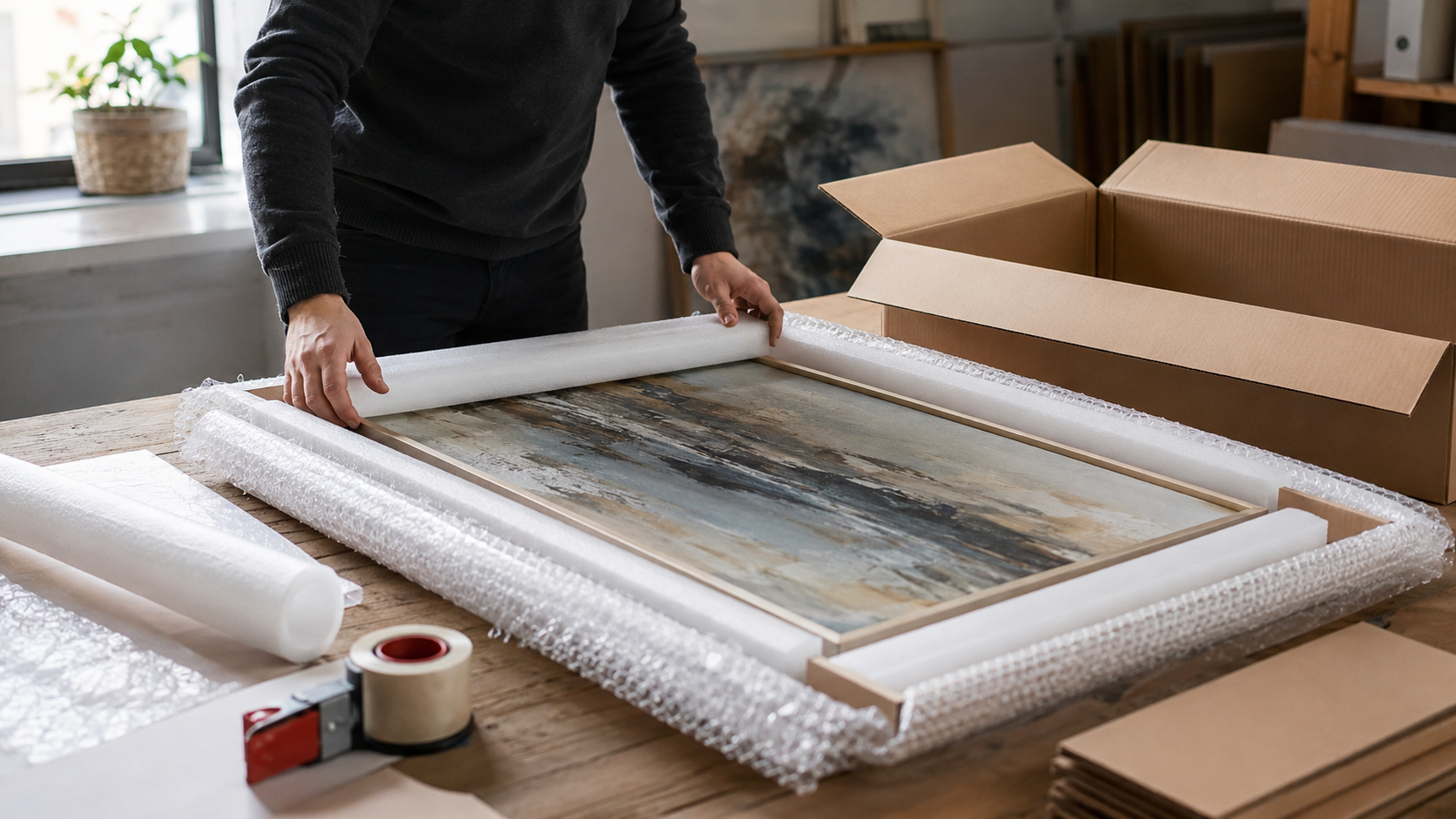
Shipping a large picture safely requires more than just a sturdy cardboard box. To ensure the artwork arrives undamaged and in perfect condition, careful packaging, the right shipping method and adequate insurance cover are essential. Especially for formats exceeding 120 × 60 × 60 cm, special regulations apply that many people underestimate. Anyone wishing to avoid damage, additional costs or returns should be familiar with the key rules for shipping large pictures.
The Most Important Things at a Glance
- Use a soft protective layer: Fleece or protective film shields the surface of the picture from scratches.
- Don’t forget impact protection: Bubble wrap and, if necessary, plywood sheets provide stability.
- Check the dimensions: From 120 × 60 × 60 cm onwards, many couriers classify the parcel as bulky goods.
- Adjust the insurance: Additional insurance is recommended for valuable artworks.
- Use a freight company for oversized items: Large, expensive or fragile works are better shipped via a specialist carrier.
What Should Be Considered When Shipping a Large Picture?
When shipping a large picture, careful packaging with fleece, bubble wrap and, if required, plywood sheets is essential. If the parcel exceeds 120 × 60 × 60 cm, it is usually classified as bulky goods. For expensive or delicate artworks, using a freight company and additional insurance is highly recommended.
Calculate your online price in just 1 minute and book shipping now <<
Careful Protective Packaging for Large Pictures
The first and most important step when shipping a large picture is the packaging. Sensitive surfaces such as oil paintings or prints require special protection. A soft fleece or specialist protective film should first be placed directly over the artwork. This prevents abrasion and scratches. The picture should then be wrapped in bubble wrap, which provides an initial protective layer against impacts and pressure.
For particularly large or fragile works, an additional measure is advisable: placing the artwork between two plywood sheets. These protect the picture from bending or localised pressure. A further soft layer should be inserted between the picture and the plywood to avoid damaging the paint surface. The entire package should then be placed inside a sturdy cardboard box or, ideally, a specialist picture shipping carton. Empty spaces should be filled with packing chips, crumpled paper or foam padding. This ensures everything stays securely in place. Important: never stick adhesive tape directly onto the artwork or its protective layer.
Why Dimensions and Weight Are Crucial
Not every package is suitable for standard parcel delivery. Once a parcel exceeds the dimensions of 120 × 60 × 60 cm, many courier services classify it as bulky goods. This results in higher costs and special handling requirements. Weight also plays an important role. Even if the dimensions are acceptable, an excessively heavy parcel may still be rejected. Therefore, always check the maximum size and weight limits of your chosen shipping provider in advance.
For example, DHL allows a maximum size of 120 × 60 × 60 cm for standard parcels. Anything larger is automatically categorised as bulky goods. For very large pictures, it is therefore advisable to measure the package carefully beforehand and compare shipping conditions. Also remember that the packaging itself significantly increases the overall weight. Plywood reinforcement can add considerable weight and should be factored into the planning. Depending on the format, it may even make sense to ship the frame and picture separately.
Bulky Goods or Freight Company – Which Option Makes Sense?
Bulky goods shipments are expensive and not available with every courier service. As soon as a picture is particularly large, delicate or valuable, using a freight company is often the better choice. These companies specialise in transporting oversized goods. They frequently use custom-made packaging and can, upon request, transport items in climate-controlled vehicles. While parcel services usually deliver only to the front door, freight companies often offer optional door-to-door services, including carrying assistance and installation.
Anyone shipping a large original painting or a framed artwork should prioritise safety. Freight companies are also the preferred choice for auction deliveries or gallery shipments. Although more expensive than standard parcel services, they provide reliable and specialised transport solutions. Arranging a delivery appointment with the recipient is also usually straightforward.
Insurance Cover in Case of Damage
One frequently underestimated aspect of shipping artwork is insurance. Standard parcels with companies such as DHL are generally insured only up to around €500. This is insufficient for many original artworks or high-quality prints. Anyone aware of the value of their artwork should declare it explicitly and take out additional insurance. Many shipping providers offer this for an extra charge. Be careful: some companies refuse to transport artworks altogether or exclude artwork damage from their liability cover. If unsure, clarify this beforehand.
Freight companies also provide insurance, often with much higher coverage limits. Another useful tip: photograph the artwork before packaging and during the packing process. These photos can serve as evidence in the event of damage. If possible, obtain proof of the artwork’s value from a gallery or professional appraiser.
Which Shipping Services Are Suitable for Large Pictures?
Not every provider transports large or delicate artworks. Parcel services such as DHL, Hermes, DPD or GLS have fixed maximum parcel dimensions. DHL currently allows parcels up to 120 × 60 × 60 cm as standard, with anything larger treated as bulky goods. Other providers such as UPS or TNT offer specialist art shipping solutions, although at higher prices.
Larger furniture transport companies may also ship pictures on request. Comparison platforms such as Packlink or Shiparound can help you find the right provider and the best price. Don’t focus solely on cost — also consider transport times, insurance cover and customer reviews. Some platforms even allow you to select preferred delivery windows or offer real-time tracking.
How to Avoid Damage and Additional Costs
One of the most common mistakes when shipping pictures is insufficient protection or incorrect declaration. If a parcel is damaged during transport, the sender is only liable if the packaging was appropriate and the contents were correctly declared. Therefore, always package the picture securely, shockproof and with adequate padding. Use corner protectors and avoid protruding parts.
Clearly mark the parcel as containing fragile goods. Many shipping companies provide labels such as “Fragile Glass” or “Do Not Bend”. Address labels should also be waterproof and duplicated — for example, one attached outside the parcel and another placed inside. To avoid extra costs, ensure the dimensions and weight are measured accurately. Returned parcels due to incorrect information can be expensive. If in doubt, use shipping calculators or contact customer service hotlines for assistance.
Conclusion
Shipping a large picture requires careful planning, secure packaging and the right choice of shipping method. Anyone who considers every detail — from protective film to insurance — can ensure the artwork arrives safely at its destination. Whether using a parcel courier or a freight company, proper preparation is the key to avoiding unpleasant surprises.
 Dansk
Dansk
 Deutsch
 Eesti
Eesti
 English (GB)
 Español
 Français
 Hrvatski
 Italiano
 Latviešu valoda
 Lietuviškai
 Magyar
 Nederlands
 Norsk Bokmål
 Polski
 Português
 Română
 Slovenčina
 Slovenščina
 Suomi
Suomi
 Svenska
 Čeština
 Ελληνικά
 Русский
 Українська
 български
 العربية
 中文 (中国)
 English