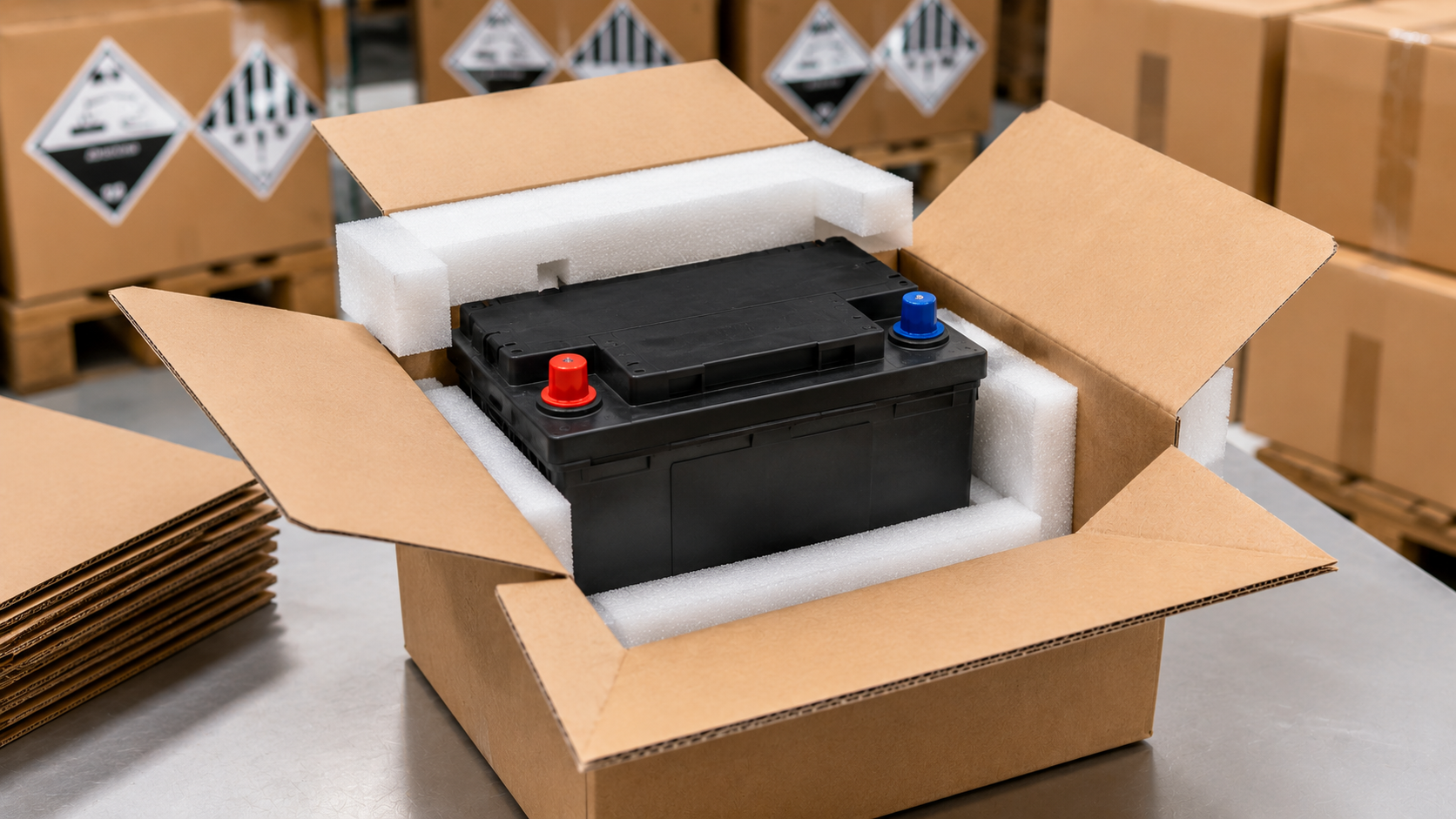
Shipping a car battery is anything but simple. Due to their chemical composition, car batteries are classified as dangerous goods. This means that anyone wishing to send such a battery must comply with strict legal regulations and safety requirements. Private individuals in particular often face significant challenges. Incorrect packaging, missing labelling or improper handling can lead to legal consequences and safety risks.
Key Facts About Shipping a Car Battery at a Glance
- Dangerous goods: Car batteries are classified as hazardous materials – not every courier service transports them.
- Leak-proof: Only leak-proof batteries may be shipped – ideally with a manufacturer’s certificate.
- Short-circuit protection: Terminals must be insulated before shipping – for example with tape or plastic caps.
- Packaging: Only ship in impact-resistant packaging, preferably in the original packaging.
- Labelling: Hazard labels and notes such as “non-spillable battery” are mandatory.
What Needs to Be Considered When Shipping a Car Battery?
When shipping a car battery, safety regulations must be observed: the battery must be classified as leak-proof, the terminals must be insulated, the packaging must be impact-resistant and the parcel must be clearly labelled. In addition, coordination with the shipping provider is required, as many only accept transport under specific conditions.
>> Calculate your price online in 1 minute and book shipping now
Hazard Classification and Legal Requirements
Car batteries, especially lead-acid batteries, are classified as Class 8 dangerous goods. This is due to their corrosive and conductive properties. As a result, they are subject to transport regulations under ADR (for road transport) and, where applicable, IATA (for air freight). Many standard parcel services such as DHL, Hermes or DPD generally exclude the shipment of car batteries or only offer it to business customers.
Certain battery types are exceptions – for example sealed lead-gel batteries with appropriate safety certification. To stay legally compliant, senders should always consult the chosen shipping provider in advance. Written confirmation of transport approval is also recommended. Violating dangerous goods regulations can result in substantial fines or even criminal penalties. Safe and legal shipping therefore begins with thorough research and planning.
Requirements for Leak-Proof Design
Not every battery is automatically approved for shipping. Only batteries declared as leak-proof may be transported. This means that no liquid may escape even if the battery is tilted or subjected to vibration. Lead-gel batteries are considered relatively safe if the manufacturer can provide documented pressure and vibration test results. This documentation should accompany the shipment if required. Conventional wet batteries, on the other hand, are usually excluded, as they contain sulphuric acid, which is hazardous to people and the environment if leaked.
Leak-proof status must also be clearly indicated on the packaging. A corresponding label is mandatory. Shipping companies should also verify the specific battery type in advance to minimise liability risks.
Implementing Proper Short-Circuit Protection
An overlooked short circuit can quickly become dangerous. To prevent this, the terminals of a car battery must be professionally insulated before shipping. This is most easily achieved using adhesive tape or special plastic caps. These prevent metallic objects inside the packaging from connecting the terminals. Extra caution is required with used batteries, as residual voltage may still be present.
Even for gel batteries, the terminals must not be exposed. For larger shipments or pallet transport, additional internal securing measures using special inserts may be necessary. Short-circuit protection is mandatory – even for leak-proof models. Failure to comply can result not only in the loss of the shipment but also in risks to transport personnel and the environment.
Suitable Packaging for Safe Transport
Robust packaging is essential when shipping car batteries. The packaging must be impact-resistant, non-slip and leak-proof. It is also important that the battery is securely fixed inside and cannot move. Foam inserts, polystyrene or custom-fit cardboard holders are proven solutions. The manufacturer’s original packaging is ideal, as it usually meets all required safety standards.
If the original packaging is no longer available, certified dangerous goods boxes can be used. These are typically double-reinforced and comply with UN regulations. Important: no metal parts that could come into contact with the terminals may be inside the packaging. Tools, cables or screws must also not be included. Packaging is not only protection – it is a requirement for shipment acceptance.
Labelling and Information for the Shipping Provider
Proper labelling often determines whether a parcel is accepted. Clearly visible warning notices must be attached to the outer packaging. At a minimum, this includes “non-spillable battery” or “Battery, non-spillable”. Depending on the battery type, a hazard label with a UN number may also be required – for example UN2800 for non-spillable batteries or UN2794 for wet batteries.
It is also essential to inform the shipping provider in advance about the exact contents. Undeclared shipments may be returned or even reported. Companies should notify their transport providers contractually or in writing about the types of batteries being shipped. Some parcel services also require individual shipping approval. For international shipments, additional language labelling may be necessary – for example in English or French.
Restrictions for Private Individuals and Alternatives
For private individuals, shipping car batteries is particularly complicated. Many shipping providers only accept batteries from registered business customers or with special authorisation. This is due to the high documentation requirements and liability associated with dangerous goods.
Private senders should always enquire in writing with the shipping provider in advance. Alternatively, transport via a freight forwarder may be an option. There are specialised dangerous goods carriers that also transport single items. These operate according to ADR regulations and handle packaging, documentation and transport.
A freight enquiry with detailed information on battery size, type and condition is essential. If you wish to dispose of a defective or used battery, it is usually better to use local collection points or recycling centres – shipping is generally not permitted.
Conclusion: Shipping a Car Battery Safely
Shipping a car battery requires careful planning and strict compliance with dangerous goods regulations. Mistakes can lead to returns, fines or even safety hazards. Private individuals in particular should gather detailed information or use specialised freight services. With the right preparation, safe and legally compliant battery transport is entirely achievable.
 Dansk
Dansk
 Deutsch
 Eesti
Eesti
 English (GB)
 Español
 Français
 Hrvatski
 Italiano
 Latviešu valoda
 Lietuviškai
 Magyar
 Nederlands
 Norsk Bokmål
 Polski
 Português
 Română
 Slovenčina
 Slovenščina
 Suomi
Suomi
 Svenska
 Čeština
 Ελληνικά
 Русский
 Українська
 български
 العربية
 中文 (中国)
 English