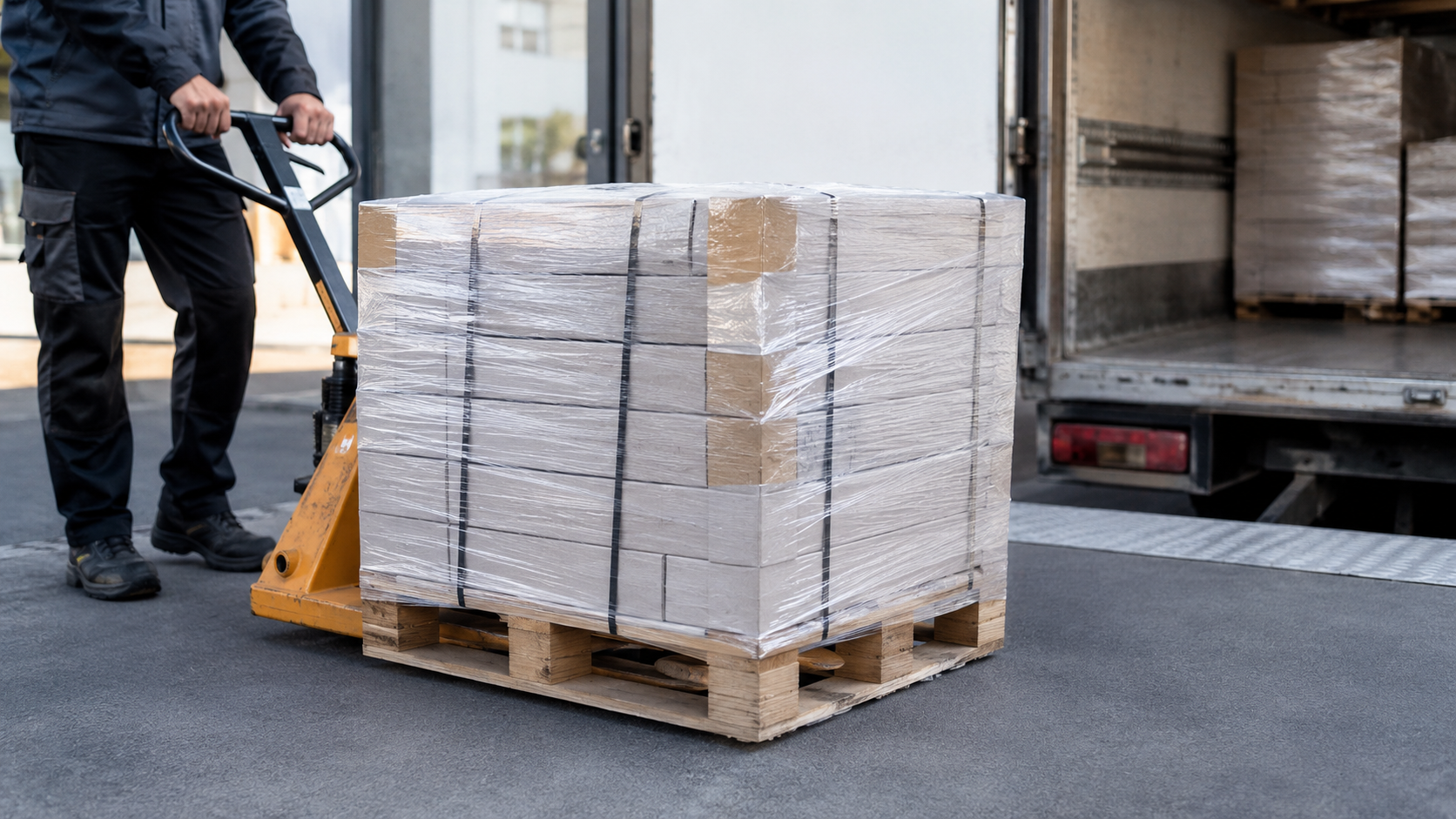
Shipping tiles is a logistical challenge that requires great care. These fragile materials are heavy, bulky, and sensitive to impacts and improper handling. To avoid transport damage, complaints, or unnecessary additional costs, the shipping process should be well planned, professionally executed, and securely packaged. Whether by freight carrier, parcel service, or in your own vehicle – thorough preparation is key.
Key Points at a Glance
- Tiles should preferably be shipped via a freight carrier on pallets
- Packaging must be shock-resistant, stable, and weatherproof
- Securing on a pallet or in the vehicle prevents transport damage
- Delivery is usually kerbside and must be accepted
- Damage must be documented and reported immediately
What Should Be Considered When Shipping Tiles?
When shipping tiles, particular attention must be paid to secure packaging, proper load securing, and reliable acceptance of the delivery.
Calculate your online price in 1 minute and book shipping now <<
Shipping Method: Freight Carrier or Parcel Service?
When shipping tiles, choosing the right method is crucial. Large quantities or heavy tile packages should generally be shipped via a freight carrier. These companies deliver goods safely on pallets and are better equipped for heavy and fragile items. Smaller quantities, such as sample tiles or single tiles, can alternatively be sent via parcel services. However, there is a higher risk of transport damage.
Parcel services such as DHL, DPD, or GLS have weight limits that are quickly exceeded with larger quantities of tiles. Anyone selling tiles via an online shop should provide clear information about the shipping method. Advance notice of delivery by the freight carrier – usually by phone – is also important. A preferred delivery date is only possible by individual arrangement and is often subject to an additional charge.
Packaging: Protection Against Breakage and Moisture
Packaging is the core element of successful tile shipping. Ideally, the manufacturer’s original cartons should be used, as they are typically designed to match the dimensions and weight of the tiles. These cartons should be stacked on sturdy pallets and carefully wrapped with stretch film to protect them from moisture. Gaps must be filled with shock-absorbing materials such as bubble wrap or foam.
Special attention should be given to edges and corners, as they are particularly prone to breakage. Additional wrapping with cardboard or edge protectors provides valuable protection. If no pallet is available, at least a sturdy box with sufficient padding should be used. As a general rule: the tighter and more compact the packaging, the lower the risk of damage.
Transport Securing: Stability on Every Journey
Whether in a freight vehicle or your own car, tiles must be securely fixed during transport. On pallets, the cartons must not move. Straps or edge protectors provide additional stability. When transporting in a car, tiles should be positioned vertically – ideally against a flat, stable surface such as the boot floor.
In this position, they are less susceptible to impacts than when laid flat. Blankets, polystyrene boards, or bubble wrap should be placed between the packages. Important: avoid sharp turns and sudden braking. Even small movements can cause cracks. If transporting multiple cartons, they should be wedged against each other. The less movement, the better for the condition of the goods.
Delivery: What Matters Upon Receipt
Freight carriers usually deliver tiles “kerbside”. This means the driver brings the pallet to the nearest public road but not into the house or onto the property. Buyers should therefore ensure that someone is present at the delivery time to accept the goods.
The freight company usually announces the delivery by phone. If no one is available or the goods are not accepted, additional costs may arise for a second delivery attempt. If ordering tiles for a construction site, the delivery should be carefully timed. It is also important to check the packaging for visible damage immediately upon arrival. If there are breakages or severely damaged cartons, this should be noted on the delivery note.
Acceptance and Damage Reporting: Acting Correctly in Case of Defects
Upon receiving the delivery, a thorough inspection of the goods is essential. Visible damage, such as broken tiles or crushed cartons, must be documented immediately. The delivery note should clearly state “received damaged”. In severe cases, it is even better to refuse acceptance.
Hidden damage must also be reported in writing within seven days. Detailed photos of the packaging and damaged tiles are essential. Anyone who misses the deadline or fails to provide evidence will often struggle to claim compensation. Complaints should be submitted by email, including photos and the delivery note number, to the responsible shipping company or retailer.
Transporting Tiles in Your Own Vehicle: Reaching the Destination Safely
Anyone transporting tiles themselves can save shipping costs but must be particularly careful. Tiles are heavy, fragile, and sensitive to vibrations. In a car, they should be transported on a flat surface – ideally upright in the boot. Blankets, foam, or polystyrene can be used to secure the cartons and cushion them against each other.
Most importantly: drive slowly, avoid harsh braking, and take turns carefully. Even slight vibrations or tipping cartons can cause surface cracks. If you frequently transport tiles, consider special transport boxes or anti-slip mats. Even short distances require full attention when driving and loading.
Conclusion
When shipping tiles, attention to detail is essential. Whether via a freight carrier or in your own vehicle: secure packaging, stable fixing, and careful acceptance protect against costly damage. Those who pay attention to details save time, money, and stress – and ensure the tiles arrive intact.
 Dansk
Dansk
 Deutsch
 Eesti
Eesti
 English (GB)
 Español
 Français
 Hrvatski
 Italiano
 Latviešu valoda
 Lietuviškai
 Magyar
 Nederlands
 Norsk Bokmål
 Polski
 Português
 Română
 Slovenčina
 Slovenščina
 Suomi
Suomi
 Svenska
 Čeština
 Ελληνικά
 Русский
 Українська
 български
 العربية
 中文 (中国)
 English