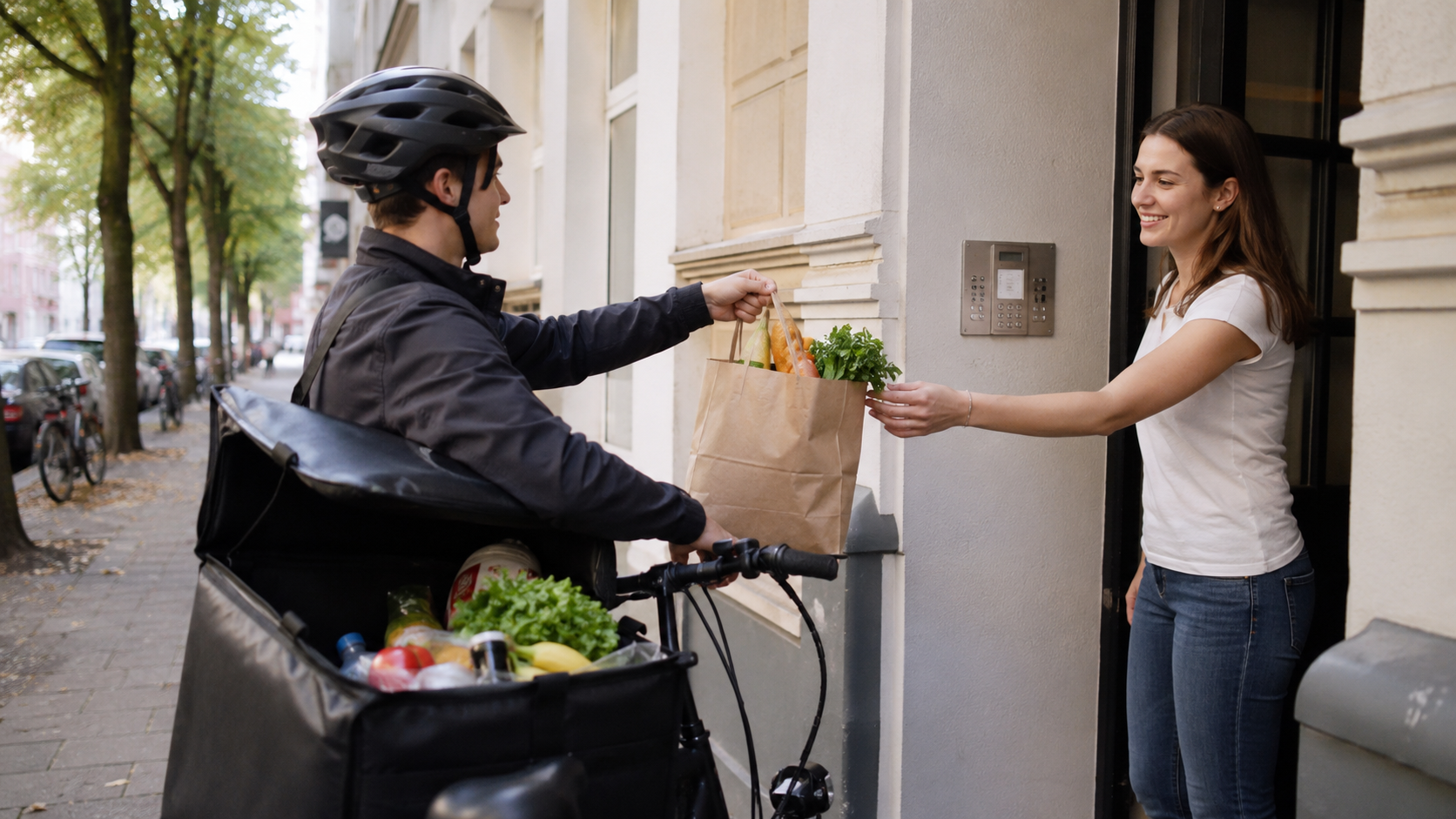
Quick commerce promises groceries, drinks and other everyday products within minutes or hours. It sounds like a simple upgrade to online retail. In reality, it depends on a demanding interplay of local inventory, real-time data, rapid picking and tightly scheduled delivery. A single incorrect stock indication or poorly planned route can undermine the entire delivery promise.
For retailers, Q-commerce nevertheless offers genuine opportunities. Businesses that understand local demand, limit their range sensibly and calculate every order economically can stand out clearly from competitors. The key question is therefore not, “How do we deliver in ten minutes?” It is, “For which products, customers and delivery areas does speed create value that people are willing to pay for?”
Key facts at a glance
Quick commerce means the particularly fast delivery of locally available products, usually within 10 to 120 minutes.
It relies on short distances, real-time inventory, fast picking and precisely controlled last-mile logistics.
Success depends not on the shortest delivery time, but on a reliable and economically viable delivery window.
Compact, frequently needed products with stable local demand and sufficient margin are especially suitable.
High site costs, small baskets, demand peaks and expensive individual journeys make profitability difficult.
For many retailers, a hybrid model is more sensible than a pure Q-commerce operation: selected products are delivered quickly while the rest of the range uses standard shipping.
A pilot area should be assessed by contribution margin, order density, repeat purchase rate and cost per delivery.
What is quick commerce?
Quick commerce, or Q-commerce, essentially means “fast retail”. Customers order through an app, mobile website or online shop. The goods are then immediately picked in a nearby warehouse or store and delivered by courier.
Typical promises range from 10 to 60 minutes. Depending on the product range, region and business model, windows of 90 or 120 minutes may also qualify as quick commerce. There is no universally binding minute threshold. What matters is that delivery is significantly faster than conventional parcel shipping and that the ordered products are already available locally.
This distinguishes Q-commerce from a normal express order. Traditional express shipping accelerates the transport of a consignment that has already been prepared. Quick commerce accelerates the entire retail process:
Select product
Check availability
Pay for the order
Pick the goods
Assign a driver
Calculate the route
Deliver the order
Every step must work without significant waiting time. The driver is only the final link. The real speed is created beforehand through local inventory, short walking routes in the warehouse, automated processes and dependable route and dispatch planning.
What are dark stores?
Many Q-commerce providers use so-called dark stores. These are small, decentralised warehouses close to customers. They may resemble supermarkets but are closed, or only partly open, to walk-in shoppers. Shelves and storage positions are designed for rapid picking.
Frequently ordered items are kept in easy-to-reach positions. Routes between product groups remain short. As soon as an order arrives, an employee collects the items, checks them and hands them to the assigned driver.
Dark stores are not essential, however. Existing supermarkets, pharmacies, drinks retailers, flower shops and other branches can also serve as local dispatch points. This ship-from-store principle reduces the need for additional warehouse space, but places higher demands on inventory accuracy because in-store and online customers draw on the same stock.
Quick commerce in Germany: market and development
Quick commerce is not a replacement for the whole retail sector. It is an especially fast service layer within the expanding online market.
According to the HDE Online Monitor 2026, German online retail generated net revenue of EUR 92.3 billion in 2025. That was growth of 3.9 per cent year on year, while online retail’s share of total retail sales rose to 13.5 per cent.
These figures do not automatically mean that consumers want every order immediately. They do show how normal digital purchasing channels have become. Quick commerce builds on that development: customers with an urgent need should no longer have to choose between ordering online and making a fast trip to a local shop.
The market has already changed noticeably in practice. Its first phase was dominated by extreme ten-minute promises and heavy investment in new delivery networks. Today, the focus is shifting towards more realistic delivery times, partnerships with existing retailers and dependable contribution margins.
That shift is necessary. Growth alone cannot sustain a quick-commerce model. A provider may complete many orders and still make a loss if delivery costs, discounts and site expenditure exceed gross profit.
From ten-minute hype to a hybrid instant service
For many companies, a hybrid approach is more economical than building an entire Q-commerce network. The standard e-commerce range remains in place, while only selected high-urgency products are stocked locally and delivered particularly quickly.
An electronics retailer, for example, could rapidly deliver chargers, batteries, adapters and commonly needed cables. Large televisions or rarely purchased specialist devices would remain in standard shipping. A drinks retailer could handle urgent top-up orders while scheduling larger stock-up deliveries for the following day.
This approach prevents every product from having to bear the cost of instant logistics. Speed is used where it creates genuine value from the customer’s perspective.
How does quick commerce work?
A Q-commerce order passes through several closely connected process stages. Even small delays accumulate. If checkout takes two minutes longer, an item is missing from the shelf and the driver then has to wait for handover, a tight delivery window is quickly missed.
Process chain of a quick-commerce order
Process
Task
Typical risk
Digital order
Capture of basket, delivery address and payment
Abandonment due to a complicated checkout
Delivery-area check
Automatic check of address, distance and capacity
Order outside the economically viable area
Real-time inventory check
Display of goods actually available
Cancellation due to incorrect inventory data
Picking
Rapid assembly and checking of the order
Missing items or long walking routes
Driver assignment
Selection of an available driver and vehicle
Waiting time caused by insufficient capacity
Route planning
Calculation of a realistic route and arrival time
Detours, traffic or an incorrect time forecast
Delivery
Handover of the complete order
Recipient unavailable
Tracking and proof
Status updates and digital proof of receipt
Queries and lack of transparency
Why inventory accuracy matters more than driving speed
An order can only be dispatched immediately if every product shown is genuinely available. In normal e-commerce, a missing item may be reordered or shipped from a different warehouse. Quick commerce does not have time for that.
The system should therefore update inventory after every sale, return, damaged item and manual withdrawal. Store inventory is particularly demanding. One shopper may be taking the last item from the shelf just as another orders it online.
A safety stock has proven useful in practice. The system marks an item unavailable before physical stock is completely exhausted. This reduces the amount theoretically available for sale, but also cuts cancellations and disappointed customers.
Why delivery areas should be managed dynamically
A fixed radius takes no account of traffic, weather or current utilisation. Two addresses may be equally far from the warehouse while producing very different journey times.
A capable system therefore evaluates more than kilometres. It considers:
current and expected traffic conditions,
available drivers,
vehicle type and transport capacity,
the order backlog in the warehouse,
average picking time,
weather conditions,
access restrictions and roadworks,
parking and handover conditions at the destination.
During peak utilisation, it may be sensible to temporarily shrink the delivery area or offer longer windows. That sounds less spectacular than a blanket ten-minute promise. For customer satisfaction, however, a realistic time estimate is worth more than a promise that is regularly broken.
What requirements must quick commerce meet?
A functioning Q-commerce model needs more than an online shop and a few drivers. Retail, warehousing, data and transport must be planned as one connected system.
Core requirements for quick commerce
Requirement
Why it is needed
Consequence of poor implementation
Sufficient local demand
Generates enough orders within a small area
High cost per delivery
Local inventory
Shortens the route between product and recipient
Delivery time cannot be met
Real-time inventory management
Prevents the sale of unavailable items
Cancellations and loss of trust
Fast picking
Reduces the time before departure
Drivers wait for the order
Digital process integration
Connects shop, merchandise management, warehouse and transport
Manual errors and breaks between systems
Intelligent driver assignment
Distributes orders across available capacity
Unnecessary waiting and empty mileage
Realistic delivery-time forecast
Creates a dependable customer promise
Delays and complaints
Suitable packaging
Protects goods and facilitates handover
Damage, temperature problems or leakage
Trained customer service
Resolves shortages and delivery problems quickly
High refund workload
Positive unit economics
Shows whether each additional order is profitable
Growth increases the loss
Digital platform and API integration
Before paying, customers should know whether their address can be served, which items are available and when the order is expected to arrive. After purchase, the data must pass to warehouse and transport control without manual transfer.
A technical interface connects orders, merchandise management and logistics. Retailers with high or recurring shipment volumes can, for example, use an API-supported transport process. It prevents duplicate data entry and enables automated status updates.
A good system must also handle exceptions. What happens if an item is missing? May an equivalent product be substituted? Does the customer have to agree? Is a partial delivery triggered or is the item refunded? These questions need a binding process before launch.
Local warehouse structure and site selection
A centrally located warehouse shortens delivery distances but usually carries higher rent. A cheaper site outside the city reduces fixed costs but lengthens every delivery. The right location therefore follows achievable order density, not the lowest price per square metre.
A site should be assessed using concrete data:
How many potential customers live or work in the delivery area?
How often are the intended products needed?
At what times do demand peaks occur?
What journey time is realistic by bicycle, e-bike, cargo bike or van?
How high are rent, service charges and staffing costs?
How many orders can each driver deliver per hour?
What competing services already exist?
Existing stores can offer a clear advantage. Storage space, inventory and employees may already be available. Rapid delivery must nevertheless not slow the physical shop. Online orders therefore need their own handover points, clear priorities and defined picking processes.
Staffing and capacity planning
Quick commerce faces sharp fluctuations. Demand may rise abruptly in the evening, at weekends, in bad weather or before public holidays. Quiet periods, by contrast, bring idle capacity and high labour costs per order.
Realistic planning combines historical order data with weather, events, weekdays and seasonal effects. Supplementary external capacity can absorb peaks. Permanent understaffing is not a solution, however. It merely shifts the costs into late orders, overload, complaints and employee turnover.
Quick commerce, e-commerce and same-day delivery compared
These terms are often confused but describe different operating models. Quick commerce is local and designed for immediate needs. Traditional e-commerce usually works with central warehouses and a broad range. Same-day delivery may be local or supra-regional, but only has to arrive by the end of the same day.
Differences between quick commerce, e-commerce and same-day delivery
Feature
Quick commerce
Traditional e-commerce
Same-day delivery
Typical delivery time
10 to 120 minutes
One to several working days
By the end of the same day
Stock location
Local and close to the customer
Usually centralised or supra-regional
Local or supra-regional depending on the order
Product range
Limited and focused on immediate needs
Large and varied
No fixed range restriction
Purchase motivation
Urgency and convenience
Choice, price and planning
Time pressure or particular importance
Typical transport
Bicycle, e-bike, cargo bike or car
Parcel service, van or freight forwarder
Car, van, panel van or direct journey
Delivery area
Tightly limited
National or international
Local to Europe-wide
Consolidation
Possible to a limited extent
Highly consolidated networks
Often dedicated or scheduled transport
Suitable goods
Compact everyday products
Almost all shippable goods
Time-critical parcels, goods or pallets
Quick commerce is not automatically a direct journey
In a traditional Q-commerce delivery, a driver may consolidate several orders on a short route. A direct journey without transloading, by contrast, is usually assigned to a specific consignment or order.
Direct transport is particularly suitable for time-critical, high-value, sensitive or larger goods. A dedicated longer journey would often be too expensive for a small grocery order. Conversely, an urgently needed spare part cannot sensibly travel across a city together with several consumer orders.
Companies should therefore not simply look for the fastest-sounding label. The mode of transport must suit the value and weight of the goods, delivery area, time window and risk of disruption.
What opportunities does quick commerce offer?
Benefits for customers
For consumers, the greatest benefit is time saved. There is no journey to the shop, search for parking, queue or need to carry heavy bags. A missing item can be ordered at short notice without rearranging the entire day.
Typical situations include:
An important ingredient is missing while cooking.
There are not enough drinks for unexpected visitors.
Nappies, pet food or hygiene products unexpectedly run out.
A charging cable or battery is urgently needed.
A gift or flowers must arrive the same day.
A person cannot shop because of illness or restricted mobility.
In these situations, the practical value is higher than for a planned weekly shop. That also explains why customers are more willing to accept a delivery or service fee for an urgent order.
Benefits for retailers
For retailers, reliable instant delivery can be a clear differentiator. Prices and product ranges are often easy to compare. A problem solved in an emergency, however, is remembered.
Further opportunities include:
an additional digital sales channel,
better use of existing store inventory,
differentiation from slower competitors,
a higher repeat purchase rate after a positive service experience,
additional impulse and complementary purchases,
better data on local and time-dependent demand,
personalised ranges for individual delivery areas,
direct customer relationships without dependence on marketplaces.
Quick commerce is especially interesting as a customer-retention tool. Not every fast order has to generate a high margin on its own, but it must not become a permanent loss-maker either. Retailers should therefore examine total customer value: How often does the customer order again? Do they later use other offers? Do they remain loyal because the retailer helps reliably in urgent situations?
Opportunities for local shops
Local retailers have an advantage that pure online providers have to build at great cost: their goods are already close to customers. A shop can therefore begin with a limited radius and offer only selected items at first.
A large in-house driver network is not essential. Delivery may be handled by local partners, specialist platforms or an external logistics provider. Ideally, the retailer retains control over the product range, pricing, customer relationship and delivery quality.
Working with a platform lowers the technical and organisational barrier to entry. Commissions and dependencies must nevertheless be included in the calculation. A retailer that gives a marketplace complete control of customer access may gain orders but lose valuable data and direct brand development.
Costs and economics: when is quick commerce worthwhile?
The most common mistake is an overly rough calculation. Revenue is considered, but the actual cost per order is not. Especially with small baskets, just a few euros of delivery expense can consume the entire product margin.
Calculate contribution margin per order
A simplified calculation is:
Product margin + delivery and service fees – variable order costs = variable contribution margin
Variable order costs include:
picking,
packaging materials,
payment fees,
driver and vehicle costs,
proportionate platform commission,
refunds and shortages,
discounts and vouchers,
customer-specific support costs.
Only the remaining contribution margin can pay fixed costs such as rent, software, management staff, insurance and basic equipment.
Simplified calculation example
The following is a model calculation, not a general market benchmark:
Example of the variable contribution margin of an order
Item
Amount
Basket
EUR 38.00
Product margin assuming 30 per cent
EUR 11.40
Delivery and service fee
EUR 3.50
Available gross profit
EUR 14.90
Payment processing
–EUR 0.80
Picking
–EUR 2.20
Packaging
–EUR 0.80
Last mile
–EUR 7.00
Shortages, refunds and shrinkage
–EUR 0.80
Variable contribution margin
EUR 4.10
In this example, the EUR 4.10 still has to finance the warehouse, software, administration and other fixed costs. If the basket falls or delivery effort rises, the contribution can quickly turn negative.
This is where order density matters. A driver who can sensibly combine two nearby orders creates lower costs per order than two separate journeys. Excessive consolidation, however, lengthens delivery time. Q-commerce is therefore a constant balancing act between speed and utilisation.
Which pricing levers are useful?
Retailers can combine several options:
minimum order value,
fixed delivery fee,
service fee based on utilisation,
free delivery above a higher basket value,
membership or delivery subscription,
surcharge for particularly tight delivery windows,
a cheaper window where consolidation is possible,
restriction to products with sufficient margin.
Free instant delivery sounds attractive, but is only viable when linked to a sufficiently large basket, membership or other revenue. Permanent discounts often conceal the fact that the underlying model does not yet work.
The most important quick-commerce metrics
No single metric is sufficient. A very short delivery time may be bought at high cost. A large basket is of little use if many orders are cancelled because of stockouts. Companies therefore need a balanced KPI system.
Important KPIs for quick-commerce providers
Metric
Meaning
Warning sign
Average basket
Average order value
Below the minimum required for viability
Gross profit per order
Available product margin
Low margin despite high revenue
Variable contribution margin
Contribution after directly attributable costs
Negative value as volume grows
Picking time
Time from order to readiness for dispatch
Drivers regularly wait for goods
On-time delivery rate
Share of deliveries made on time
Delivery promise is frequently missed
Cost per delivery
Last-mile expense
Costs rise as volume increases
Orders per driver hour
Delivery productivity
Frequent waiting or idle periods
Out-of-stock rate
Share of ordered items that are unavailable
High number of substitutions or cancellations
Cancellation rate
Share of abandoned orders
Problems with inventory, payment or capacity
Repeat purchase rate
Share of customers who order again
High new-customer costs without retention
Customer acquisition cost
Marketing cost per acquired customer
Higher than expected customer value
Complaint rate
Share of orders subject to complaints
Quality problems in the warehouse or delivery
The most important metric: contribution margin of the delivery area
Individual orders can vary greatly. One address is directly beside the warehouse; another is at the edge of the delivery area. Orders should therefore not only be judged in isolation. What matters is whether a delivery area covers its variable and fixed costs over a representative period.
An area with many orders may still be unprofitable if baskets are small and journeys poorly consolidated. Conversely, a smaller area can work economically if customers order frequently, distances remain short and the product range offers a solid margin.
Disadvantages and limits of quick commerce
High last-mile costs
The final distance to the customer is labour-intensive. Each order has to be accepted, transported and handed over individually. Congestion, lack of parking, hard-to-find entrances and unavailable recipients increase the effort.
The tighter the window, the fewer orders can be consolidated. That is precisely what makes delivery more expensive. A promise of 30 or 60 minutes may therefore be more economical than ten minutes.
Small and spontaneous baskets
Many Q-commerce purchases arise because one item is missing. The need is urgent but the basket is small. Additional product recommendations can increase order value, but must not make checkout unnecessarily complex.
Minimum order values help the economics but can deter customers. Someone who only needs milk and has to buy more products may quickly find the service impractical.
Fluctuating demand
Orders are distributed unevenly. During a demand peak, drivers and warehouse staff are scarce. In quiet periods, capacity is unused. Managing this fluctuation is one of the model’s most difficult tasks.
Flexible shifts, external peak capacity and dynamic delivery windows can help, but they do not replace dependable baseline planning.
Out-of-stocks and quality problems
An incorrect quick-commerce order is especially frustrating. The customer ordered precisely because the need was urgent. A missing item, damaged package or unsuitable substitute destroys the expected time saving.
Checks must therefore not be omitted despite the time pressure. Speed without process quality creates more refunds, support cases and negative reviews.
Cannibalisation of existing sales
A fast delivery channel does not automatically create additional revenue. Existing customers may merely move from standard shipping or store purchases to the more expensive delivery channel. The retailer earns the same product revenue but carries higher logistics costs.
Before expanding, businesses should therefore assess whether quick commerce genuinely creates new customers, additional purchases or stronger loyalty.
Limited suitability for rural regions
In sparsely populated areas, distances are longer and orders less frequent. Delivery within minutes becomes expensive. An adapted model can still work, using longer windows, fixed routes, collection points or regionally consolidated orders.
Quick commerce does not have to look the same everywhere. An urban ten-minute model cannot be transferred unchanged to rural areas.
How sustainable is quick commerce?
Quick commerce is neither automatically environmentally friendly nor inherently harmful to the climate. The balance depends on vehicle type, utilisation, distance, warehouse structure, packaging and the shopping journey being replaced.
A separate motorised journey for a small basket involves different effort from a consolidated cargo-bike route. The comparison baseline also matters. If delivery replaces a five-kilometre car trip to a supermarket, the assessment differs from a purchase that the customer would otherwise have made on foot.
The German Environment Agency identifies substantial optimisation potential on the last mile. In the scenarios studied, electrification and delivery concepts using micro-depots and bicycles could cut greenhouse-gas emissions per last-mile delivery by up to 80 per cent.
At the same time, the agency notes that accelerated instant-delivery services can cause at least 60 per cent more emissions than standard delivery times in one comparison scenario. The main reason is that highly urgent consignments are harder to consolidate.
How to improve the environmental impact
Consolidate deliveries in densely populated areas.
Use bicycles, e-bikes and cargo bikes on suitable routes.
Use electric vehicles at sensible utilisation levels.
Offer realistic windows instead of unnecessary extreme promises.
Use micro-depots or existing stores as local starting points.
Assess reusable containers for recurring delivery loops.
Reduce packaging volume and filling material.
Avoid stockouts so substitute or follow-up deliveries are unnecessary.
Let customers choose between a fast individual delivery and a cheaper consolidated window.
The most sustainable order is not necessarily the slowest. What matters is that vehicles are well utilised, distances remain short and unnecessary individual journeys are avoided.
Which products and sectors suit quick commerce?
Suitable products meet several criteria. They are needed frequently or spontaneously, can be picked quickly, are easy to transport and have sufficiently stable demand.
Suitability of different product groups for quick commerce
Product group
Suitability
Typical need
Special consideration
Groceries
Very high
Missing ingredients and spontaneous meals
Freshness, shelf life and, where required, the cold chain
Drinks
Very high
Visits, events and gaps in household supplies
Weight, deposit returns and vehicle capacity
Drugstore products
High
Short-notice personal need
Large number of compact items
Household goods
High
Cleaning and consumable products
Use leak-proof packaging
Pet supplies
High
Missing food or litter
Heavy bulk packs increase delivery costs
Flowers and small gifts
High
Forgotten or last-minute occasions
Sensitive transport
Electronic accessories
Medium to high
Cables, adapters, batteries and chargers
Good margin but a wide range of variants
Pharmacy-type products
Depends on the product
Short-notice health need
Product-specific and pharmacy regulations
Spare parts
Depends on the application
Avoiding repair or production downtime
Often better suited to same-day or direct transport
Furniture and large appliances
Low
Rarely a minute-critical need
Size, weight and required appointment coordination
Building materials
Low to medium
Missing materials on a construction site
For urgent needs, express or direct transport is usually more suitable
Quick commerce in B2B
The term is used less often in business markets, but the underlying idea is similar: a product needed at short notice is taken rapidly from available stock to the place of use.
For machine components, tools or production materials, delivery within ten minutes is rarely the priority. Binding collection, direct transport and verifiable delivery matter more. Here, Q-commerce overlaps with modern spare-parts logistics, same-day courier services and express journeys.
The economic value can be particularly high in B2B. A spare part may cost only a few hundred euros. If fast delivery prevents prolonged machine downtime, the benefit of the transport service is much greater than the value of the goods.
Legal requirements for quick commerce in Germany
Quick commerce does not operate outside the law. Fast processes must meet the same requirements as other retail and delivery models. Applicable rules depend on the range, packaging, employment relationships and data processed.
The following points are not a substitute for individual legal advice. They show which areas should be checked before launch.
Packaging Act and LUCID
Shipping and online retailers that commercially distribute packaged goods in Germany must assess their obligations under the Packaging Act. According to the Central Agency Packaging Register, shipping packaging is almost always subject to system participation.
Depending on the packaging type, the following steps may in particular be required:
registration with the LUCID Packaging Register,
conclusion of a system participation agreement,
reporting packaging quantities subject to system participation.
Labels, adhesive tape and filling material may also form part of shipping packaging. Reusable packaging is partly subject to different requirements, but must likewise be classified correctly.
Food and the cold chain
Food must be stored, picked and transported under hygienically sound conditions. For chilled or frozen goods, speed must not compromise prescribed temperature conditions.
A provider needs clear processes for:
goods receipt and temperature checks,
separate storage of different product groups,
suitable transport containers,
cleaning and hygiene,
handling damaged packaging,
documentation and traceability.
The challenge is not limited to the journey. A fully picked order can also warm up if it waits too long at the handover point.
Occupational safety and working time
Tight windows must not be achieved through dangerous driving or permanently excessive pressure. The German Federal Ministry of Labour and Social Affairs notes that the Working Time Act limits maximum daily working hours and specifies minimum breaks and rest periods.
For operators, that means delivery targets, shifts, breaks and routes must be achievable in practice. An algorithm must not effectively pressure drivers to disregard traffic rules or break requirements.
Location data and data protection
Quick-commerce apps routinely process addresses, order data, payment information and sometimes precise location data. These data must not be collected without a clear purpose or reused arbitrarily.
Companies should in particular assess:
Which location data is genuinely required for delivery?
How long are location and order data stored?
Who receives access to customer and driver data?
Which data is transmitted to platforms, mapping services or payment providers?
How transparently are tracking, analysis and personalisation explained?
How can data subjects exercise their rights?
Data minimisation not only reduces legal risk, but also limits the consequences of potential security incidents.
Regulated products
Medicines, alcohol, tobacco and other regulated products are subject to additional requirements. These may include age checks, special storage conditions, documentation duties or sales restrictions.
For example, the German Pharmacy Operations Ordinance governs the proper supply of medicines and pharmacy-only medical devices. A fast delivery process must not bypass professional or legal requirements.
Launching quick commerce: a 90-day pilot instead of immediate expansion
A common mistake is investing in several cities or a large range too early. A clearly limited pilot is more sensible. It provides real data on demand, delivery costs and customer behaviour.
Phase 1: define demand and target group
First, the problem being solved must be clear. “Deliver faster” is not yet sufficient positioning.
Specific questions include:
Which products are actually needed at short notice?
Who is prepared to pay for speed?
Which situations trigger an order?
What alternatives does the customer have?
Why should they order from this particular provider?
Phase 2: limit the delivery area
The pilot begins in a tightly defined area. It should offer enough potential demand and be reachable within a realistic window. City boundaries or postcodes alone are not sufficient for this decision.
A division based on actual journey time is better. Busy roads, bridges, rivers, pedestrian zones and parking difficulties can split a geographically small area into separate logistics zones.
Phase 3: select the range by demand and margin
The launch range should remain manageable. Products with high demand, low error risk and sufficient margin are suitable.
Variants that are rarely ordered occupy warehouse space and increase the risk of excess stock. A smaller, reliably available range is more valuable at launch than a broad selection with frequent shortages.
Phase 4: test processes before launch
Before public launch, test orders should represent different scenarios:
an order at the edge of the delivery area,
several simultaneous orders,
a missing item,
an unavailable recipient,
payment abandonment,
a driver becoming unavailable,
heavy traffic or bad weather,
a damaged or leaking product.
A process is only dependable when exceptions are regulated as well.
Phase 5: limited soft launch
The initial launch may target regular customers, selected postcodes or limited time windows. This keeps order volume controllable.
Delivery times should not be presented with artificial optimism during this phase. Real measurements are more valuable than temporarily attractive advertising claims.
Phase 6: conduct an honest review after 90 days
The review must consider more than revenue and order count. Relevant metrics are:
variable contribution margin per order,
contribution margin of the whole delivery area,
cost per delivery,
average basket,
repeat purchase rate,
orders per driver hour,
stockout and cancellation rate,
share of on-time deliveries,
complaint and refund rate.
The product range or delivery area should only expand once these values show a viable pattern. More orders do not solve a structural margin problem.
When is an external courier service worthwhile?
An in-house driver network offers control but creates fixed costs and organisational effort. External transport capacity can make sense while order quantities still fluctuate, when individual deliveries need particular vehicles or when peaks have to be covered.
An external partner is especially suitable for:
time-critical same-day orders,
overflow during unexpected order peaks,
deliveries outside the company’s own urban area,
larger or heavier goods,
valuable and sensitive consignments,
direct B2B deliveries,
scheduled deliveries with digital proof,
failure of in-house vehicles or drivers.
DAGO Express supports companies with time-critical express and same-day deliveries and direct point-to-point transport. These services are particularly useful when a consignment does not fit a tightly defined bicycle-courier model or requires especially binding delivery.
For a traditional ten-minute grocery service within a single neighbourhood, a dense local courier network will usually remain the better solution. For urgent replenishment, larger goods, B2B consignments or flexible backup for e-commerce logistics, however, a courier service with supra-regional availability can fill an important gap.
Frequently asked questions about quick commerce
What is quick commerce?
Quick commerce is a form of online retail in which locally available goods are delivered particularly quickly, usually within 10 to 120 minutes. It relies on short distances, real-time inventory, fast picking and tightly managed delivery logistics.
What is the difference between quick commerce and e-commerce?
Traditional e-commerce focuses on a broad selection and supra-regional delivery. Quick commerce works with a smaller range held locally and much shorter delivery times. The goods must already be close to the customer and ready for immediate processing.
Does quick commerce have to deliver within ten minutes?
No. Windows of 30, 60, 90 or 120 minutes may also count as quick commerce. A reliable and economically achievable window is more sensible than an extremely short promise that is regularly missed.
Which products are suitable for quick commerce?
Compact, frequently needed products such as groceries, drinks, drugstore products, pet supplies, household goods, flowers and electronic accessories are particularly suitable. Large, heavy or rarely needed goods are usually less appropriate. Same-day or direct transport is often better for urgent larger consignments.
Is quick commerce worthwhile for small retailers?
It can be worthwhile when local inventory, a suitable customer base and stable demand already exist. A limited delivery area and small launch range reduce the risk. Contribution margin, delivery costs and repeat purchase rate should be evaluated before expansion.
What costs arise in quick commerce?
In addition to purchasing goods, costs arise for warehousing, picking, packaging, payment processing, software, customer service and delivery. The last mile in particular can consume a large part of the margin. Basket size, delivery fee and cost per order must therefore be calculated together.
Is quick commerce sustainable?
The environmental impact depends on vehicle type, distance, utilisation, packaging and consolidation. Bicycle or electric-vehicle deliveries can be efficient in dense areas. Many separate motorised instant journeys are often less favourable than consolidated deliveries with a longer window.
When should an external courier service be used?
An external courier is useful when in-house capacity is unavailable, order peaks arise or goods must be delivered beyond the normal area. It is also suitable for larger, sensitive, high-value or especially time-critical consignments. Retailers thereby avoid immediately building a permanently large in-house fleet.
Conclusion: quick commerce needs more than speed
Quick commerce connects digital retail with local instant logistics. The model can solve a concrete everyday problem for customers and give retailers a strong competitive advantage. That requires the product range, site, inventory management, picking and delivery to work together precisely.
The fastest delivery is not automatically the best. A reliable 60-minute window may be more economical, sustainable and customer-friendly than a risky ten-minute promise. Contribution margin remains decisive: after product margin, delivery fee and directly attributable costs, every order must make a sufficient contribution.
For many retailers, a hybrid launch is the most sensible route. A small range is delivered locally and quickly while the remaining inventory stays in traditional shipping. Businesses that first test a limited area, evaluate real data and only then scale reduce financial risk considerably.
Quick commerce is therefore neither a short-lived hype nor a universal solution for all retail. Used correctly, it is a targeted service for products and situations in which time has measurable value.
 Dansk
Dansk
 Deutsch
 Eesti
Eesti
 English (GB)
 Español
 Français
 Hrvatski
 Italiano
 Latviešu valoda
 Lietuviškai
 Magyar
 Nederlands
 Norsk Bokmål
 Polski
 Português
 Română
 Slovenčina
 Slovenščina
 Suomi
Suomi
 Svenska
 Čeština
 Ελληνικά
 Русский
 Українська
 български
 العربية
 中文 (中国)
 English