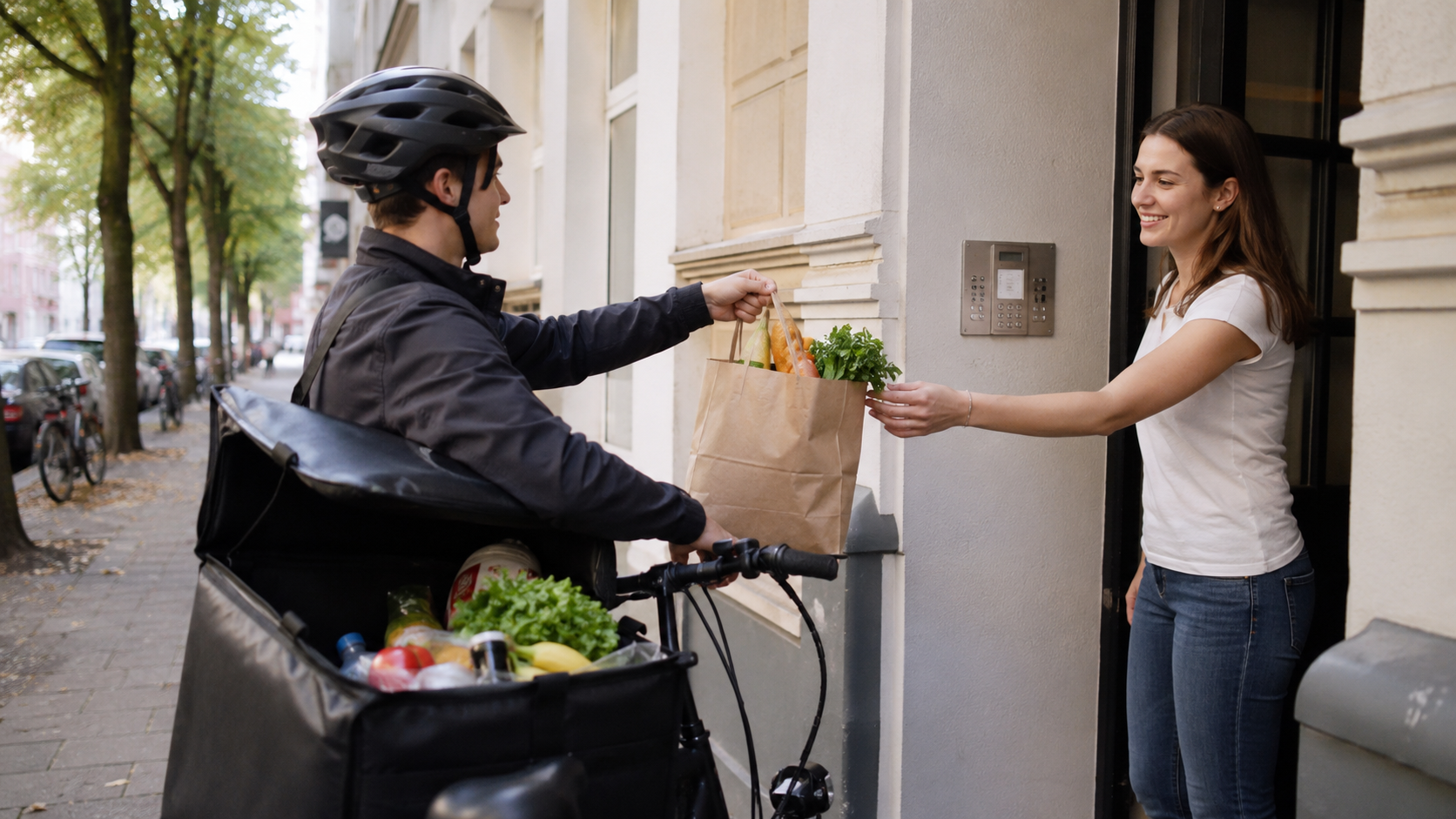
Quick commerce offers rapid delivery of locally available products. The customer sees a short delivery estimate; the retailer has to coordinate inventory, picking, dispatch, and the final handoff.
The key business question is whether customers value the speed enough to support the cost. A faster promise is not automatically a more profitable service.
Start with a focused assortment that customers need quickly and that staff can pick reliably. Products should fit the planned vehicles and handling process. Regulated goods, temperature-sensitive products, and restricted items require separate operational and compliance planning.
Define the service area using travel conditions and receiving requirements, not just a circle on a map. Apartment access, parking, traffic, and dispersed addresses can make two equally distant stops very different to serve.
A short delivery promise fails when the item shown online is missing from the shelf. Keep stock updates connected to the ordering process, reserve accepted orders, and give customers clear choices when an item is unavailable.
Consider the role of e-commerce logistics and last-mile delivery separately. Order processing and physical delivery must agree on when an order becomes ready for dispatch.
Start with product gross profit and the delivery fee received. Subtract picking, packaging, payment-related costs, transportation, and expected exception costs. Then assess whether the remaining contribution supports the fixed costs of the operation.
For illustration, an order producing $14 in product gross profit and a $5 delivery fee brings in $19 before fulfillment costs. If picking and packaging cost $4, delivery costs $10, and other variable costs total $2, the contribution is $3 before fixed overhead. These are hypothetical values, not market rates.
Discounting or a failed delivery can erase that contribution. Track outcomes for each delivery area rather than relying only on average order value.
A retailer can offer rapid delivery on selected products and a wider window on the rest. A minimum order value, an explicit delivery fee, or a smaller peak-time service area may improve the economics.
Same-day delivery does not necessarily require a promise measured in minutes. A dependable afternoon window may satisfy the customer at a lower operational cost. The multi-stop distribution guide explains where planned grouping can help.
If the process depends on automated booking and inventory updates, review the shipping API integration guide. Automating inaccurate stock data only makes the failure reach the customer faster.
Some rapid-delivery orders replace purchases that would have happened in-store anyway. Include that possibility when judging growth. A useful quick-commerce service adds customer value while covering its additional costs, rather than moving existing sales into a more expensive fulfillment channel.