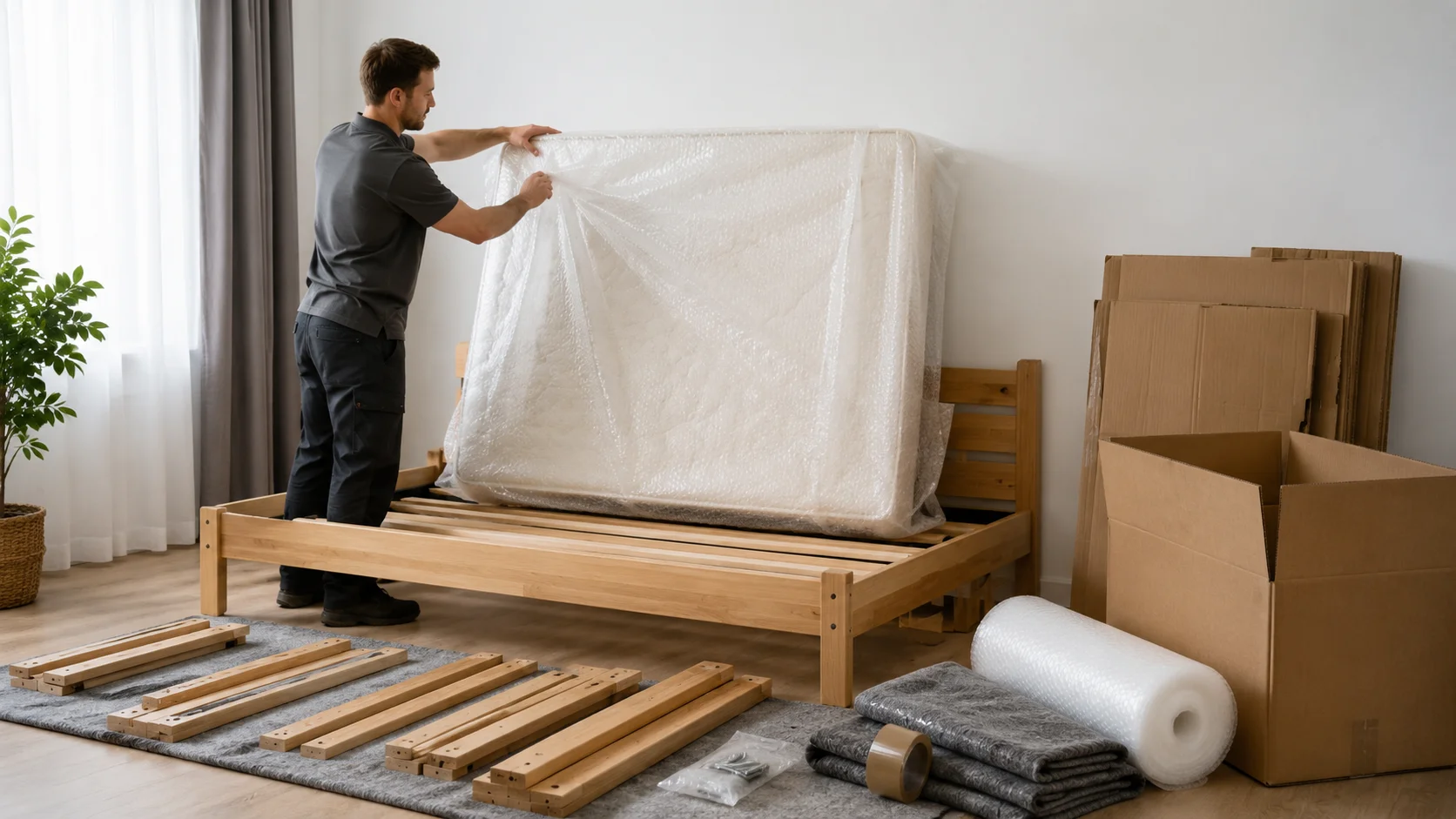
Shipping a bed can feel like a major challenge. Beds are bulky, heavy, and often emotionally valuable pieces of furniture. Whether you’ve sold a bed on eBay, are moving to a new city, or want to send it to family members, the question is always the same: how can you transport a bed safely, conveniently, and affordably from A to B?
The good news is that, with the right preparation and the right logistics partner, shipping a bed is far easier than most people expect. This complete guide explains everything step by step — from exact shipping costs and secure packaging to choosing the best transport method. That way, your bed arrives safely and damage-free.
How Much Does It Cost to Ship a Bed?
The most important question first: shipping a bed with a freight company within Germany usually costs between €80 and €250. There is no fixed price, as the final cost depends on four main factors:
Size & Weight
A lightweight single bed (90x200 cm) is much cheaper to transport than a heavy solid wood king-size bed (200x200 cm). The decisive factor is the total volume and weight of all packaged parts.
Service Level
Standard kerbside collection is the cheapest option. Additional services such as collection directly from inside your home or two-person handling will increase the price.
Insurance
Reputable freight companies usually include basic insurance based on weight. However, for an expensive designer bed or an antique heirloom, additional insurance coverage is highly recommended.
Tip: Use an online shipping calculator with your exact dimensions and the recipient’s postcode to receive a binding quote. This provides full price transparency and avoids unpleasant surprises.
Comparing Shipping Options: Freight Forwarder, Oversized Parcel or Part Load?
Choosing the right shipping provider is essential for a successful delivery. Not every option suitable for parcels also works for furniture such as beds. Let’s take a closer look at the available solutions.
Option 1: Shipping via Freight Company (Recommended)
For bed shipping, a professional freight company is the safest, most reliable, and often the only realistic option. Freight forwarders specialise in transporting large and heavy items and offer services tailored specifically to furniture shipping.
Advantages
- Collection directly from your address
- No need to transport heavy furniture to a parcel shop yourself
- Professional handling by trained staff
- Suitable vehicles minimise the risk of transport damage
- No strict size or weight restrictions like parcel services
- Transport insurance is usually included
Option 2: Shipping as Oversized Parcel
Sending a bed as oversized luggage with parcel services such as DHL or Hermes may sound convenient, but in 99% of cases it fails due to strict size restrictions. Even a disassembled bed frame often exceeds the permitted limits.
Limitations & Disadvantages
Maximum Dimensions
Most parcel services use strict dimensional formulas. A 200 cm side panel alone may already exceed the allowed size.
Weight Restrictions
Oversized parcels are generally limited to around 31.5 kg. Solid wood headboards or slatted frames can easily weigh more.
Higher Risk of Damage
Parcel sorting facilities are not designed for sensitive furniture. Scratches, dents, and breakages are significantly more likely.
Conclusion
Oversized parcel shipping is generally unsuitable for beds and bed components. It often results in rejection or transport problems.
Option 3: Shared Load Transport
A part-load shipment means your bed uses free space in a lorry already travelling along a similar route. This can be a cost-effective alternative but requires flexibility.
Advantages
- Often cheaper than booking a dedicated freight transport
Disadvantages
- Longer and less predictable delivery times
- Collection and delivery scheduling is less flexible
- The route depends on the main shipment
Preparation Is Everything: How to Disassemble and Package a Bed Properly
Careful dismantling and secure packaging are the best protection against transport damage. Take enough time for preparation — it is worth the effort. A scratch in the wood or a tear in the fabric is far more frustrating than spending an extra hour packaging properly.
Step 1: Disassemble the Bed
Break the bed down into manageable transport pieces systematically:
- Remove the mattress and slatted base
- Disconnect the headboard, footboard, and side panels
- Unscrew feet or decorative elements if necessary
Important Tip
Place all screws, dowels, and small parts into a resealable bag. Securely tape this bag to the inside of the largest bed component, such as the headboard. This prevents anything from getting lost.
Step 2: Use the Right Packaging Materials
Invest in proper packaging materials. You will need:
- Bubble wrap for protection against scratches and impacts
- Edge protectors made of foam or cardboard
- Corrugated cardboard sheets
- Stretch film to secure the packaging
- Strong parcel tape
Step 3: Packaging Instructions
Package every dismantled part individually, starting with the most delicate sections.
Protect the Edges
Attach edge protectors to all corners and long edges.
Wrap Carefully
Wrap each component in at least two layers of bubble wrap.
Add Extra Surface Protection
For glossy or lacquered wood surfaces, add a layer of cardboard before taping everything securely.
Secure with Stretch Film
Wrap the entire package tightly with stretch film. This keeps everything together and protects against dirt and moisture.
Special Case: How to Ship a Mattress
Mattresses require special handling depending on their type.
Rollable Mattresses
Foam and many memory foam mattresses are the easiest to transport.
- Roll the mattress as tightly as possible
- Secure it with strong straps or heavy-duty tape
- Wrap it fully in thick plastic sheeting or a mattress cover
In some cases, these can even be shipped as oversized rolls, although combining them with the bed shipment via freight company is usually the best solution.
Non-Rollable Mattresses
Spring mattresses and box spring mattresses must remain flat during transport.
Important:
Folding or bending can permanently damage the internal structure.
- Use a large plastic mattress protection cover
- Seal all openings carefully with tape
- Reinforce the corners with cardboard for additional protection
These mattresses should only be transported via freight forwarding services.
Common Bed Shipping Mistakes (And How to Avoid Them)
Learning from other people’s mistakes can save time, money, and frustration.
Incorrect Measurements
Always measure the packaged items, not the bare furniture. Incorrect measurements often result in expensive surcharges.
Poor Packaging
A simple rubbish bag does not protect against impacts. Insufficient packaging is the leading cause of transport damage and may void insurance coverage.
No Photos
Document the condition of the bed before dismantling and after packaging. These photos are extremely valuable in the unlikely event of damage claims.
Ignoring Insurance
Check the standard insurance coverage carefully. For high-value beds, additional insurance is usually worth the small extra cost.
Conclusion: With the Right Freight Company, Bed Shipping Becomes Easy
Shipping a bed does not need to become a stressful project. Once you rule out transporting it yourself or using unsuitable parcel services, the best solution becomes clear: professional freight shipping.
A freight company handles the hardest work, provides the necessary insurance, and ensures your bed arrives safely thanks to professional transport handling. Combined with careful dismantling and robust packaging, you create the perfect conditions for a smooth delivery process.
Save yourself time, stress, and the risk of damage — leave the logistics to the professionals.
Calculate your bed shipping costs today and receive a transparent quote in just a few clicks.
 Dansk
Dansk
 Deutsch
 Eesti
Eesti
 English (GB)
 Español
 Français
 Hrvatski
 Italiano
 Latviešu valoda
 Lietuviškai
 Magyar
 Nederlands
 Norsk Bokmål
 Polski
 Português
 Română
 Slovenčina
 Slovenščina
 Suomi
Suomi
 Svenska
 Čeština
 Ελληνικά
 Русский
 Українська
 български
 العربية
 中文 (中国)
 English