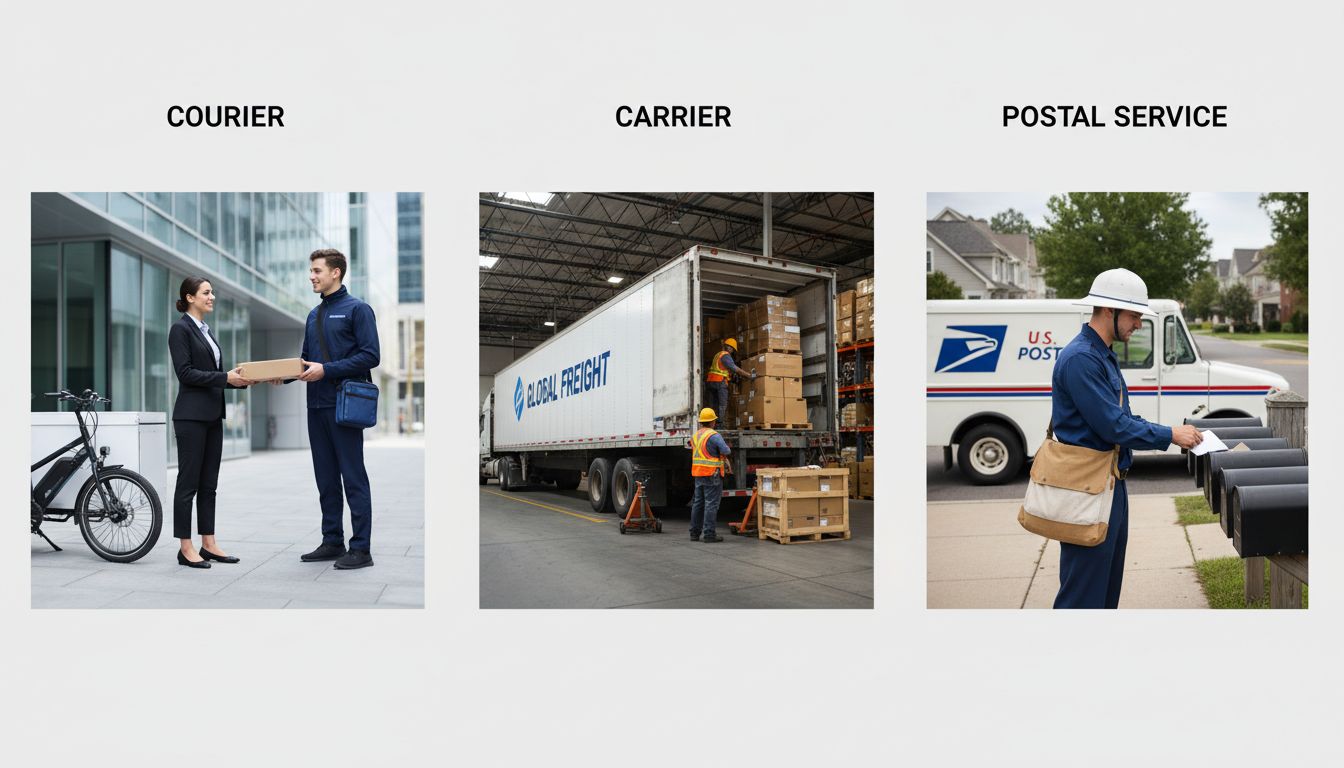
Choosing the right delivery service has a direct impact on speed, cost, and reliability. Courier services, carrier services, and postal services all play important roles in logistics, but they serve very different purposes. Some are built for urgent, door-to-door deliveries, while others specialize in transporting large volumes of goods across countries or even continents. This comprehensive guide explains the differences in detail, so you can confidently decide which option best fits your shipping needs.
The main difference lies in speed, shipment size, and delivery method. Couriers offer fast, direct deliveries, carriers transport large volumes over long distances, and postal services handle small shipments at lower cost but slower speed.
A carrier is a logistics organization that transports goods over long distances. Carriers typically manage bulk shipments, heavy freight, and large volumes of goods across cities, countries, and continents. Unlike couriers, carriers generally do not provide door-to-door delivery. Instead, shipments move between ports, terminals, warehouses, and distribution centers.
There are three main types of carriers in the logistics industry. Common carriers transport goods for multiple customers and operate under government licenses. Contract carriers work long term for a single shipper, ranging from individual owner-operators to global corporations. Private carriers are owned by companies and transport only their own goods.
Carrier services are slower than couriers but far more cost-efficient for large shipments. Delivery times often range from several days to multiple weeks, depending on distance and transport mode.
Carriers operate with multiple transportation methods. Road transport relies on box trucks and semi-trucks and is flexible for short and medium distances. Air freight is the fastest option for international shipments but also the most expensive. Sea freight uses cargo ships and is the most cost-effective method for transporting large volumes globally, although it is slower and less flexible. Rail transport is efficient for long inland distances and bulk cargo.
Well-known global carrier providers include Amazon, DHL, A.P. Moller – Maersk, and Kuehne + Nagel International AG.
Carriers mainly transport shipments weighing more than 100 pounds up to several tons. This includes pallets, containers, and sometimes hazardous materials requiring special permits and secure destinations. Because carriers move large quantities at once and are not constrained by tight delivery windows, their cost per unit is usually lower than courier services.
However, efficiency comes at the expense of speed. Shipments pass through warehouses, sorting facilities, and multiple vehicles. This increases transit time and slightly raises the risk of damage or loss.
A postal service is typically government-operated and legally required to deliver to all addresses within a country. A common example is USPS. Postal services mainly deliver letters, documents, and small parcels up to 70 pounds.
Delivery vehicles include postal trucks, vans, and small cars. Tracking and routing systems are often limited compared to private logistics providers. Standard delivery times range from one day to a full week. Overnight and express options exist but can be costly.
Postal services are ideal for low-value, non-urgent shipments. The downsides include slower delivery, size restrictions, and a higher risk of damage because parcels are often transported loosely with many other items.
A courier service focuses on fast, door-to-door delivery. Couriers can deliver shipments within an hour, the same day, or by the next day, depending on the service selected. They handle everything from envelopes to pallets and prioritize direct transport without unnecessary stops.
Large courier companies operate fleets of scooters, sedans, cargo vans, and box trucks. Because shipments are usually transported directly from pickup to delivery, couriers offer the highest level of control and security.
Courier services come in many forms. Rush or hot shot couriers provide immediate pickup and direct delivery, often within hours. Same day couriers deliver by the end of the day and are more affordable than rush services. Nationwide couriers operate networks of drivers across major cities and regions. On-demand couriers wait for customer requests and perform direct deliveries only.
Local couriers serve limited geographic areas and usually transport smaller items. Legal couriers specialize in court filings and confidential documents, maintaining strict chain-of-custody procedures. Overnight couriers guarantee next-day delivery if packages are picked up before a specific cutoff time and offer a balance between speed and cost.
| Feature | Courier Service | Carrier Service | Postal Service |
|---|---|---|---|
| Delivery speed | Minutes to same day | Days to weeks | 1–7 days |
| Delivery type | Door to door | Terminal to terminal | Door to door |
| Shipment size | Envelope to pallets | Bulk freight, containers | Small parcels |
| Cost | Highest | Lowest per unit | Low |
| Security | Very high | Medium | Lower |
A carrier service is best when shipping large quantities, heavy freight, or international cargo without urgent deadlines. A postal service is suitable for small, inexpensive items that are not time-sensitive. A courier service is the right choice when speed, precision, fragile goods, or strict delivery times matter most.
Asking three simple questions helps guide the decision. Does the shipment need to arrive fast? Is it large or heavy? Is door-to-door delivery required? The answers clearly point to the correct service.
Courier services, carrier services, and postal services each serve a distinct purpose. Couriers deliver speed and reliability, carriers provide efficiency for large-scale transport, and postal services offer affordability for small shipments. Understanding these differences ensures smoother logistics, lower costs, and fewer delivery problems. When timing and safety are critical, investing in the right delivery service makes all the difference.


