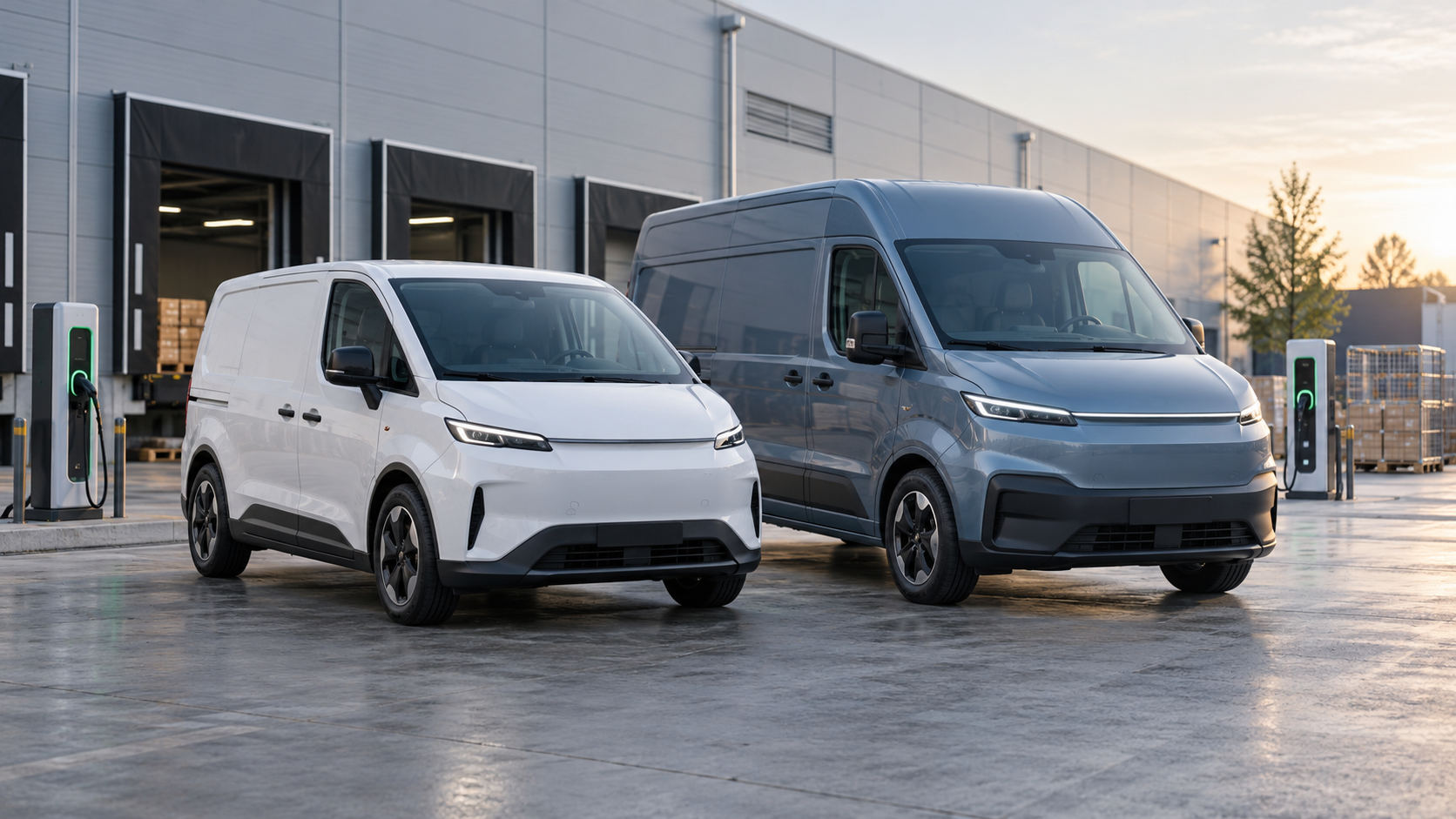
Kia PV5 Cargo or Renault Trafic E-Tech? These electric commercial vans target different jobs. The compact Kia is built for urban routes and frequent stops, while the larger Renault offers more payload, cargo room, towing capacity, and faster charging. This guide compares the numbers that matter to couriers, service fleets, and logistics operators.
Quick verdict
- Kia PV5 Cargo: up to 416 km (258 miles) WLTP range, 4.4 m³ of cargo space, two Euro pallets, and up to 790 kg (1,742 lb) of payload.
- Renault Trafic E-Tech: about 450 km (280 miles) WLTP, up to 5.8 m³, three Euro pallets, roughly 1,250 kg (2,756 lb) of payload, and 2,000 kg (4,409 lb) towing.*
- The best van is determined by real cargo weight, longest route, charging downtime, and depot infrastructure—not range alone.
Kia PV5 Cargo vs. Renault Trafic E-Tech specs
| Specification | Kia PV5 Cargo | New Renault Trafic E-Tech |
|---|
| Vehicle class | Compact electric van | Midsize electric van |
| WLTP range | 297 or up to 416 km | nearly 350 or about 450 km* |
| Battery | 51.5 / 71.2 kWh | LFP Urban Range / NMC Long Range |
| DC fast charging | 10–80% in about 30 min | 15–80% in about 20 min |
| Payload | up to 790 kg | up to about 1,250 kg* |
| Cargo volume | 4.4 m³; 2 Euro pallets | up to 5.8 m³; 3 Euro pallets |
| Braked towing | up to 750 kg | up to about 2,000 kg* |
| Market status | available to order | orders announced from fall 2026 |
* Some Renault figures remain subject to final homologation. Real range varies with load, speed, temperature, HVAC use, and body configuration.
Cargo space and loading ergonomics
The Kia measures 4,695 mm long and 1,895 mm wide. Its box-shaped 4.4 m³ cargo bay fits two Euro pallets. A 419 mm rear step-in height cuts effort and handling time across dozens of daily stops. That is valuable for parcel delivery, field service, and mobile technicians.
The Trafic sits one class higher. Renault lists up to 5.8 m³, room for three Euro pallets, and payload of roughly 1.25 metric tons. This margin suits shop equipment, machinery, and dense freight. If your operation rarely needs more than two pallets, however, a larger van may add cost and footprint without adding revenue.
Range in real-world operations
The PV5 is rated for up to 297 km with the 51.5-kWh battery and up to 416 km with 71.2 kWh. The smaller pack may be the lowest-cost choice for fixed urban and regional routes when dependable overnight charging is available.
Renault plans an LFP Urban Range battery with nearly 350 km and an NMC Long Range version around 450 km WLTP. The extra buffer helps with freeway miles, winter weather, detours, and second shifts.
Do not schedule a route to the last percent. Apply an operating reserve for cold or hot weather, higher speeds, climate control, full payload, and charger availability. A suitable van should complete the longest recurring route under unfavorable—not ideal—conditions.
Charging and downtime
Kia quotes about 30 minutes from 10 to 80% under optimal conditions. That is adequate for fleets that mainly charge at the depot and use public fast charging only on exceptional runs.
Renault's 800-volt architecture is expected to charge from 15 to 80% in about 20 minutes and recover roughly 260 km of range. The time advantage matters most for two-shift operation or long routes with short breaks. It only materializes when a charger can deliver the required power.
Check payload before range
PV5 payload changes with battery and door configuration. The heavier Long Range pack reduces available payload. Count the driver, shelving, tools, safety equipment, and accessories before comparing the remaining capacity with typical freight.
The Trafic's announced 1,250 kg payload and two-ton towing rating make it better suited to heavy work. Because final figures are still pending in some markets, confirm homologated specifications before committing to an expensive body or upfit.
Which van should you choose?
Choose the Kia PV5 Cargo if:
- your routes are urban, access is tight, and stops are frequent;
- two Euro pallets are enough;
- cargo and equipment fit within roughly 700–790 kg;
- daily mileage is predictable and overnight charging is available;
- a low load floor and easy maneuvering are priorities.
Choose the Renault Trafic E-Tech if:
- you need three pallets or bulky freight;
- high payload or trailer use is routine;
- regional and freeway routes are long;
- short fast-charging stops are business-critical;
- special upfits and advanced fleet software are required.
Compare total cost of ownership
Purchase price is only one line. Model annual energy, charging losses, financing or lease payments, insurance, maintenance, tires, charging equipment, and residual value. Add productivity: charger detours, waiting time, and an extra run caused by insufficient payload can outweigh a lower sticker price.
In Germany, Kia lists the 51.5-kWh PV5 from €33,100.84 net before delivery. Final pricing for the new Trafic has not yet been published. A fair TCO comparison therefore requires a specific configuration, duty cycle, and annual mileage.
Fleet checklist before ordering
- How long is the longest recurring winter route?
- What do freight, driver, shelving, and tools weigh together?
- How many pallets or roll cages move at once?
- Can every van charge overnight at the depot?
- Is public fast charging normal operation or backup only?
- What does one hour of downtime or an additional run cost?
Run a one- or two-week trial with representative cargo. Record energy use, charging time, remaining range, maneuvering effort, and loading time.
Bottom line
The Kia PV5 Cargo is the compelling specialist for compact, high-frequency urban and regional work. It combines useful range, a low cargo floor, and a space-efficient body. The Renault Trafic E-Tech is the more capable choice on paper when three pallets, heavier loads, trailer duty, or very short charging stops are essential. There is no universal winner: choose the van sized for your actual route and cargo.
FAQ
Which van has more range?
Renault currently targets about 450 km WLTP, while Kia rates the PV5 at up to 416 km. Some Renault figures are still pending final approval.
How many Euro pallets fit?
The Kia fits two Euro pallets. Renault says the new Trafic will carry three.
Which one charges faster?
Renault targets about 20 minutes from 15 to 80%; Kia quotes about 30 minutes from 10 to 80%.
Is the Kia PV5 Cargo suitable for express delivery?
Yes. It is especially well suited to predictable urban and regional routes with frequent stops and moderate payloads. Larger or heavier urgent freight may justify a midsize van.
Sources
 Dansk
Dansk
 Deutsch
 Eesti
Eesti
 English (GB)
 Español
 Français
 Hrvatski
 Italiano
 Latviešu valoda
 Lietuviškai
 Magyar
 Nederlands
 Norsk Bokmål
 Polski
 Português
 Română
 Slovenčina
 Slovenščina
 Suomi
Suomi
 Svenska
 Čeština
 Ελληνικά
 Русский
 Українська
 български
 العربية
 中文 (中国)
 English