Flatbed Trucking: Trailer Types, Costs and Shipping Checklist
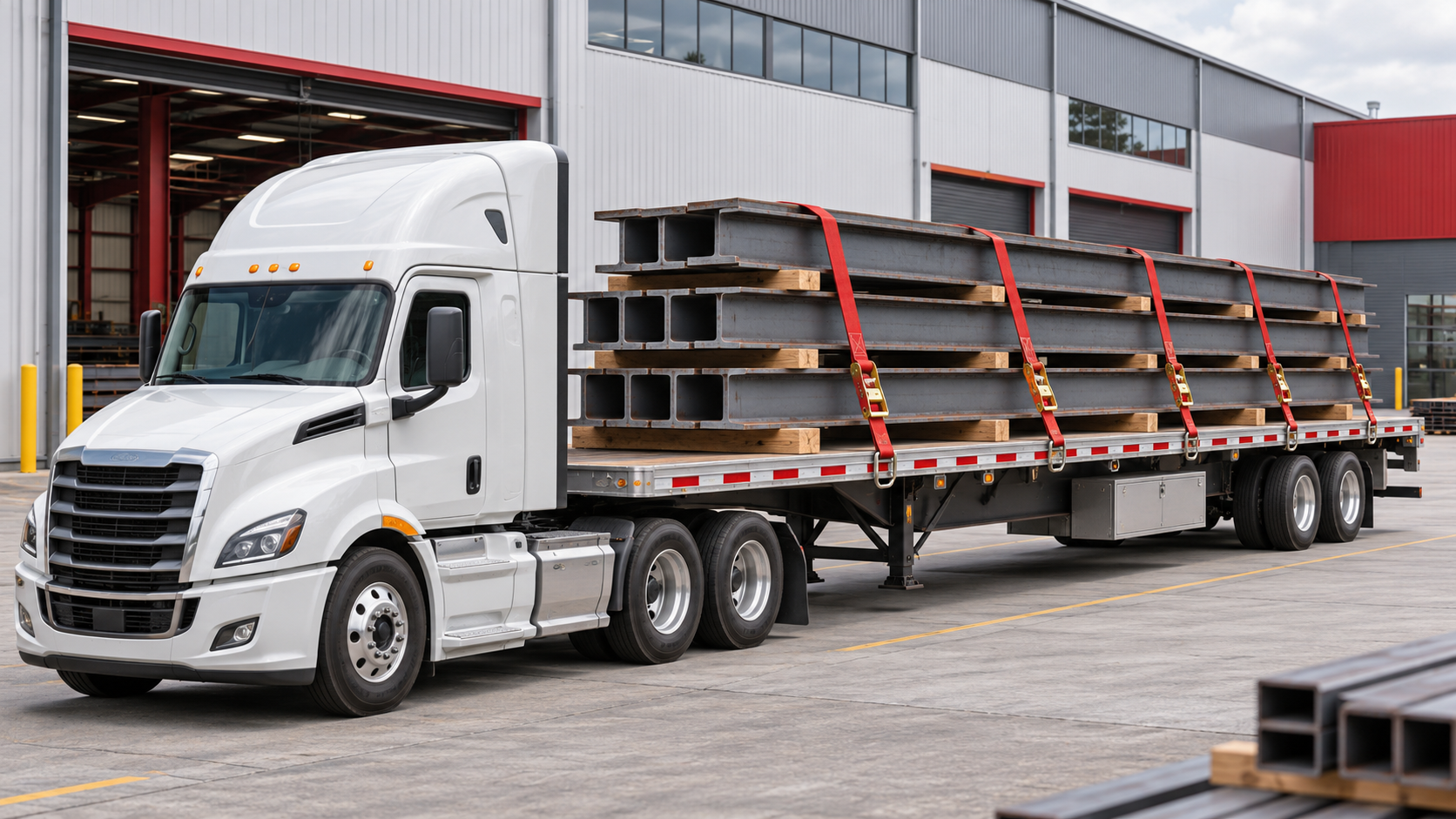
Flatbed trucking moves freight on an open trailer without fixed sides or a roof. It is useful when cargo needs side or overhead loading, has an unusual shape or does not suit an enclosed trailer. The open deck improves access, but it also makes weather protection, load securement and accurate equipment selection central to the shipment plan.
This guide explains the advantages and limitations, compares common trailer configurations and gives shippers a practical checklist for requesting a usable flatbed quote.
Table of contents
When should you use flatbed trucking?
Start with how the cargo can be loaded, supported and protected. A long fabricated assembly may need crane access from above. Bundled material may be easier to load from the side. A machine may require a lower deck or a drive-on loading arrangement rather than a standard flatbed.
Common candidates include structural components, building materials and suitably prepared industrial equipment. The commodity name alone is not enough to select a trailer: dimensions, weight distribution, lifting points, packaging and weather sensitivity determine the practical fit.
Flatbed advantages and trade-offs
Match each advantage to its planning requirement
Potential advantage
What it helps with
What to check
Open loading access
Side loading and overhead lifting.
Suitable lifting equipment, clear working space and agreed responsibilities.
Flexible cargo geometry
Freight that does not fit through an enclosed trailer door.
Actual loaded dimensions, support points and route restrictions.
Specialized deck options
Taller, longer or machinery-related loads.
The exact trailer configuration, capacity and loading method.
Direct project delivery
Movement to a prepared industrial or construction receiving site.
Access, ground conditions, appointment and unloading readiness.
The corresponding disadvantages are exposure to weather and road spray, additional preparation work, and potentially more complex loading and securement. Open access does not automatically make a load quicker or safer to handle. The outcome depends on the equipment and the plan.
Common flatbed and open-deck trailer types
Standard flatbed
A generally level open deck provides access from above and the sides. It can suit material and equipment that fit the available dimensions and load ratings. Confirm the specific trailer rather than relying on a generic capacity figure.
Step deck or drop deck
A lower main deck can provide additional vertical cargo space compared with a standard-height deck. Deck lengths and the transition between levels affect where the load can sit. A lower deck does not automatically make an overheight shipment legal on every route.
Double drop or lowboy
A particularly low well can suit tall equipment. Usable well length, ground clearance and axle configuration are important. These trailers are specialized equipment, not interchangeable substitutes for an ordinary flatbed.
Removable gooseneck (RGN)
A detachable front section can allow suitable machinery to load from the front. Confirm the approach, clearance, machine mobility and support requirements. Not every machine can simply be driven onto any RGN.
Extendable trailer
An extendable configuration can support longer cargo. The extended length, support spacing and resulting capacity must be checked for the actual equipment. Additional route or permit requirements may apply.
Rolling-tarp system
A retractable cover can combine access with weather protection. Its internal clearance, loading sequence and suitability for the cargo still need confirmation. A cover is not automatically temperature control or a substitute for protective packaging.
Smaller open-deck or hot shot equipment
A smaller trailer may suit certain lighter loads and routes. Payload, towing configuration, securement and service requirements remain decisive. “Hot shot” describes an operating segment, not a universal promise of immediate delivery. See our hot shot trucking guide for the broader service comparison.
Dimensions, payload and permits: avoid universal assumptions
Trailer dimensions and permissible cargo weight vary with the equipment, tractor, axle arrangement, route and applicable limits. A trailer's advertised structural rating is not the same as the legal payload available for your journey.
Provide the complete packed length, width and height, plus the gross weight and support requirements. The loaded vehicle's overall dimensions matter as well as the cargo itself. Our US truck and trailer dimensions guide explains why cargo space and road limits need to be considered separately.
Oversize or overweight movements can require permits, route approval and additional conditions from the relevant authorities. Requirements vary by jurisdiction and load. Use the FHWA directory of state oversize and overweight permit contacts to identify the responsible permitting offices. Confirm the route-specific arrangements before scheduling the move.
Weather protection and securement are separate questions
A tarp protects against some exposure; it does not secure the cargo. Likewise, a well-secured load can still suffer weather damage if the packaging is unsuitable. Specify moisture sensitivity, surface protection and any cover restrictions when requesting the quote.
The FMCSA cargo securement rules include general requirements and provisions for particular commodities. The carrier and qualified loading personnel need to determine the appropriate securement arrangement for the actual cargo, vehicle and equipment. A generic strap count from an online example is not a loading plan.
Provide available drawings, photographs, center-of-gravity information and manufacturer lifting or transport instructions. Identify suitable support and attachment points. Agree who supplies blocking, protective materials and loading equipment, and who checks the shipment before departure.
What affects flatbed shipping cost?
Lane and dates: origin, destination, available equipment and scheduling flexibility.
Trailer specification: standard or specialized deck, usable length, payload and loading configuration.
Cargo: dimensions, weight distribution, protection and handling requirements.
Site work: loading time, cranes or forklifts, appointment restrictions and waiting time.
Route requirements: applicable permits, escorts or other approved movement conditions.
Additional services: covering, special materials, extra stops or changes after booking.
There is no meaningful universal flatbed price per mile for every load. Request a complete quote for the actual shipment and ask which assumptions could change the charge. Our freight quote comparison guide provides a useful framework.
Flatbed vs. dry van vs. dedicated box truck
Choose flatbed when open access or cargo geometry calls for it. Consider an enclosed trailer when the freight fits its doors and interior and benefits from enclosure. For a smaller compatible shipment, a dedicated box truck may offer suitable capacity without reserving a full-size trailer.
Equipment and capacity model are separate decisions. Flatbed describes the vehicle configuration; full truckload describes reserving capacity. Some open-deck freight can move as a partial load where the provider accepts the dimensions and handling requirements. The LTL vs. FTL comparison explains that distinction.
Three examples of the equipment decision
Long fabricated components loaded by crane
Open access may make flatbed appropriate. Confirm supported length, lifting arrangements, surface protection and the final loaded dimensions. A legal route and suitable support plan are more important than the nominal trailer length alone.
A tall industrial machine
Compare lower-deck options using the machine's transport dimensions and weight distribution. Clarify whether it can move under its own power or needs lifting equipment. Do not assume that selecting a lowboy removes every permit or access requirement.
A weather-sensitive pallet that fits an enclosed vehicle
Flatbed may introduce protection and handling work without a clear advantage. Compare enclosed equipment and the required delivery service. For suitable cargo, box truck freight may be an alternative to discuss.
Flatbed quote checklist: what to send
Origin and destination addresses, including site access instructions.
Ready date, receiving appointment and any hard delivery deadline.
Accurate commodity description and quantity of separate pieces.
Packed dimensions and gross weight of each piece.
Drawings or photographs showing shape, support points and protrusions.
Loading and unloading method at each end, including available equipment.
Weather sensitivity, packaging and covering requirements.
Known lifting, support and securement restrictions.
Site working hours, maneuvering space and ground conditions.
Written confirmation of equipment, included charges and responsibility for any required permits or additional services.
How to discuss the shipment with DAGO Express
Send the full cargo and route information before choosing a vehicle. For US movements, DAGO Express Inc. is a freight broker arranging transportation with independent motor carriers. Flatbed or specialized equipment availability must be confirmed for the particular load; this educational guide is not a blanket offer of heavy-haul or oversize services.
Review business transportation options and ask which accepted equipment and service can meet your requirements. If an enclosed or smaller dedicated vehicle is suitable, compare that option as well.
Frequently asked questions
Is flatbed trucking only for oversized cargo?
No. Legal-size cargo may use flatbed because side loading, overhead lifting or its shape makes an open deck practical.
Does flatbed automatically mean full truckload?
No. Equipment type and capacity arrangement are different. Ask whether the provider offers an appropriate partial-load option and how it affects handling and timing.
Can a tarp replace weather-resistant packaging?
Do not assume so. Confirm the protection needed for the cargo and the limits of the proposed covering arrangement.
Who arranges a crane at delivery?
That must be agreed before booking. State what the receiving site can provide and obtain written confirmation of any additional service.
What is the most common quoting mistake?
Providing incomplete dimensions or describing the cargo only by total weight. Shape, support points, loading access and protection requirements can change the equipment and the price.
 Dansk
 Deutsch
 Eesti
 English (GB)
 Español
 Français
 Hrvatski
 Italiano
 Latviešu valoda
 Lietuviškai
 Magyar
 Nederlands
 Norsk Bokmål
 Polski
 Português
 Română
 Slovenčina
 Slovenščina
 Suomi
 Svenska
 Čeština
 Ελληνικά
 Русский
 Українська
 български
 العربية
 中文 (中国)
 English