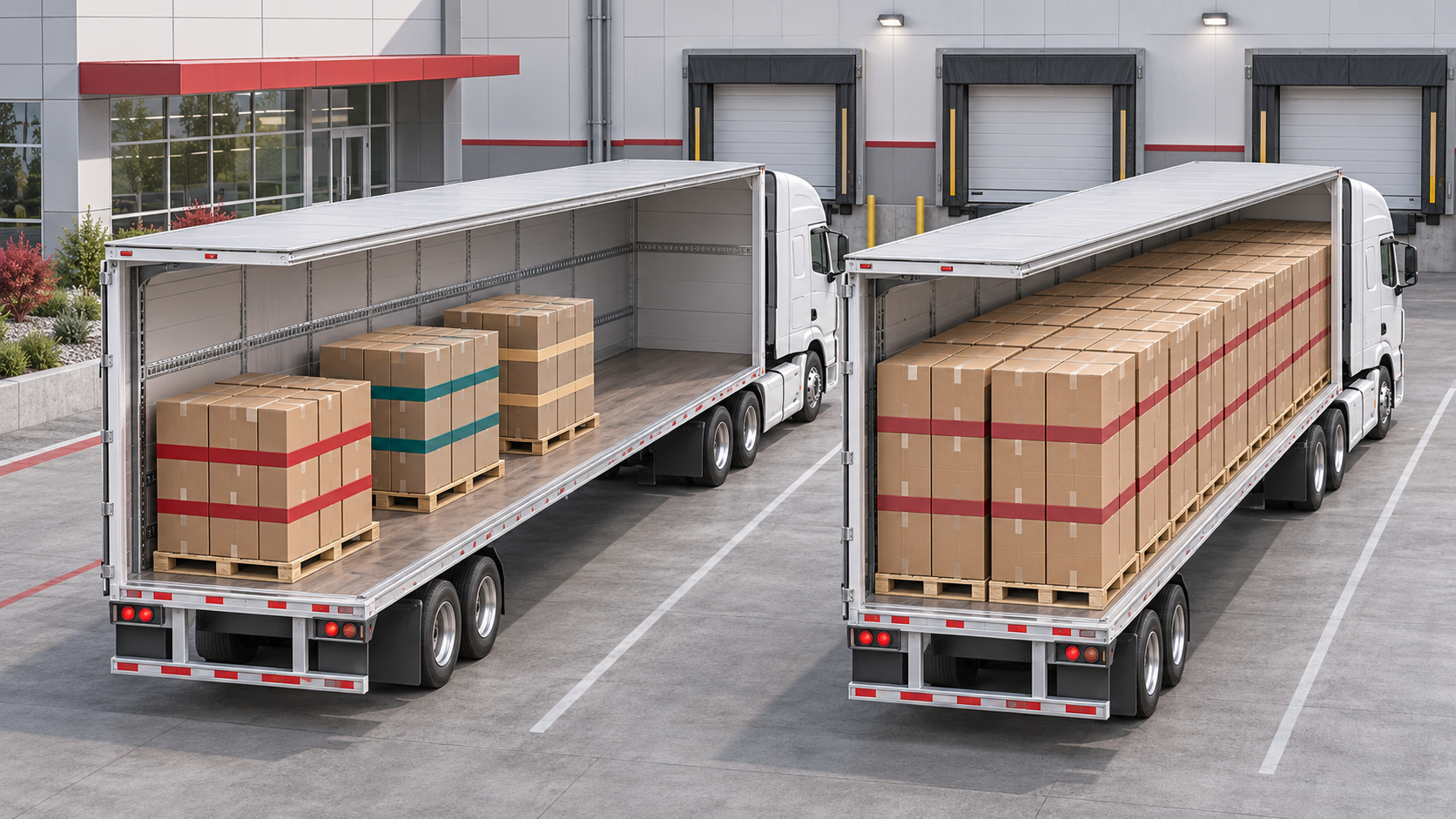
LTL vs. FTL Shipping: Differences, Costs and How to Choose
The main difference between LTL and FTL is how you buy truck capacity. Less-than-truckload (LTL) combines freight from several shippers. Full truckload (FTL) reserves a truck or trailer for one shipment, even when it is not completely full. Choose by total cost, handling requirements and the delivery commitment—not pallet count alone.
For a small, robust shipment with a flexible receiving window, LTL is often a sensible starting point. For a large load, sensitive cargo or a requirement to avoid terminal transfers, compare FTL. An urgent small shipment may need a dedicated cargo van or box truck instead of either conventional option.
Table of contents
LTL vs. FTL: the differences at a glance
Compare the actual service offered on your lane
Decision factor
LTL shipping
FTL shipping
Capacity
Shared with other shippers.
Reserved for one shipment; unused space may remain.
Typical routing
Pickup, consolidation, line haul and local delivery; terminal transfers may occur.
Usually moves between the agreed loading and delivery points without terminal sorting.
Pricing inputs
Lane, dimensions, weight, commodity/classification, service and accessorials.
Lane, equipment, dates, capacity, loading requirements and accessorials.
Handling
Potentially several loading and unloading events.
Generally fewer cargo transfers; confirm the actual routing.
Timing
Network schedules and delivery appointments affect transit.
Can avoid consolidation time, but is not automatically expedited or guaranteed.
Best starting point
Smaller, well-packaged loads with flexible timing.
Larger loads or shipments needing exclusive capacity.
Key question
What handling and delivery services does the quoted rate include?
What vehicle, route and delivery commitment am I reserving?
What is LTL shipping?
LTL means less than truckload. A carrier consolidates smaller consignments so several customers share the cost of moving freight. A typical pallet shipment may travel from a local pickup route to a terminal, then on a longer line-haul movement before final delivery.
The price reflects more than the number of pallets. Packed dimensions, gross weight, stackability, the goods themselves and delivery requirements all matter. In US LTL, the applicable NMFC item and freight class may affect rating. Accurate measurements help avoid reclassification and billing disputes. See our palletized freight and LTL shipping guide for preparation details.
What is FTL shipping?
FTL means full truckload. The shipper reserves the relevant vehicle or trailer capacity for a load. “Full” describes the service arrangement, not a requirement to use every inch of the trailer. A shipment can justify FTL because of size, handling sensitivity or the need for exclusive space.
A standard truckload booking is not a promise of immediate pickup or nonstop movement. Driving limits, appointment availability, equipment and the agreed itinerary still matter. Specify whether there are additional stops, trailer changes or special loading requirements. Our full truckload shipping page explains the option to discuss for a dedicated larger load.
Which is cheaper: LTL or FTL?
For a smaller shipment, shared capacity may cost less than reserving a whole truck. As floor space, weight or extra handling requirements increase, that advantage can narrow or disappear. There is no universal pallet-count threshold at which FTL becomes cheaper. Obtain comparable quotes for the same lane, dates, goods and delivery conditions.
Compare these three layers:
Quoted transportation: the base rate, fuel surcharge and equipment.
Required additional services: liftgate, appointment, limited access, waiting time, storage or redelivery.
Your business exposure: the operational consequence of missed delivery, extra handling or unavailable unloading equipment.
A simple break-even example
Illustrative figures only—not DAGO Express rates or market averages. Imagine an LTL quote of $650 plus $150 for required services, totaling $800. An FTL quote for the same shipment is $1,250 with those required services included. The quoted premium for FTL is $450.
If both services meet your handling and delivery needs, the $800 option may be the better purchase. If the direct option demonstrably reduces a business risk, compare that reduction with the $450 premium. For example, a hypothetical 15-percentage-point reduction in the likelihood of a $4,000 disruption represents $600 in expected avoided cost: 0.15 × $4,000. Under those assumptions, paying $450 more could make sense.
The risk figures are assumptions, not measured performance differences between modes. Replace them with evidence from your lane and operation. Do not assume FTL eliminates delays or damage. Our freight quote comparison guide helps you compare what is actually included.
How shipment size, density and floor space change the decision
Two loads with the same pallet count can require very different capacity. Compare their loaded footprint, height, gross weight, stackability and ability to fit through the vehicle opening. A light but bulky, non-stackable load can consume more useful space than a denser shipment.
For example, a packed handling unit measuring 48 × 40 × 40 inches occupies about 44.44 cubic feet. If its gross weight is 480 lb, its density is approximately 10.8 lb per cubic foot. Include the pallet and packaging in both measurements. This calculation does not, by itself, establish every commodity's NMFC class; verify the applicable item and rules. NMFTA explains the role of density in freight classification.
For a larger load, request an equipment and loading-plan check. Do not assume every trailer has the same usable dimensions or payload, or that a quoted number of pallet spaces fits your actual layout.
For cargo requiring side or overhead loading, see our flatbed trucking guide. Trailer configuration and the decision to reserve exclusive capacity are separate questions.
Transit time and handling: what changes in practice?
A conventional LTL network introduces consolidation and sorting stages. A direct truckload movement can avoid those stages. That can be valuable, but the service label alone does not tell you when freight will arrive.
Ask whether pickup and delivery times are estimates, appointment windows or explicit commitments.
Confirm the expected number of cargo transfers and whether the shipment stays on the same vehicle.
Check how missed appointments, access problems and after-hours delivery are handled.
Agree who provides updates, who responds to an exception and what proof of delivery you receive.
Fewer handling events may reduce opportunities for handling damage, but good packaging remains essential. High-value, fragile, temperature-sensitive or regulated cargo needs a service specifically accepted for those requirements. Neither “LTL” nor “FTL” alone establishes suitability.
Where partial truckload and dedicated express fit
The choice is not always binary. Partial truckload can suit freight that occupies a substantial part of a trailer without requiring all its capacity. Providers use the term differently, so ask whether the proposed movement involves terminal transfers and how space is charged.
For one urgent pallet or a small critical load, compare a dedicated delivery using equipment sized to the shipment. The operational requirement may be exclusive use and direct routing, not a full-size trailer. Expedited freight is worth discussing when the arrival deadline drives the decision.
A five-question LTL vs. FTL decision checklist
Can the goods tolerate the proposed handling? If not, request an accepted direct or specialist service before comparing price.
What is the real receiving deadline? Separate a preferred date from a deadline that would interrupt production or a customer commitment.
How much usable capacity does the load need? Send packed dimensions, gross weights and stackability for every handling unit.
Can both sites load and unload the proposed vehicle? Confirm docks, forklifts, liftgates, access restrictions and appointments.
Which complete offer meets those requirements at the best total cost? Compare included charges and written service arrangements.
Three shipping examples
Two pallets of robust spare parts for routine replenishment
The consignee has a forklift, the packaging is suitable for terminal handling and the delivery date is flexible. Start with an LTL quote. Confirm the commodity details and required accessorials. There is no obvious reason to reserve a whole trailer solely because the goods are business-critical in general.
A large, non-stackable display shipment
The load takes substantial floor space and must arrive for an installation appointment. Compare LTL, partial truckload and FTL using the actual footprint. Ask how transfers affect the display packaging and whether the receiver can accept the proposed vehicle. FTL may be appropriate even if the trailer has unused volume.
One replacement component needed for a stopped production line
The shipment is small, but delay has a high operational cost. Compare an accepted expedited option with a dedicated vehicle sized to the packed component. Obtain a feasible pickup and delivery plan. Buying a larger truck than necessary does not automatically improve the outcome.
Is LTL more sustainable than FTL?
Consolidation can improve vehicle utilization, but LTL is not automatically the lower-emission choice for every shipment. Routing, terminal activity, equipment, load factors and empty running affect the comparison. A well-utilized direct truckload may perform differently from a lightly loaded or circuitous alternative. Ask for shipment-specific estimates calculated on a consistent basis rather than relying on a mode label.
What to send when requesting comparable quotes
Provide origin and destination ZIP codes, ready date, receiving hours, required arrival time, a precise commodity description, handling-unit count, packed dimensions, gross weights and stackability. Add loading equipment, access restrictions, special requirements and the value or protection requirements relevant to the booking. Ask for itemized charges, routing and handling details, transit terms and the exception contact.
Need a direct alternative for your US shipment? Compare full truckload with dedicated delivery and request the equipment appropriate to your load. DAGO Express Inc. is a freight broker arranging transportation with independent motor carriers. Availability, price and timing depend on the confirmed shipment and route.
Frequently asked questions
How many pallets make a full truckload?
There is no single count that applies to every shipment. Pallet dimensions, stacking, cargo weight and trailer configuration determine what fits. You can also reserve truckload capacity without physically filling the vehicle.
Is FTL always faster than LTL?
No. Direct routing can avoid terminal consolidation, but pickup availability, distance and appointments still matter. Compare the actual offered transit commitment.
Can I ship one pallet by FTL?
You can reserve exclusive capacity for a small load, but a smaller dedicated vehicle may be more appropriate. Check dimensions, weight, handling needs and the delivery deadline.
Does FTL mean my freight is fully insured?
The transport mode does not define the insurance protection. Check applicable liability terms, exclusions and any additional cargo coverage offered for the booking.
Should I choose LTL solely because the quote is lower?
Only after checking that the quoted service meets your requirements. Include necessary accessorials and the consequences of delay or unsuitable handling in the comparison.
 Dansk
 Deutsch
 Eesti
 English (GB)
 Español
 Français
 Hrvatski
 Italiano
 Latviešu valoda
 Lietuviškai
 Magyar
 Nederlands
 Norsk Bokmål
 Polski
 Português
 Română
 Slovenčina
 Slovenščina
 Suomi
 Svenska
 Čeština
 Ελληνικά
 Русский
 Українська
 български
 العربية
 中文 (中国)
 English