Truck and trailer dimensions: US width, height and cargo space
US truck dimensions are not the same as European lorry dimensions. On the National Network, the federal commercial-vehicle width standard is 102 inches, interpreted as the approximate metric equivalent of 2.6 m; Hawaii has a specific exception. There is no federal vehicle-height limit. State limits and the actual route must be checked.
For a shipment, ask for three different measurements: the vehicle's exterior dimensions, usable cargo dimensions, and clear loading-door opening. A trailer described as “53-foot” does not provide 53 feet of unobstructed interior space.
Table of contents
US truck and trailer dimensions at a glance
Measurement
Planning reference
What to check
Width on the National Network
102 in; federal interpretation approximately 2.6 m
Applicable route, excluded safety devices and state-specific exceptions
Vehicle height
No uniform federal maximum
State limits, posted clearances and loaded running height
Common dry van trailer lengths
48 ft (14.63 m) and 53 ft (16.15 m)
Actual trailer specification and route eligibility
Total tractor-trailer length
Different from trailer length
Tractor configuration and applicable combination rules
The FHWA explains the federal network and state responsibilities. A 53-foot trailer is common equipment, not a blanket federal maximum or a promise of access to every road. Sources: FHWA Federal Size Regulations and Great Dane dry van configurations.
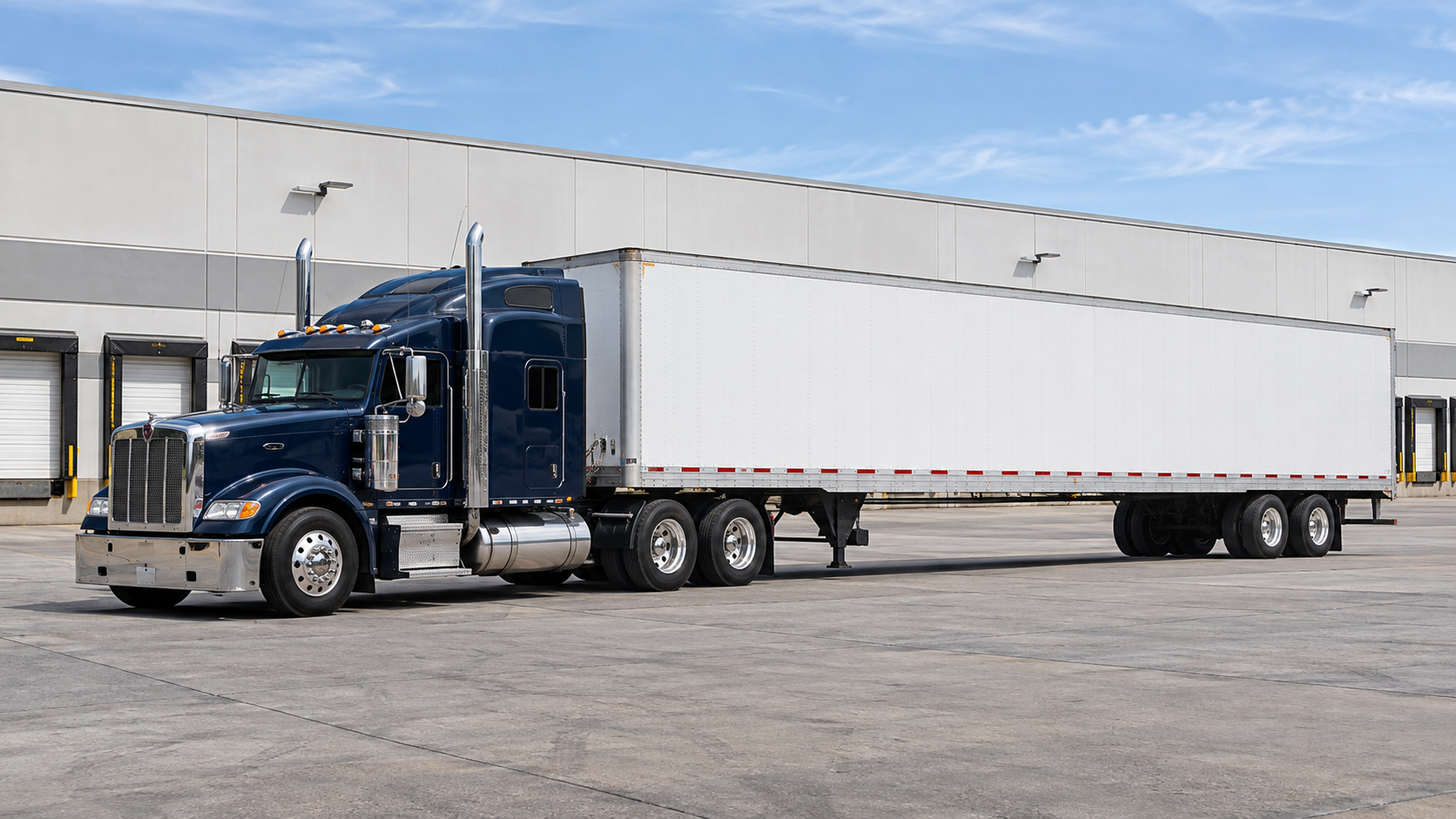
AI illustration of a US tractor and dry van semi-trailer. Not a scale drawing or a specification for a particular vehicle.
53-foot dry van interior dimensions: a specific example
The following figures come from the plate dry van configuration in Premier Trailer Leasing's specification guide. They illustrate why the door type matters. They are not guaranteed dimensions for every 53-foot trailer or for a DAGO booking.
Measurement
Swing-door example
Roll-door example
Exterior trailer length
53 ft (16.15 m)
53 ft (16.15 m)
Interior length
52 ft 6 in (16.00 m)
52 ft 1.5 in (15.89 m)
Interior width
101.5 in (2.578 m)
101.5 in (2.578 m)
Interior height
110 in (2.794 m)
110 in (2.794 m)
Clear door height
110 in (2.794 m)
105 in (2.667 m)
Clear door width
98 5/16 in (2.497 m)
93 5/16 in (2.370 m)
Source: Premier Trailer Leasing specification guide, dry van table. Metric conversions are rounded. In this example, a 108-inch-high crate fits beneath the 110-inch interior ceiling but cannot enter upright through the 105-inch roll-door opening. Confirm the loading method instead of relying on interior height alone.
Dry van, reefer, box truck or flatbed?
A dry van encloses the freight. A refrigerated trailer has insulation and equipment that can reduce usable cargo space. A straight box truck may suit an address that cannot accommodate a full tractor-trailer, but its actual cargo body and door dimensions still need verification.
A flatbed allows different loading methods, but freight height must be added to the deck height to calculate the loaded vehicle height. Open-deck equipment does not remove route restrictions. Oversize loads need a separate assessment of permits, routing and handling.
How wide is a truck including mirrors?
Published body width is not the same as the space required through a gate. Federal rules exclude certain safety devices from width measurement, but those devices still occupy physical space. Ask for actual overall width at the widest relevant point and enough room to maneuver. Turning into a narrow entrance may require substantially more space than driving straight through it.
Height limits and low-clearance routes
FHWA describes state height limits commonly ranging from 13 ft 6 in to 14 ft. Those figures are not permission to pass under a bridge of the same nominal height. State law, posted signs, local access restrictions and the vehicle's actual loaded height all matter. Include the final approach to the shipper and receiver in the route review.
Record exterior running height separately from interior cargo height and door height. Also check dock height, overhead obstructions inside a warehouse, and whether unloading equipment can operate safely.
How many pallets fit?
A pallet count needs a loading plan. Start with the outer dimensions of each loaded pallet, including overhang and wrapping. Check orientation, stackability, weight distribution and securement space. Multiplying the trailer's interior length by width only gives floor area; it does not prove that a particular arrangement fits through the door or meets axle and payload limits.
For example, two 48-inch-wide loaded units require 96 inches before adding handling clearance. They may fit side by side inside a wide trailer while still needing to be loaded separately through a narrower doorway. Never infer door clearance from the number of pallet positions.
Freight measurement checklist before booking
Measure each piece in its intended shipping position, including its pallet, crate and protruding parts.
Provide weight per piece and total shipment weight in pounds; identify unusually concentrated loads.
Confirm whether the freight can be stacked, tilted or rotated. Do not assume these handling methods are acceptable.
Request usable interior dimensions and clear door dimensions for the dispatched equipment.
Specify dock access, forklift availability and any liftgate requirement at both addresses.
Check the liftgate platform size and rated capacity for the freight and handling arrangement.
Confirm loaded vehicle height, route restrictions, turning space and delivery-site access.
Request the right vehicle for your freight
For expedited freight with DAGO Express, provide piece dimensions, weights, origin, destination and loading requirements. Ask for the dispatched vehicle's usable cargo space and openings to be confirmed. A general equipment guide is not a commitment to a particular trailer configuration.
 Dansk
 Deutsch
 Eesti
 English (GB)
 Español
 Français
 Hrvatski
 Italiano
 Latviešu valoda
 Lietuviškai
 Magyar
 Nederlands
 Norsk Bokmål
 Polski
 Português
 Română
 Slovenčina
 Slovenščina
 Suomi
 Svenska
 Čeština
 Ελληνικά
 Русский
 Українська
 български
 العربية
 中文 (中国)
 English